An apparently very authoritative answer, from a forum member making their first ever post on the forum...
Read the answer given more carefully and you will realise that, for all those words, it is adding no new knowledge or insight. When you boil it down, what is being said is "whichever is the most accurate answer, that's the most accurate answer".
@mirobychee you have been fooled. The reply came from an AI like ChatGPT. It told you what it thought you wanted to hear by combining patterns of words it has found in answers to other, unrelated questions.
Mod edit:
The reply to which this refers has been removed because, as noted, it adds nothing. The user who posted it has been suspended for posting spam.
Thanks PaulRB for spotting the ChatGPT answer, I didn't know what was going on. I have asked the moderators to remove it. It is just a vomit of words. Update: that ChatGPT answer is removed.
What really is happening here is that the manufacturer has 1.2 as average factor.
The manufacturer assumes that that it can be up to 20% lower or 20% higher.
You have to divide the value by 1.2. It does not matter if you can't read a high lux value.
Only if you can calibrate the sensor with a good luxmeter, then maybe the value of 1.2 needs to be something else.
The BH1750 has different ways to calculate the lux. I explored them years ago: BH1750.ino
With a different method, it can read almost direct sunlight. But direct sunlight will probably damage the sensor. For direct sunlight you need a grey-filter.
In my project that used a BH1750, I used the type of module with a circular shape that fits into a hemispherical dome of translucent white plastic. This dome reduces the light level, so it is necessary to adjust the readings to compensate for that. The dome protects the sensor from strong sunlight, to some extent, and also diffuses the sunlight so that the angle of the sun to the sensor has less effect on the readings.
I didn't have a luxmeter to calibrate my BH1750, but I was able to compensate for the dome by measuring the light level at a fixed position under a desk lamp, taking readings with and without the dome covering the sensor.
in my project im using the small square one and i prefer that the sun can pass through because my light source is a mix of sunlight and led so im wondering about the accuracy of the small one and i also want to know if i should use the raw value or the one that is divided. thank youuu
It is the same bh1750 chip on the square and circular modules, so the accuracy is the same.
I have not compensated for the 1.2 factor you mentioned. I have compensated for the reducing effect of the dome, and that was a similar amount. But I have no other light meter to check the results against, so I can't know for sure if my readings are correct or not correct.
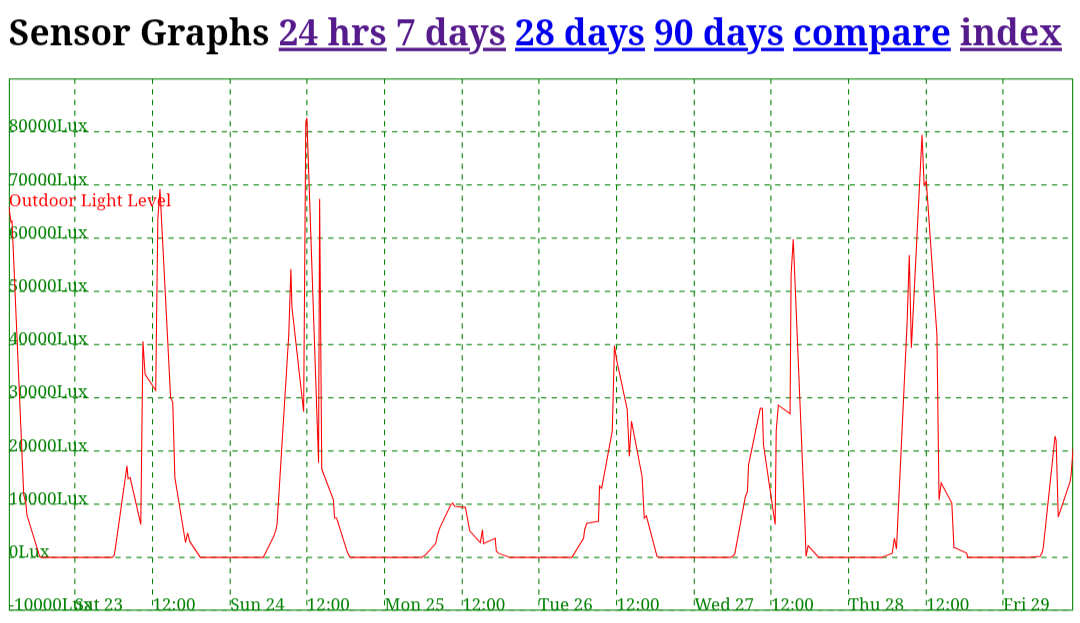
I have read that sunlight can be up to 100,000 lux, so if your readings are less than that on sunny summer days around noon, maybe you need to compensate for the 1.2 factor.
Below you can see my readings over the last week. They peak over 80,000lux. If I compensated for the 1.2 factor, my readings would exceed 100,000 lux, which would not seem correct for northern England in March.
Seriously, "accuracy" here is unreachable without some qualifiers. Light has both intensity and wavelength. The BH1750 reports different readings depending on the color of the light. And sunlight is not all color temperatures (or wavelengths)
Different color LED's of the "same intensity" will read differently on the BH1750.
Two different BH1750 are likely to be 5% or so different. They could be up to 40% different by spec, but this is unlikely.
So your best approach is to pick the numbers you can reproduce and stay with that.
We did a cross calibration to measure PAR with a BH1750 sensor that you might find interesting. On days with patchy cloud cover the light levels regularly exceeded the Lux readings we got on blue sky days because side reflections increased the non-direct light hitting the sensor.