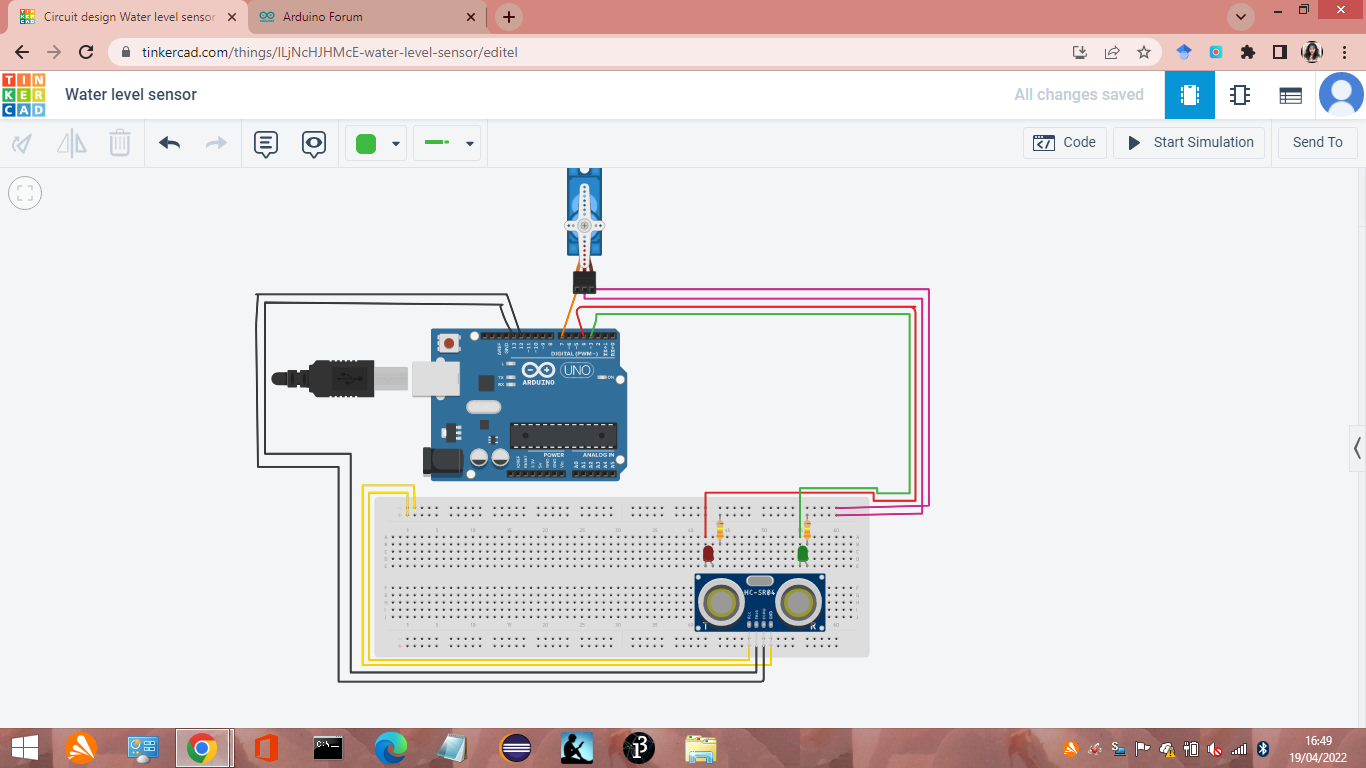
And activates the green LED?
My project is meant to be a water level sensor:
My code:
// C++ code


const int trigPin = 13;
const int echoPin = 12;
const int ServoPin = 4;
const int green = 3;
const int red = 4;
int distance;

// **************************************//
void setup()
{

 Serial.begin(9600);
  pinMode(trigPin, OUTPUT);
  pinMode(echoPin, INPUT);
  pinMode(green, OUTPUT);
  pinMode(red, OUTPUT);
  srv.attach(4);

}

void loop() {
  pinMode(trigPin, OUTPUT);
  digitalWrite(trigPin, LOW);
  delayMicroseconds(3);
  digitalWrite(trigPin, HIGH);
  delayMicroseconds(9);
  digitalWrite(trigPin, LOW);
  uint32_t distance = (pulseIn(echoPin, HIGH) * 17) / 50;
  Serial.print("distance: ");
  Serial.print(distance);
  Serial.println(" cm");

  if (distance <= 50); {
  digitalWrite(red, HIGH);
  srv.write(180);
} else {
digitalWrite(red, LOW);
  srv.write(0);
}
  if (distance >= 50); {
digitalWrite(green, HIGH);
    else {
  digitalWrite (green, LOW);
delay(3000);
}
My Arduino Uno:
Looks like there is some code missing.
1 Like
rafaelleduarte:
if (distance <= 50);
Oops
rafaelleduarte:
if (distance >= 50);
And again
The pin should already be an output, and it should already be LOW
1 Like
The editor says:
" In function 'void loop()':
However I don't quite catch this.
An if with a semicolon at the end, as I highlighted, is your problem
kolaha
April 19, 2022, 8:16pm
6
// C++ code
const byte trigPin = 13;
const byte echoPin = 12;
const byte ServoPin = 7;
const byte green = 3;
const byte red = 4;

// **************************************//
void setup() {
  Serial.begin(9600);
  pinMode(trigPin, OUTPUT);
  digitalWrite(trigPin, LOW);
  pinMode(echoPin, INPUT);
  pinMode(green, OUTPUT);
  pinMode(red, OUTPUT);
  srv.attach(ServoPin);
}

void loop() {
  delayMicroseconds(3);
  digitalWrite(trigPin, HIGH);
  delayMicroseconds(9);
  digitalWrite(trigPin, LOW);
  uint32_t distance = (pulseIn(echoPin, HIGH) * 17) / 50;
  Serial.print("distance: ");
  Serial.print(distance);
  Serial.println(" cm");

  if (distance < 50) {
    digitalWrite(red, HIGH);
    digitalWrite (green, LOW);
    srv.write(180);
  } else {
    digitalWrite(red, LOW);
    digitalWrite(green, HIGH);
    srv.write(0);
  }
  delay(3000);
}
It's still an oops.
kolaha
April 19, 2022, 8:31pm
10
repaired. should i distance formula correcting?
Temperature correction?
kolaha
April 19, 2022, 8:33pm
12
actually should beuint32_t distance = (pulseIn(echoPin, HIGH) * 17) / 1000;
I changed connections in the Arduino and didn't proofread my code before posting it here
Could you please explain the trigger part as if you were talking to an 8-year-old girl? I don't need answers, just guidance to find them myself.
if (distance < 50) {
  digitalWrite(red, HIGH);
  srv.write(180);
} else {
digitalWrite(red, LOW);
  srv.write(0);
}
  if (distance > 50) {
digitalWrite(green, HIGH);
  }else {
  digitalWrite (green, LOW);
delay(3000);
  }
}
A colleague of mine sent me his code and it seems that he has written a code to test the servo as if it was the water triggering it to open and close it . Is it what my code is lacking?
Actually, I was just referring to the fact that your code as posted doesn't compile.
1 Like
The way you have it, you write the trigger pin low, then high, then low again.
1 Like
If we re-arrange your above codes, we get the following: (Note that if() is not a function; so, it should not have a terminating semicolon.)
if (distance <= 50)
;
{
  digitalWrite(red, HIGH);
  srv.write(180);
}
else
{
  digitalWrite(red, LOW);
  srv.write(0);
}
There is something in the above codes that does not match with if-else statement. What is this?
2 Likes
Could you please tell me if the wiring that I made is correct?