So I read (and was advised) that a well regulated 5V supplied directly to arduino 5v pin can power it up. I am using a 12V 5A supply and stepped it down using L7805 regulator in below configuration. Only it is stepping it down to 4.95V as checked in my multimeter. Is it Fine or must it be 5V exactly?

Check the datasheets of the components on the board. You don't state which board you're using but from e.g. the 328P datasheet
• Operating Voltage:
– 1.8 - 5.5V
Now it depends on the frequency that you use how low you can go; the main processor on 328P based Arduinos runs at 16 MHz and a minimum of 4.5V is OK.
If you board uses the 16U2, check its datasheet; if your board used the CH340 or a FTDI chip, check their datasheets.
10% tolerance is usually assumed, if not stated, so 4.5 to 5.5V. However at 5.5V you are getting uncomfortably close to the absolute maximum operating voltage of 6.0V.
As previously mentioned the MCU itself will operate at much lower voltages but there are limitations on the clock rate. Many sensors will not work at lower voltages, so always check their data sheets if in doubt.
ok, got it. I am currently on 5v 16Mhz pro mini but also intend to use a nano. Glad to know I am in the good.
Suppose that your board needs 100mA and there are 10 leds of each 20mA.
Then your total current will be 300mA.
The 7805 has to dissipate (12V-5V) * 300mA = 2.1 Watt.
That is a lot. It can not do that without a heatsink.
For most project, a 12V power supply is too high for a linear voltage regulator. That is why we advise to use 7.5V or 9V maximum to power for example a Arduino Uno via the barrel jack.
A DC/DC-converter has no problems with the 12V.
This is an example of a DC/DC-converter: https://www.pololu.com/product/2843
I see now that groundFungus already wrote about this in the other topic: Is a fuse a good idea while powering arduino through Vin? - #6 by groundFungus
When you measure the voltage on the pins of the voltage regulator itself, do you still measure 4.95V ? Is your multimeter accurate ? The voltage regulators are often set a little higher (up to 1% higher) to compensate for losses.
The reason I am now trying to power my arduino through the 5V pin is that in the other topic I learned through the discussion that it was not the best idea to power it through Vin and risk heating the onboard regulator.
I did check the Pololu piece as recommended by groudFungus, but my the problem with that is that 1. it is not available readily in my geography (will have to buy it through importers and that would take time) 2. It is too expensive for my project (at best this project can achieve chinese buck convertors).
I didn't measure to the pins of the regulator itself but to the output of the second right hand capacitor as shown in the picture, there it was 4.95V.
I would be using a regular heat sink which is bolted to the regulator. But if this regulator is designed to step down 12V and is rated for 1A current, why should there be any problem in that range with a heat sink in place?
this below heat sink is what I intend to use
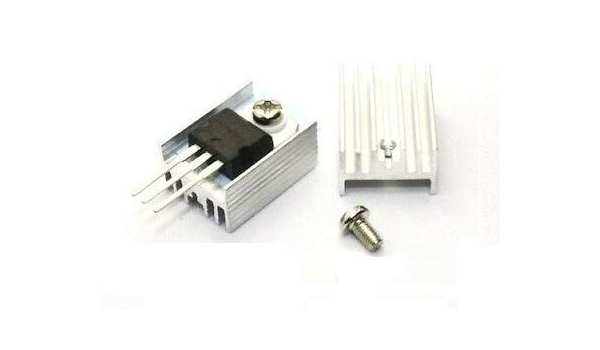
From 12V to 5V = 7V. 1A * 7V = 7W. What the datasheet says
Thermal resistance of the TO-220 package
(T) is typically 4°C/W junction to case and 50°C/W case to ambient.
7W and 50°C/W gives 350°C + 24°C ambient temperature. What says the datasheet over the max temperature?
Maximum Junction Temperature
(K Package) 150°C
(T Package) 150°C
Your heatsink must at least 224°C lower the temperature. How many °C/W is the heatsink? For that type is >15°C/W normal. All the same heatsink that I've found hasn't the datasheet published. That isn't a good sign.
Do you use good thermal paste?
you guys are so scaring me...but also making me happy for I didn't know and do all that maths. Why can't there be just a straight easy solution to something!
No I am not using a thermal paste. But also I am not expecting to draw that much current. I am just using a 16x2 I2c LCD screen which should draw about 20mA and a flow sensor YFS201 which should draw about the same, besides the arduino pro micro's own 50mA. I also just now felt that the regulator is getting hot. Performance is also going down of the sensor readings...
Bigger heatsink - more mass, more metal.
You need high frequency bypass on the 7805. You need to read the manufacturer's data sheet for the values, they are not all the same.
My suggestion is to power it via Vin and the accessories with the external 5V power especially motors etc. The on board regulator gets hot when overloaded. A few mA such as a LCD will not have much impact. I prefer the Vin because of the additional noise immunity it affords the design and the stability of the Vref (used for A/D). If the external power supply glitches it has less probability of zapping the Arduino.
Why?
Just plug a 5volt cellphone charger into the USB socket and be done with it.
Leo..