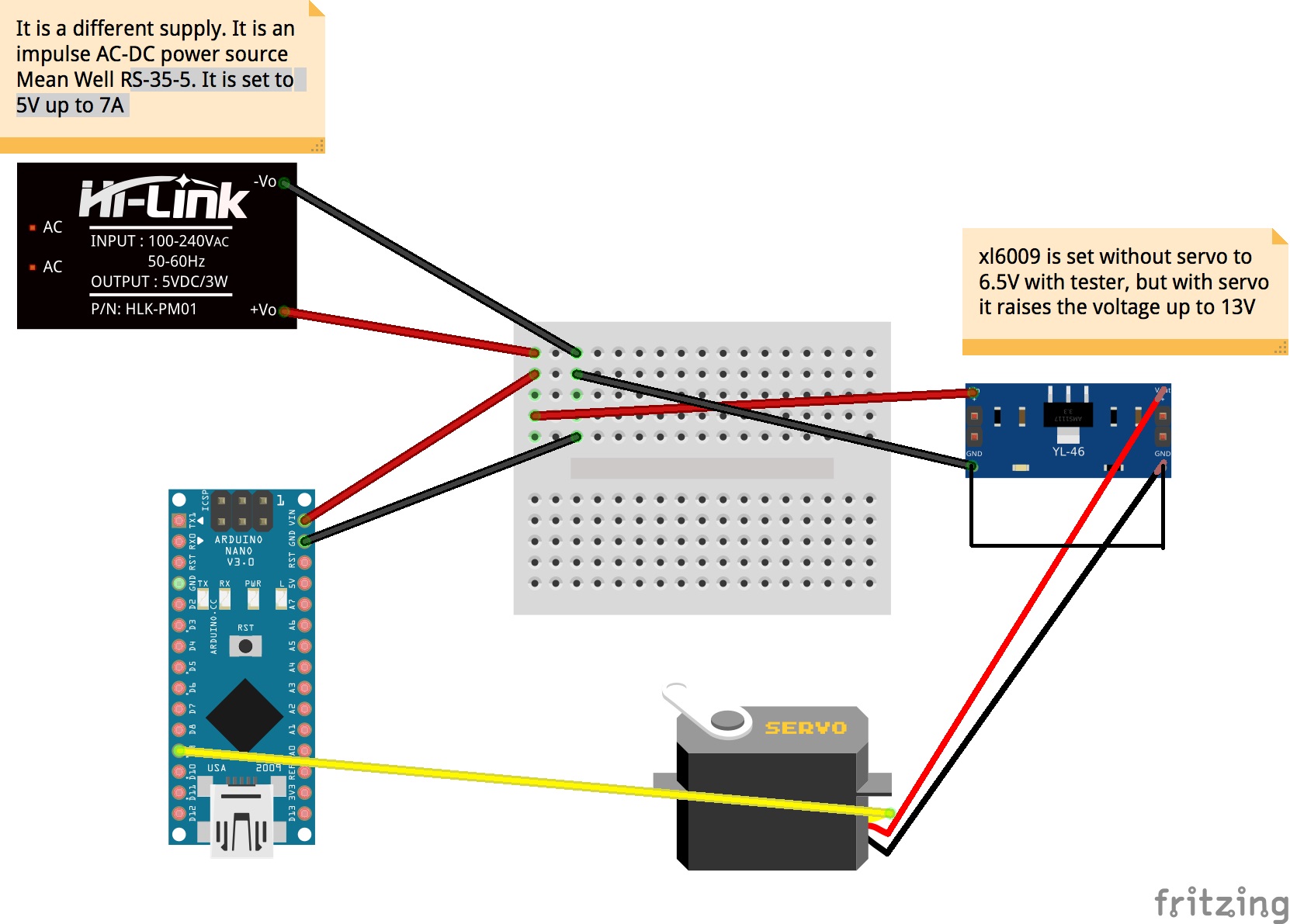
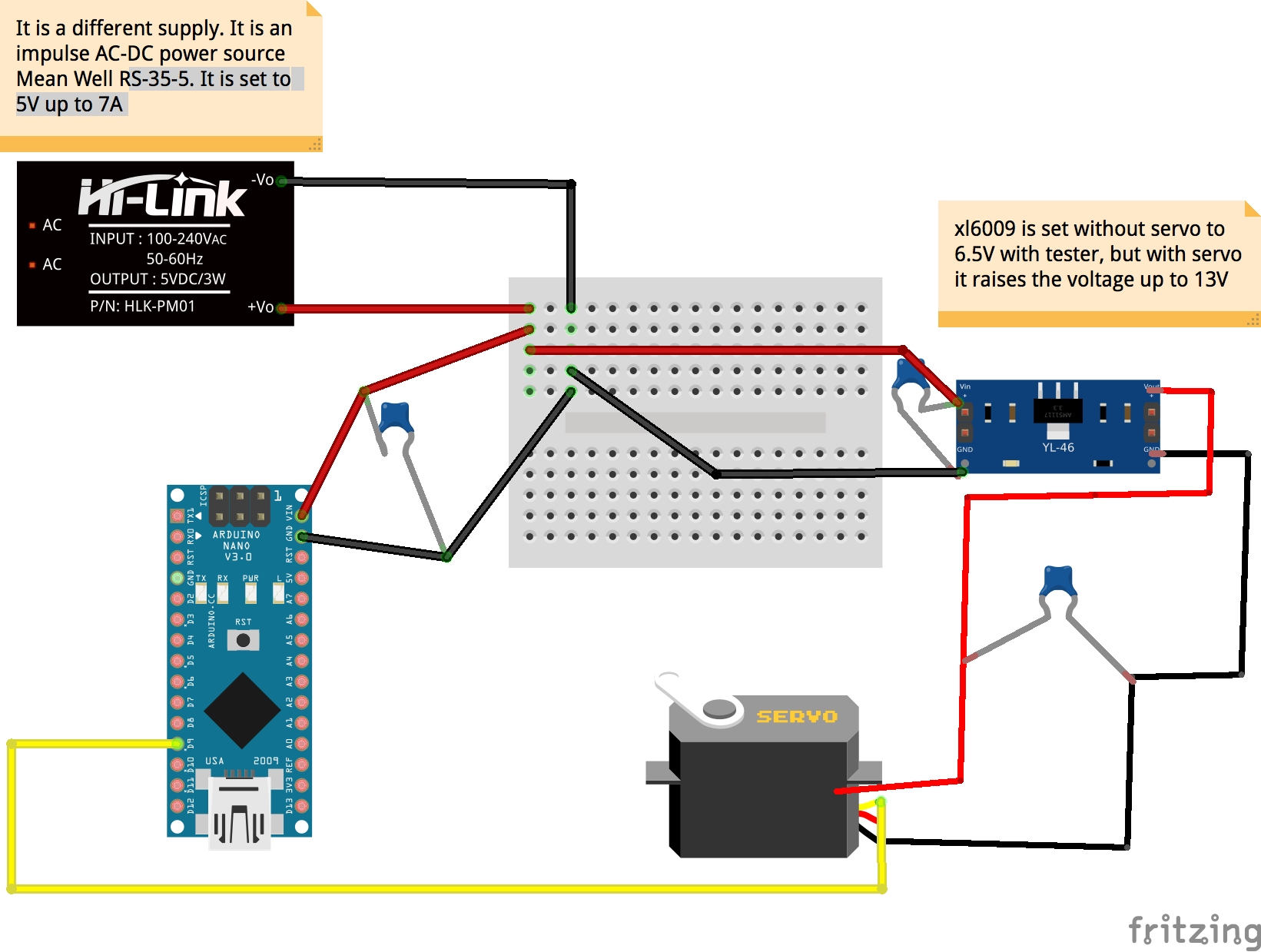
I have an impulse power source 5V 7A, I need to get 6V 3A for a servo motor, but when I connect my servo in the moment when it should start the currency changes from 6V to 13V on an output of the xl6009 module and it's not rotating. What is wrong?
Tofer:
I have an impulse power source 5V 7A, I need to get 6V 3A for a servo motor, but when I connect my servo in the moment when it should start the currency changes from 6V to 13V on an output of the xl6009 module and it's not rotating. What is wrong?
My servo is connected to xl6009 out. Brown servo wire to minus out XL6009, red to plus out XL6009. Yellow wire is connected to arduino nano pin 9.
My xl6009 is connected to RS-35-5. plus to plus, minus to minus.
My arduino is connected in parallel to RS-35-5 with Fundruino board.
My servo works ok without xl6009 in this scheme. But I need a bit more voltage to make it rotating a bit faster. The best voltage for my servo is 6,5V. When I add xl6009 between RS-35-5 and my servo, the servo starts to make strange noises and doesn't work. I measured the voltage on xl6009 and it goes from 6 to 13v when servo should start.
I cannot find any reference that tells me if the output is isolated.
If the OP is using the Arduino gnd as reference, then this could be what is observed.
As well as 0.1 uF ceramic capacitors I would also add a large 100uF or so on the output of your boost regulator.
The thing about decoupling to remember is that while you can under do it it is quite hard to over so it. Their is no “do this and it is fixed” you have to try what the circuit needs. It could be that you need the Pi filter with an inductor shown on the last diagram of that page I linked to. Try it first without but if it is still a problem then see if it helps. You can also put a large capacitor across the motor when you have the Pi circuit fitted.