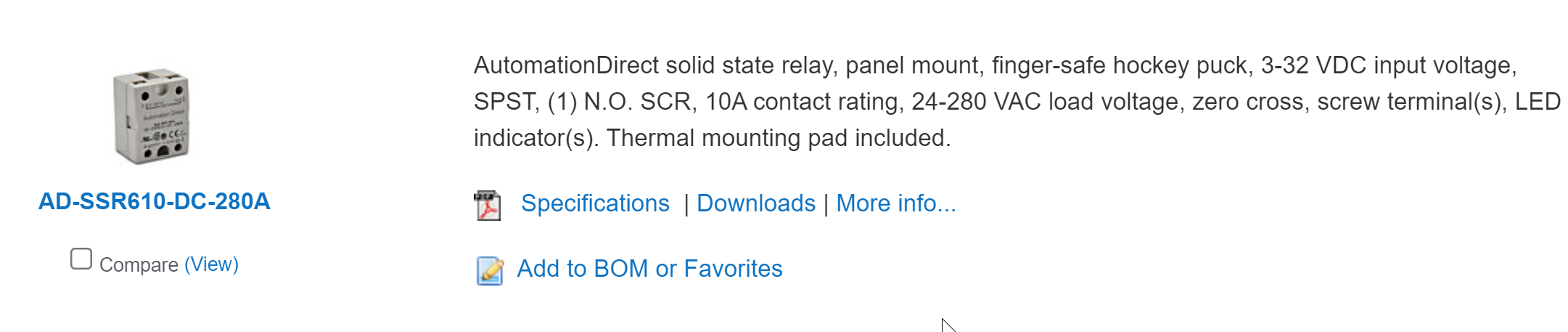
I want to use an arduino and a solid state relay to control the wattage of a 240 V, 6 kW heating element.
I know that for lights, many people use a TRIAC to avoid flickering, but for this application, flickering isn't an issue, so I think the simpler SSR is better. However, to achieve stable heating, I would like to use a cycle preferabbly under 1 second. I am wondering how to do this with Arduino.
will it work well if I simply use a PWM pin to directly control the SSR, or do I somehow have to time the pulses with some other component to match the frequency of the AC voltage?
Raising a mass from room temperature to operating temperature will need a MUCH longer time than is necessary to hold the operating temperature.
My experience converting a 1950 drying oven to Arduino control needed about 15 minutes to bring the cast iron covered heating element up to running temperature. Then the off/on times were in the one minute range.
So much depends on the OP's heating environment.
Of course, the logic still works... Power will be held-on until you hit the setpoint.
...If you want to ramp it up more slowly, you ramp-up the setpoint and allow it to cycle on & off instead of trying to apply the exactly-correct amount of power moment-to-moment.
No, the overshoot in temperature exceeded the limit for the ICs being dried. Yes, could have ramped the setpoint, but the problem only occurred during initial heating, so decided to just heat and wait for a specific length of time.
We got trays of ICs that had warnings about exploding during soldering in the convection oven. So the drying oven was just in case we ever encountered the problem. Never did.
I need a stable heat output, not a stable temperature. Basically, I am looking for the simplest, cheapest way to set the wattage of the element from an arduino, and I'm not sure how to best do it. An important requirement is that I can't have too long cycle times, (1 sec on, 1 sec off is too long).
would switching a SSR from a digital pin work? Say, 50ms on, 50 ms off for 50% power?
A six kilowatt laser. Should be easy to get a license for that. Just joking please don’t take offense.
Six kW resistance heater will draw approximately 26 amps depending on the mains voltage of your continent. Single phase of course. This sounds like a job for a triac circuit.
Since the OP has not provided the mass nor the material being heated, we are only guessing. Perhaps only a CC needs to be heated and the OP already has a 6kw heating element.
On/off switching will not give you a stable heat output.
No, because unless it did zero crossing detection you would get massive interference; and if it did use zero crossing detection it would go in and out of synch with the mains frequency.
You should EITHER use a larger thermal mass and switch more slowly - 1 second only allows for 40 zero crossings;
OR
use a triac circuit for fully proportional control (over a limited range)
but if you use a triac circuit you will need to manage the isolation from the mains.