That would be my preferred approach - glad that you added that.
I thought that the supply was 12V, then multiple LEDs could be in series for increased 'light' output.
That would be my preferred approach - glad that you added that.
I thought that the supply was 12V, then multiple LEDs could be in series for increased 'light' output.
so, we mark digikey.com as unprofessional.
At this point, maybe just Don Johanneck. He has an Associate’s degree from a community college so we don’t have to treat him with the same respect as perhaps someone with a EE degree from a university.
The IRLB8721PbF would be useless in your application with only a 3.3V gate drive, the resistance will be high. You need something close to 4V to fully turn on that MOSFET.
A DMN2053U would be a better choice, it only has a resistance of 0.048Ω at at gate drive of only 2.5V
A common BJT could be much easier than a mosfet in this case (3.3volt drive).
The transistor there is not used as a switch, so a low saturation voltage does not apply.
Leo..
I'd agree with Leo's suggestion; however there is information we are lacking and maybe a simpler solution could be used.
We need to know the characteristics of your pulse; I havent done the sums, but here is the idea:
pulse is off, capacitor charges through a resistor to "around" 5V. It then holds a set amount of charge Q = CV.
Pulse is on: capacitor discharges through a current limiting resistor and the LED. The resisitor is chosen to limit the peak current to 1A
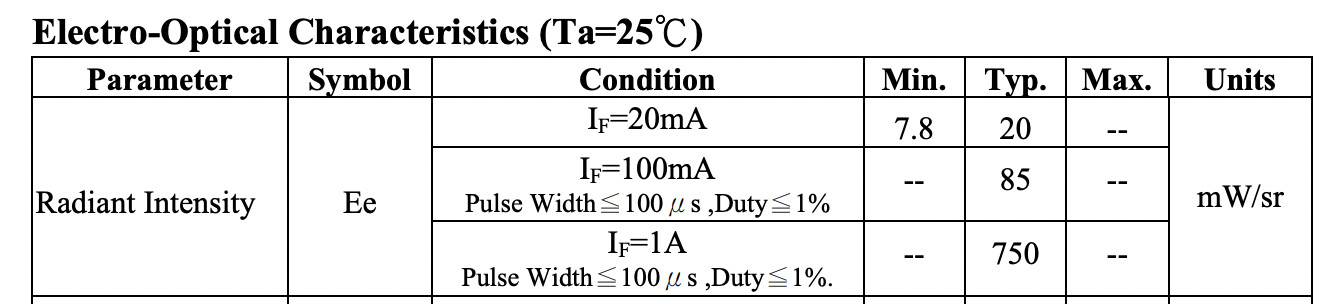
Although the IR LED linked to in the first post can be pulsed at 1A, did you read the datasheet to find out under what conditions that was?
Likely a 38kHz burst, Because then you can simply use a 3-pin remote control receiver.
A largely useless specification. I have seen <100mA continuous, and <180mA at 50% PWM 38kHz as absolute max in several IR LED datasheets. You can only increase that current if you use a shorter burst time, which the receiver migh not like.
Still wondering which lens you're using. I think not all are suitable for IR.
Isn't it easier to use a long 5mm black tube.
Leo..
Yes, That is what I was trying to point out,
It is the note 1 at the bottom of the table that determines what you can safely do:

At the moment i'm planning on implementing something like this Milestag 2 protocol
also planning on using a readily available IR receiver (3 pin, 38kHz).
I don't really understand that note - what is "100 u s" and "Duty"? (not an EE, if you couldn't tell...)
So do we think the 6R8 resistor in the diagram above would need to be a greater resistance to limit the current to... something less than 1amp?
So what is the Rds(on) at 3.3V
6R8 will limit the current to about 100mA
The pulse can provide 1.0 Amp for a maximum of 100 microseconds but can only repeat a maximum of 1% of the time: 1.0 amp flows for 100 microsecond but rests for the next 9900 microseconds.
no idea what that means! 
using a esp32 d1 mini as the controller
6R8 will limit the current to about 100mA
Right, so that specific LED can be on continuously at 100ma, or on for 100 microseconds at 1amp, that correct?
A "pulse" in the context of this diagram is the LED flashing on/off right? So the header is flashing for 2400us?
So is the question I should be asking, "what is the maximum current for this LED to be on 50% of the time? And then what resistor do I use to achieve that current?
You may be right about the lens. But that's deff a "experiment and see" - it shouldn't effect the electronics part right?
100mA, so 6.8 ohms
How do you propose focusing the lens?
You can't see the Infra Red, and the focal length of the lens will be different to visible light.
ok, thank you.
So from the datasheet it looks like the brightness is 85mW/sr - i'm curious why that also has a Duty of <= 1%?
anyway, looking at another LED, the datasheet has a brightness of 180
I feel like i'm missing something... The "ultrabright" one doesn't seem very bright...?
And if the LED is only on 50% of the time, can I not push the current for more brightness? like to maybe 200ma?