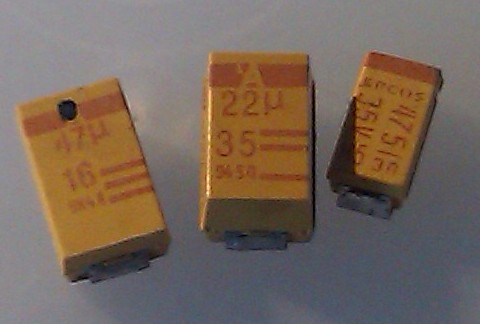
Yep - I have some of the exact same tantalums here. That looks rather like a 47µF one to me, but it's hard to make out the markings on that photo.
And yes, pads are free, but components cost. Adding pads where they might be wanted in the future is always good. It doesn't cost any more, and could save a whole bundle on a board re-design.
Grumpy_Mike:
It is rare that there is too much decoupling. The only case I have ever encounters is that some DC to DC converters will not start with too much of a capacitave load, and the odd case of low dropout regulators, most are not that fussy.
If you put too much in isn't it a bit like shorting out the power supply at startup?
It is rare that there is too much decoupling. The only case I have ever encounters is that some DC to DC converters will not start with too much of a capacitave load, and the odd case of low dropout regulators, most are not that fussy.
If you put too much in isn't it a bit like shorting out the power supply at startup?
It depends upon how you define decoupling, eg small ceramic caps or large electrolytics. The term has
been used both ways on this thread. The following people use decoupling to refer to the former, small
ceramics.
A lot of small value caps will likely have little effect on startup. OTOH, if the values of the electrolytics
are too high, then the power supply may be slow in starting up, and possibly affect bootup of the
microcontroller, but I wouldn't think this would be a problem in general, unless the values are really
high, say over 100 or 500 uF, depending on the circuit.
The only reference I could find to this in the 328P d/s was the following, and they're not referring to
boot-up, although by heavily filtered they certainly mean the electrolytics.
"In heavily filtered power supplies, VCC is likely to rise or fall slowly on power-up/down. This causes
the device for some period of time to run at a voltage lower than specified as minimum for the clock
frequency used."
Well Yeah that's electronics 101... But the only way to have a "Slow" power supply is to design one that way, by using 1. Low current linear regulators (I've used 2200uF on the output side of a 7805 and the BOD working on the processor, Very successfully). 2. By adding large (>10 ohm series "Filter" R's in the Vcc line, while a common method for isolating low power loads, should never be used for the main Vcc unless the load can tolerate being powered up "later". and 3. using a primary power source that can't fully supply the required load current. In the past I've successfully used 470uF caps with 100 mA regulators both 78L05's as well as LM2931's to power PIC processors in low speed low power applications with great success with the BOD enabled. The Basic Layout I used was a 100 to 470uF electrolytic right where the battery connected to the PCB. This part isn't so much filtering or 'decoupling' as it is compensation for a low battery charge condition, because the batteries internal resistance increases when the battery is nearly discharged and the addition of this part enables the use of a little more of the power in the battery. After the linear regulator I would use between 47 to 220 uF (depending on what the board had to do) a 10 to 22uF tant cap somewhere in the "middle" of things and a 100nF cap for each IC right at the IC. What works in one application usually won't work in production and skimping on bypassing because you don't fully understand the topic is usually a waste of time because the circuit might work well in the test configuration usually doesn't when everything is interconnected. You will have greater success if you remember that...
Murphy was an optimist..