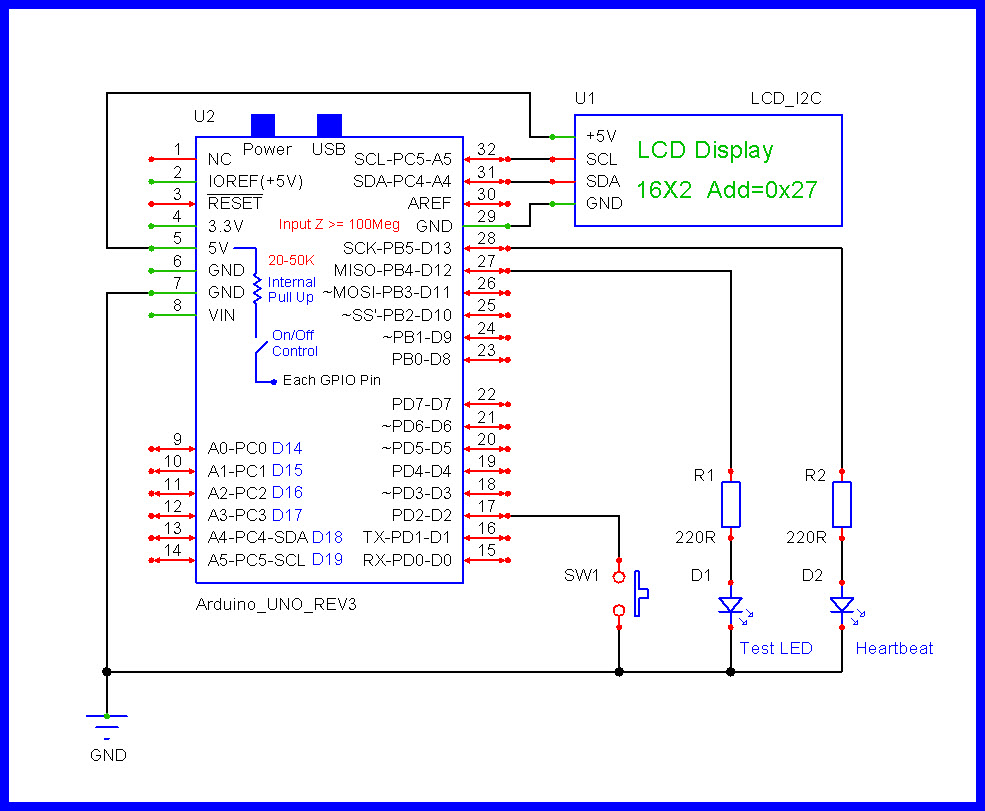
-
Okay let's start.
Let me know when you need a rest, we can carry on the next day.
-
Attached is the skeleton Sketch I mentioned.
For now, we will use the Arduino UNO as our target, this sketch will work on the ESP32 with some GPIO changes.
-
We always start our projects with a schematic showing our component interconnections.
-
Wire up the components to your UNO as seen above.
-
Upload the sketch below, set serial monitor to 115200, report back what you see on the LEDs, push the Switch on GPIO #2.
-
You may need to get the hd44780.h Library before your LCD will work:
GitHub - duinoWitchery/hd44780: Extensible hd44780 LCD library
-
Do not worry about the code for now, we will cover things a bit at a time.
//
//================================================^================================================
//                               B a s i c   S k e l e t o n   S k e t c h
//
//  https://forum.arduino.cc/t/arduino-millis-and-indexing-code/1376338/17
//
//  LarryD
//
//  Version    YY/MM/DD    Comments
//  =======    ========    ========================================================================
//  1.00       23/01/14    Running code
//
//
//
//
//  Notes:
//
//
//
//

//================================================
#include <Wire.h>

//Use I2C library:     https://github.com/duinoWitchery/hd44780
//LCD Reference:       https://www.arduino.cc/en/Reference/LiquidCrystal

#include <hd44780.h>   //main hd44780 header

//NOTE:
//hd44780_I2Cexp control LCD using I2C I/O expander backpack (PCF8574 or MCP23008)
//hd44780_I2Clcd control LCD with native I2C interface (PCF2116, PCF2119x, etc...)

#include <hd44780ioClass/hd44780_I2Cexp.h> //I2C expander i/o class header

//If you do not know what your I2C address is, first run the "I2C_Scanner" sketch
//OR
//run the "I2CexpDiag" sketch that comes with the hd44780 library
//hd44780_I2Cexp lcd(0x3F);

hd44780_I2Cexp lcd(0x27);


//================================================
#define LEDon              HIGH   //PIN---[220R]---A[LED]K---GND
#define LEDoff             LOW

#define PRESSED            LOW    //+5V---[Internal 50k]---PIN---[Switch]---GND
#define RELEASED           HIGH

#define CLOSED             LOW    //+5V---[Internal 50k]---PIN---[Switch]---GND
#define OPENED             HIGH

#define ENABLED            true
#define DISABLED           false

#define RELAYon            LOW
#define RELAYoff           HIGH


//================================================
#define ONE_SECOND   1000ul              //milliseconds
#define ONE_MINUTE   (ONE_SECOND * 60ul) //60 seconds in one minute
#define ONE_HOUR     (ONE_MINUTE * 60ul) //60 minutes in one hour
#define ONE_DAY      (ONE_HOUR * 24ul)   //24 hours in one day


//                                   c l a s s   m a k e T I M E R
//================================================^================================================
//
/*
  //========================
  makeTIMER toggleLED =
  {
     //.TimerType, .Interval, .TimerFlag, .Restart, .SpeedAdjustPin
     MILLIS/MICROS, 500ul, ENABLED/DISABLED, YES/NO, A0-A5

     //.SpeedAdjustPin defaults to 0 i.e. no speed adjustment is used
     //if .SpeedAdjustPin = A0-A5, a potentiometer on this pin adjusts the TIMER's speed (for diagnostics)
     //class static flag "makeTIMER::normalFlag" can be used to ENABLE/DISABLE adjustable TIMER speed,
     //ENABLE = normal speed, DISABLED = potentiometer controls TIMER speed
  };

  TIMER functions we can access:
  toggleLED.checkTIMER();
  toggleLED.enableRestartTIMER();
  toggleLED.restartTIMER()
  toggleLED.disableTIMER();
  toggleLED.expireTimer();
  toggleLED.setInterval(100ul);

  Static variable access
  makeTIMER::normalFlag = ENABLED/DISABLED  //defaults to DISABLED at power up time i.e. variable speed is allowed
*/

//                          millis() / micros()   B a s e d   T I M E R S
//================================================^================================================
//
//These TIMER objects are non-blocking
class makeTIMER
{
#define MILLIS             0
#define MICROS             1

#define ENABLED            true
#define DISABLED           false

#define YES                true
#define NO                 false

#define STILLtiming        0
#define EXPIRED            1
#define TIMERdisabled      2

  private:
  public:

    static bool              s_normalFlag;    //when ENABLED, adjustable TIMERs run at normal speed

    unsigned long            Time;            //when the TIMER started

    //these "members" are needed to define a TIMER
    byte                     TimerType;       //what kind of TIMER is this? MILLIS/MICROS
    unsigned long            Interval;        //delay time which we are looking for
    bool                     TimerFlag;       //is the TIMER enabled ? ENABLED/DISABLED
    bool                     Restart;         //do we restart this TIMER   ? YES/NO
    byte                     SpeedAdjustPin;  //a potentiometer on this pin, A0-A5, adjusts TIMER speed


    //================================================
    //constructor with no parameters
    makeTIMER()
    {
      TimerType = MILLIS;
      Interval = 1000ul;
      TimerFlag = ENABLED;
      Restart = YES;
      SpeedAdjustPin = 0;

      Time = 0;
    }

    //================================================
    //constructor with parameters
    makeTIMER(byte _TimerType, unsigned long _Interval,
              bool _TimerFlag, bool _Restart, byte _SpeedAdjustPin = 0)
    {
      TimerType = _TimerType;
      Interval = _Interval;
      TimerFlag = _TimerFlag;
      Restart = _Restart;
      SpeedAdjustPin = _SpeedAdjustPin;

      Time = 0;
    }

    //================================================
    //condition returned: STILLtiming (0), EXPIRED (1) or TIMERdisabled (2)
    //function to check the state of our TIMER        ex: if(myTimer.checkTIMER() == EXPIRED);
    byte checkTIMER()
    {
      //========================
      //is this TIMER enabled ?
      if (TimerFlag == ENABLED)
      {
        //============
        //is this an adjustable TIMER OR is the "normalSpeed" switch closed ?
        if (SpeedAdjustPin == 0 || s_normalFlag == ENABLED)
        {
          //============
          //this TIMER "is not" speed adjustable,
          //has this TIMER expired ?
          if (getTime() - Time >= Interval)
          {
            //============
            //should this TIMER restart again?
            if (Restart == YES)
            {
              //restart this TIMER
              Time = getTime();
            }

            //this TIMER has expired
            return EXPIRED;
          }
        }

        //============
        //this TIMER is speed adjustable
        else
        {
          //============
          //for diagnostics, we use a potentiometer to adjust TIMER speed,
          //has this TIMER expired ?
          if (getTime() - Time >= Interval / adjustInterval())
          {
            //============
            //should this TIMER restart again?
            if (Restart == YES)
            {
              //restart this TIMER
              Time = getTime();
            }

            //this TIMER has expired
            return EXPIRED;
          }
        }

        return STILLtiming;

      } //END of   if (TimerFlag == ENABLED)

      //========================
      else
      {
        //this TIMER is disabled
        return TIMERdisabled;
      }

    } //END of   checkTime()

    //================================================
    //function to enable and restart this TIMER       ex: myTimer.enableRestartTIMER();
    void enableRestartTIMER()
    {
      TimerFlag = ENABLED;

      //restart this TIMER
      Time = getTime();

    } //END of   enableRestartTIMER()

    //================================================
    //function to disable this TIMER                  ex: myTimer.disableTIMER();
    void disableTIMER()
    {
      TimerFlag = DISABLED;

    } //END of    disableTIMER()

    //================================================
    //function to restart this TIMER                  ex: myTimer.restartTIMER();
    void restartTIMER()
    {
      Time = getTime();

    } //END of    restartTIMER()

    //================================================
    //function to force this TIMER to expire          ex: myTimer.expireTimer();
    void expireTimer()
    {
      //force this TIMER to expire
      Time = getTime() - Interval;

    } //END of   expireTimer()

    //================================================
    //function to set the Interval for this TIMER     ex: myTimer.setInterval(100);
    void setInterval(unsigned long value)
    {
      //set the Interval
      Interval = value;

    } //END of   setInterval()

    //================================================
    //function to return the current time
    unsigned long getTime()
    {
      //return the time             i.e. millis() or micros()
      //========================
      if (TimerType == MILLIS)
      {
        return millis();
      }

      //========================
      else
      {
        return micros();
      }

    } //END of   getTime()


    //================================================
    //for diagnostics, a potentiometer on an analog pin is used to adjust TIMER speed, thanks alto777
    unsigned int adjustInterval()
    {
      unsigned int Speed = analogRead(SpeedAdjustPin);

      //using integer math to save on memory
      Speed = 1 + (Speed * 14) / 1023;  //Speed will have a range from 1 to 15

      return Speed;

    } //END of   adjustInterval()

}; //END of   class makeTIMER

//================================================
//initialize the static "s_normalFlag" variable,
//when ENABLED, adjustable TIMERs run at normal speed
bool makeTIMER::s_normalFlag = DISABLED;


//                                T I M E R   D e f i n i t i o n s
//================================================^================================================
//
//========================
//example: uses default library values
//.TimerType, .Interval, .TimerFlag, .Restart, .SpeedAdjustPin
//    MILLIS,    1000ul,    ENABLED,      YES,       0
//makeTIMER testTIMER{};

//========================
makeTIMER heartbeatTIMER =
{
  //.TimerType, .Interval, .TimerFlag, .Restart, .SpeedAdjustPin
  MILLIS, 500ul, ENABLED, YES, 0
};

//========================  (5ms * s_filter) i.e. 5ms * 10 = 50ms for checking a valid switch operation
makeTIMER switchesTIMER =
{
  //.TimerType, .Interval, .TimerFlag, .Restart, .SpeedAdjustPin
  MILLIS, 5ul, ENABLED, YES, 0
};

//========================
makeTIMER machineTIMER =
{
  //.TimerType, .Interval, .TimerFlag, .Restart, .SpeedAdjustPin
  MICROS, 1000ul, ENABLED, YES, 0
};

//========================
makeTIMER commonTIMER =
{
  //.TimerType, .Interval, .TimerFlag, .Restart, .SpeedAdjustPin
  MILLIS, 1000ul, DISABLED, NO, 0
};


//                                  c l a s s    m a k e I n p u t
//================================================^================================================
//
//a class to define "Input" objects, switches or sensors

//================================================
class makeInput
{
#define NOTvalidated       0
#define VALIDATED          1
#define NOchange           2

  private:

  public:

    static byte s_filter;
    //say the above validating "s_filter" variable is set to 10
    //if we scan "inputs" every 5ms
    //i.e. we sample our inputs every 5ms looking for a change in state.
    //5ms * 10 = 50ms is needed to validate a switch change in state.
    //i.e. a switch change in state is valid "only after" 10 identical changes are detected.
    //This technique is used to filter out EMI (spikes), noise, etc.
    //i.e. we ignore switch changes in state that are less than 50ms.

    unsigned long switchTime;       //the time the switch was closed
    byte counter;                   //a counter used for validating a switch change in state

    //these "members" are needed to define an "Input"
    byte pin;                       //the digital input pin number
    byte lastState;                 //the state the input was last in


    //================================================
    //constructor with parameters
    makeInput(byte _pin, byte _lastState)
    {
      pin = _pin;
      lastState = _lastState;

      switchTime = 0;
      counter = 0;

      pinMode(pin, INPUT_PULLUP);
    }

    //================================================
    //condition returned: NOTvalidated (0), VALIDATED (1) or NOchange (2)
    //check to see if the input object has had a valid state change
    byte validChange()
    {
      byte currentState = digitalRead(pin);

      //===================================
      //has there been an input change in state ?
      if (lastState != currentState)
      {
        //we have had another similar change in state
        counter++;

        //is the "change in state" stable ?
        if (counter >= s_filter)
        {
          //an input change has been validated
          //get ready for the next scanning sequence
          counter = 0;

          //update to this new state
          lastState = currentState;

          if (currentState == CLOSED)
          {
            //capture the time when the switch closed
            switchTime = millis();
          }

          return VALIDATED;
        }

        return NOTvalidated;
      }

      //===================================
      //there has not been an input change in state
      counter = 0;

      return NOchange;

    } //END of   validChange()

}; //END of   class makeInput

//================================================
//a change in state is confirmed/validated when 10 identical state changes in a row are seen
byte makeInput::s_filter = 10;


//                                    S t a t e   M a c h i n e
//================================================^================================================
//
//the states in our State Machine
enum STATES : byte
{
  STARTUP, STATE1, STATE2, STATE3, STATE4, FINISHED
};

STATES mState = STARTUP;


//                              G P I O s   A n d   V a r i a b l e s
//================================================^================================================
//

//Analogs
//================================================
//

//INPUTS
//================================================
//

//============                  GPIO 2
makeInput mySwitch =
{
  //.pin, .lastState
  2, OPENED
};


//OUTPUTS
//================================================
//
const byte testLED                = 12;
const byte heartbeatLED           = 13;

//VARIABLES
//================================================
//
const unsigned long shortPushTime = 500ul;
const unsigned long longPushTime  = 2000ul;


//                                           s e t u p ( )
//================================================^================================================
//
void setup()
{
  Serial.begin(115200);

  digitalWrite(heartbeatLED, LEDoff);
  pinMode(heartbeatLED, OUTPUT);

  digitalWrite(testLED, LEDoff);
  pinMode(testLED, OUTPUT);

  //================================================
  //LCD stuff
  lcd.begin(16, 2);
  lcd.clear();

  lcd.setCursor(0, 0);
  //                   111111
  //         0123456789012345
  //             Skeleton
  lcd.print("    Skeleton    ");

  lcd.setCursor(0, 1);
  //                   111111
  //         0123456789012345
  //              Sketch
  lcd.print("     Sketch     ");


} //END of   setup()


//                                            l o o p ( )
//================================================^================================================
//
void loop()
{
  //========================================================================
  //Print the time it takes to return to this same spot.
  //Comment the next 3 lines when no longer needed
  //static unsigned long startTime;
  //Serial.println(micros() - startTime);
  //startTime = micros();


  //========================================================================  T I M E R  heartbeatLED
  //condition returned: STILLtiming, EXPIRED or TIMERdisabled
  //is it time to toggle the heartbeat LED ?
  if (heartbeatTIMER.checkTIMER() == EXPIRED)
  {
    //toggle the heartbeat LED
    digitalWrite(heartbeatLED, digitalRead(heartbeatLED) == HIGH ? LOW : HIGH);
  }

  //========================================================================  T I M E R  switches
  //condition returned: STILLtiming, EXPIRED or TIMERdisabled
  //is it time to check our switches ?
  if (switchesTIMER.checkTIMER() == EXPIRED)
  {
    checkSwitches();
  }

  //========================================================================  T I M E R  machine
  //condition returned: STILLtiming, EXPIRED or TIMERdisabled
  //is it time to service our State Machine ?
  if (machineTIMER.checkTIMER() == EXPIRED)
  {
    checkMachine();
  }


  //================================================
  //       Other non blocking code goes here
  //================================================


} //END of   loop()


//                                    c h e c k M a c h i n e ( )
//================================================^================================================
//
void checkMachine()
{
  //================================================
  //service the current "state"
  switch (mState)
  {
    //========================
    case STARTUP:
      {
        //do startup stuff
      }
      break;

    //========================
    case STATE1:
      {
        //condition returned: STILLtiming, EXPIRED or TIMERdisabled
        if (commonTIMER.checkTIMER() == EXPIRED)
        {
          digitalWrite(testLED, LEDoff);

          //we are finished with this TIMER
          commonTIMER.disableTIMER();

          //next state
          mState = STARTUP;
        }
      }
      break;

    //========================
    case STATE2:
      {
        //Do something
      }
      break;

    //========================
    case STATE3:
      {
        //Do something
      }
      break;

    //========================
    case STATE4:
      {
        //Do something
      }
      break;

    //========================
    case FINISHED:
      {
        //Do something
      }
      break;

  } //END of  switch/case

} //END of   checkMachine()


//                                   c h e c k S w i t c h e s ( )
//================================================^================================================
//
//we have access to:
//object.validChange()    - checks to see if there was a valid state change
//object.pin              - input hardware pin number
//object.lastState        - the state the input was/is in
//object.switchTime       - the millis() value when the switch closes

void checkSwitches()
{
  //========================================================================  mySwitch
  //was there a valid input change ?
  //condition returned: NOTvalidated (0), VALIDATED (1) or NOchange (2)
  if (mySwitch.validChange() == VALIDATED)
  {
    //========================
    //was this switch closed ?
    if (mySwitch.lastState == CLOSED)
    {
      digitalWrite(testLED, LEDon);

      //make this TIMER 2 seconds
      commonTIMER.setInterval(2000ul);

      //start this TIMER
      commonTIMER.enableRestartTIMER();

      //next state
      mState = STATE1;
    }

    //========================
    //this switch was opened
    else
    {
      Serial.print("The switch was closed for ");
      Serial.print(millis() - mySwitch.switchTime);
      Serial.println("ms.");

      //================================================  Short Push
      //was this a short push ?
      if (millis() - mySwitch.switchTime <= shortPushTime)
      {
        //do something
        Serial.println("Short Push");
      }

      //================================================  Long Push
      //was this a long push ?
      else if (millis() - mySwitch.switchTime >= longPushTime)
      {
        //do something
        Serial.println("Long Push");
      }

      //================================================  Regular Push
      //this was a regular push
      else
      {
        //do something
        Serial.println("Regular Push");
      }
    }

  } //END of mySwitch


} //END of   checkSwitches()


//
//================================================^================================================
//