Hey guys,
I am trying to code a control system and i am currently having problems trying to get the correct output. What my code does is that it takes an input square wave of 1.6MHz and should turn it into a 100kHz square wave with a specific duty cycle. While i am getting the correct waveforms, the output frequency seems to be limited to 16.4kHz. I am guessing the problem is with my code, as the Uno has a CLK speed of 16Mhz. Note: I am meassuring the signals with a load of 1k ohms.
This picture shows the output signal with an input of 1.6MHz. If the input frequency is above 240kHz, the output signal will stay at a constant 16.4kHz.
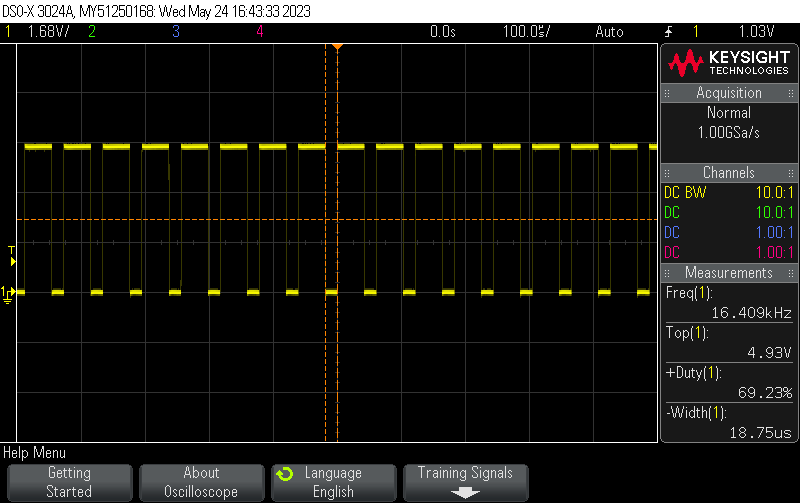
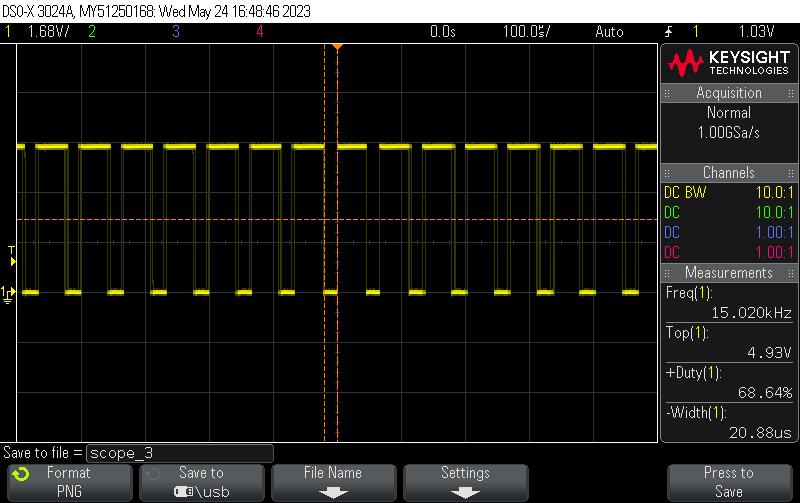
The picture below shows the output signal with an input of 240kHz. Which gives the appropriate 15kHz output.
Here is the code:
#include <avr/io.h>
#include <avr/interrupt.h>

//Input 1.6MHz squarewave onto pin 2 and output squarewaves with varying duty cycles at 100kHz

volatile int count = 0;

ISR (INT0_vect) // external interrupt 0
{
  count++;

  switch(count){
    case 2:
    PORTD |= (1 << PORTD6);
    PORTD &= ~(1 << PORTD4);
    break;

    case 7:
    PORTD |= (1 << PORTD4);
    PORTD &= ~(1 << PORTD6);
    break;

    case 10:
    PORTD |= (1 << PORTD5);
    PORTD &= ~(1 << PORTD7);
    break;

    case 15:
    PORTD |= (1 << PORTD7);
    PORTD &= ~(1 << PORTD5);
    break;

    case 16: count = 0; break;
  }
}

void setup() {
  cli();

  DDRD &= ~(1 << DDD2); //PD2 input

  DDRD |= (1 << DDD4)|(1 << DDD5)|(1 << DDD6)|(1 << DDD7); //pin 4 to 7 is now output

  EICRA |= (1 << ISC00)|(1 << ISC01); // set INT0 to trigger on rising edge
  EIMSK |= (1 << INT0); // Turns on interrupt for INT0
  sei(); // turn on interrupts
}

void loop() {
  // put your main code here, to run repeatedly:
}