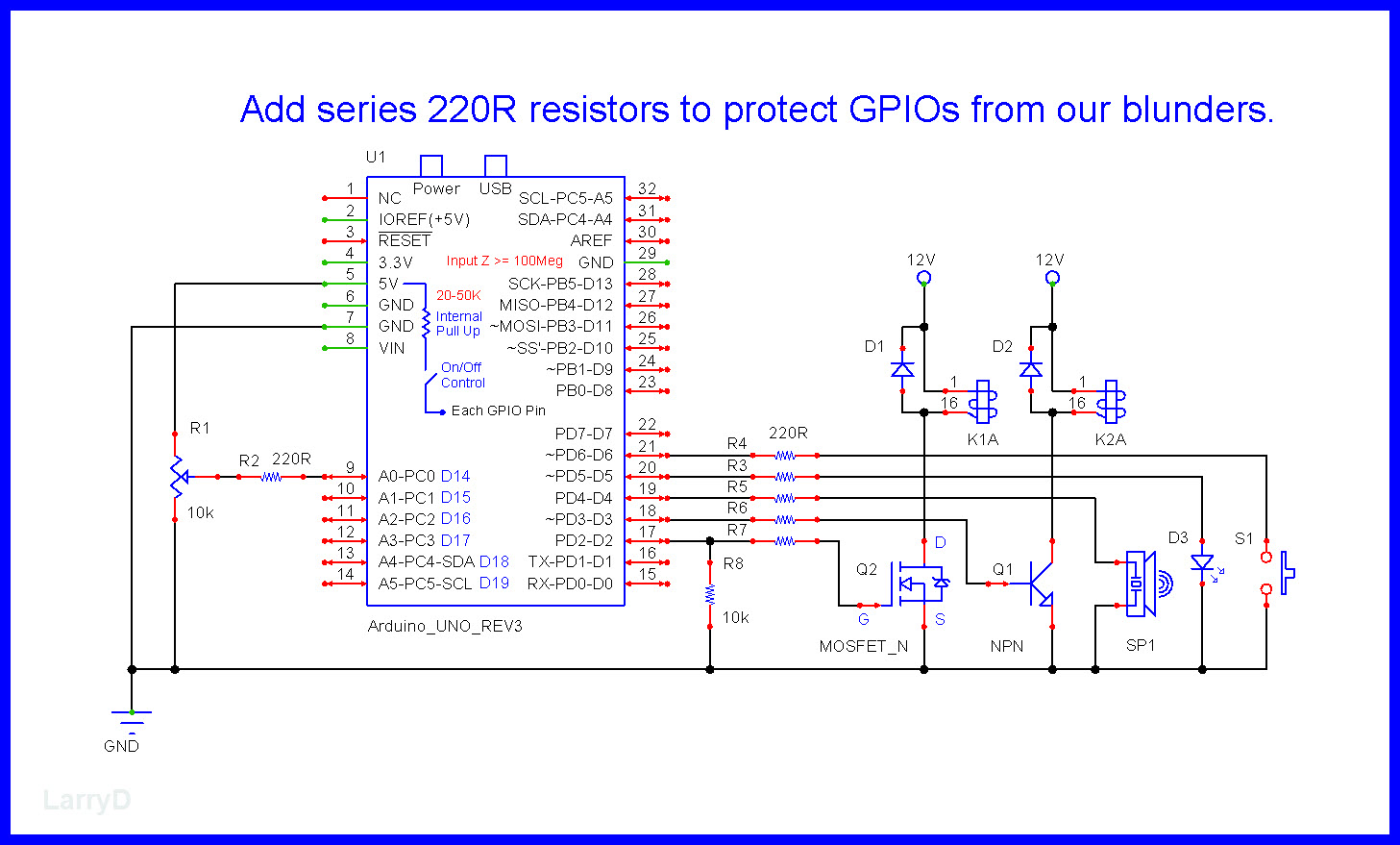
I may be misreading this, so I really need to check, to avoid damage to the board. According to this documentation, the input resistance is massive, as in about 100 Megohms.
Does this mean that I could literally take a 3.3v power supply, and just link it directly to the input, with no issues?
"Arduino (Atmega) pins default to inputs, so they don't need to be explicitly declared as inputs with pinMode() when you're using them as inputs. Pins configured this way are said to be in a high-impedance state. Input pins make extremely small demands on the circuit that they are sampling, equivalent to a series resistor of 100 megohm in front of the pin. This means that it takes very little current to move the input pin from one state to another, and can make the pins useful for such tasks as implementing a capacitive touch sensor, reading an LED as a photodiode, or reading an analog sensor with a scheme such as RCTime."
If your input pin is directly connected to a power supply other than the supply powering the processor, consider what will happen when the processor's power supply is removed but the power supply connected to the input pin remains active. Power will flow through the internal protection diodes. Goodbye processor.
So would it be recommended to use a resistor, somewhere in the region of at least (about) 1KOhm? If my calculations are correct, that would mean that with the device off, it would still be limited to: 3.3/1000 = 3.3ma.
However, I only came across the link that I gave in the OP question. It is maybe something to do with information overload, and learning curve, I'm afraid.
You should check the processor's datasheet to see how much current the internal protection diodes can handle and then ensure that your resistance is higher than that. How much higher will depend on your risk tolerance.
Edit: and I should add that applying signals to an unpowered processor is in general not recommended.
Well, what I do know is the is 8ma. That is what I have been using. It seemed however that this is due to output, and trying to PULL too much from the Arduino, and overloading is, due to output.
Oh, no problem. It was just an example, but it would pertain specifically to whether a resistor needs to be used, on the input. It would likely, more likely, be using something like a photo sensor (proximity or through), or taking something (signal) from a device like a little cheap security alarm. The alarm I have is kind of rudimentary, and I would improve upon it with things like loud-speakers, for a much louder sound, e.g. a super loud horn device!
Well the current draw from the device was what I was thinking of. It says a maximum of 8ma, so I presume that, for example, if I were to activate a transistor switch, you would need around 1k ohm to avoid too much being drawn from the Arduino output.
No, they don't force the input to take any current. The input pin will draw whatever current it need. Obviously if the impedance is 100M ohms then the current is very small.
Just as a little bit of backstory regarding my experience. I was a maintenance engineer in high speed production. The maintenance were never given the ability to (re)program the PLCs. It was not that I (or we) could not, but it was mainly due to the idea being: As a maintenance engineer, you are simply expected to change a part, and therefore, no modification was required to the PLC program (by maintenance).
It was considered out of the scope of the maintenance crew, and fell within production engineering.
Again: the output current of whatever is feeding the input pin on your unpowered processer has no relation to what the protection diodes on the unpowered processor's input pin can safely handle. I don't know how to make that any clearer.