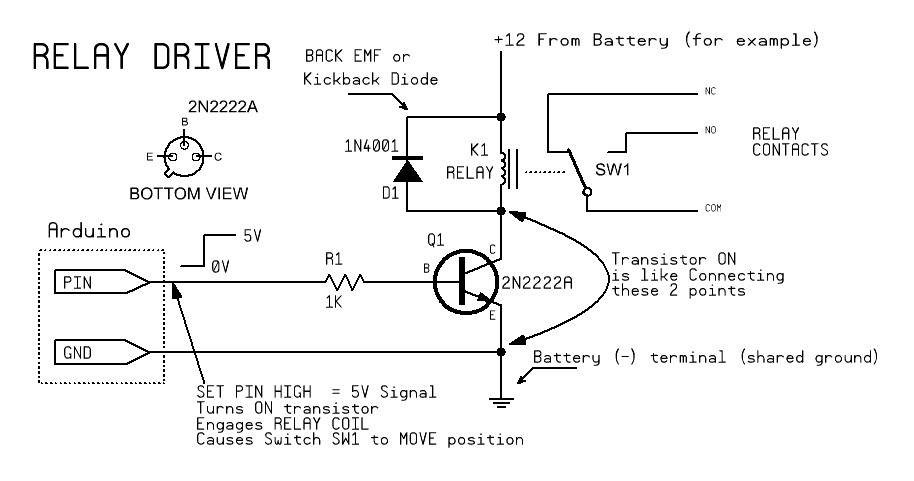
Hi guys,
I'm going to do a project using a car battery (giving 12V DC) and a water pump working with 12V DC. I have two questions :
1_ I want to supply the arduino with the car battery. I would like to use a step down voltage regulator in order to have 5V for the arduino. What do you think about it? Do you have other ideas?
2_ I want to send signals with the arduino to activate the water pump when need it. For that I was thinking about a step up voltage regulator giving 12V. What do you think about it? I was maybe thinking instead of the voltage regulator, a ezl
I'm doing a project with an arduino, using a car battery (12V DC OUT) and a water pump (12V DC IN). The arduino is supposed to be supply by the car battery and it (the arduino) will send signals to control the water pump. I have 2 questions :
1_ I would like to use a step down voltage regulator to supply the arduino with the car battery. Is it a good idea and the best solution? Do you have some advices?
2_ The arduino will control the water pump. For that, I was thinking about using a step up voltage regulator giving 12V for the water pump. Is it a good idea? I was maybe thinking to use a relay but I'm not sure if it's a better solution. What do you think about it?
Great, be sure to connect it to the 5V//Vcc pin of the Arduino. If you use a Uno, don't connect USB at the same time. Or set the step down to 7V and connect it to Vin/RAW.
Bad idea, the Arduino can't deliver the power you need. Use a transistor to drive the pomp from the 12V. Or even easier, a relay module to switch the power to the pomp.
Thank you a lot! I will use a relay then. But I have another question now, you said the arduino can't deliver the power I need but thats no the job of the arduino. Isn't the step up voltage regulator job to deliver the power to the water pump?
Thanks to the moderator correcting my mistake posting 2 same posts.
Right... No need to step back up. You already have 12V and the N channel (or NPN) transistor is switching close to 0-1 volt on the ground path of the pump... but if you are not comfortable or don't know the pump motor current... then use a relay. See link below.
Not only a relay! An Arduino can't drive that directly either. Then you need a transistor (and a diode and resistor) as well. That's why I said relay module, that has all that build onto it
GrInGo04:
Isn't the step up voltage regulator job to deliver the power to the water pump?
But where is the step up getting it's power from then?
Power is not the same as voltage. P = U x I and for a Arduino pin that means 5V x 40mA = 200mW... And that's not even including the losses in the step up
Two things: you will likely need a free-wheel diode across your pump to prevent arcing of the
relay contacts.
Also that temperature sender is likely to be thermistor, you'll need to find the response curve of
resistance v temperature to convert its resistance to temperature, and use a resistive divider to
actually measure its resistance.
A forum post isn't a letter to your best friend or a rejection letter to someone applying for a job.. You don't really need to extend a parting salutation but if you feel compelled to do so the most approriate would not be wishing US luck since YOU are the one with the problem, not us. An appropriate salutation for an OP such as yourself would be "Thanks for your responses...", whereas an appropriate salutation for a member replying to an OP would be:
"Regards,
[name]"
although for whatever reason "Cheers" seems to be popular, which brings to mind the image of someone toasting at a bar and I feel compelled to go mix myself a Bloody Mary. As you can imagine, if all the posts ended with cheers I would be seeing double after only a few posts.
So I have connect the temperature sensor and everything was working good until my laptop turned off instantly while i was using the arduino connected to the USB. Now I cant turn it on I really dont undestand why, the laptop has only 3 months!!
It is possible that the arduino could burn it or something? For me its like impossible but I want to be sure.
If you shorted the 5V you could possible harm the laptop. But that said, the Uno has a fuse on it for protection. And most laptops/computers have protection in the USB supply as well. AND I doubt that just shorting USB 5V and all previous fails more then just the USB port is damaged.
So I would be more concerned about a production fault in the laptop.
1- Sounds like you skipped Reply#6. ( too bad)
2- Based on replies in your post , you never posted any schematics or asked for ang clarification on your circuit. You never told us how much electronics dxperience you have and hou never ssjed us to verify that what you planned to do was the correct course of action
However, I'm still trying to see how it works exactly and if I can use it for the arduino. If someone knows or has any ideas, they are most welcome.
Two things: you will likely need a free-wheel diode across your pump to prevent arcing of the
relay contacts.
Also that temperature sender is likely to be thermistor, you'll need to find the response curve of
resistance v temperature to convert its resistance to temperature, and use a resistive divider to actually measure its resistance.
So I have connect the temperature sensor and everything was working good until my laptop turned off instantly while i was using the arduino connected to the USB. Now I cant turn it on I really dont undestand why, the laptop has only 3 months!!
Where is the post where you post a schematic of your planned interface and ask us to check your proposed circuit ?
As far as I can see, at NO time did you ever post a schematic saying :
"This is what I plan to do and this is my circuit. IS this correct ?"
( you also IGNORED the question in Reply#6 about your experience.
If you needed to post to ask us then you probably needed to ask us to check your proposed circuit.
That apparently never happened, and this is the result.
We have no idea what you did because you never posted your circuit wiring before you actually hooked it up. We have no idea how you wired anything. We know you have a relay and a sensor and that's all we know. (well, actually , now we know whatever you did without asking us first didn't work)


 I really dont undestand why, the laptop has only 3 months!!