This clock do have really big digits 
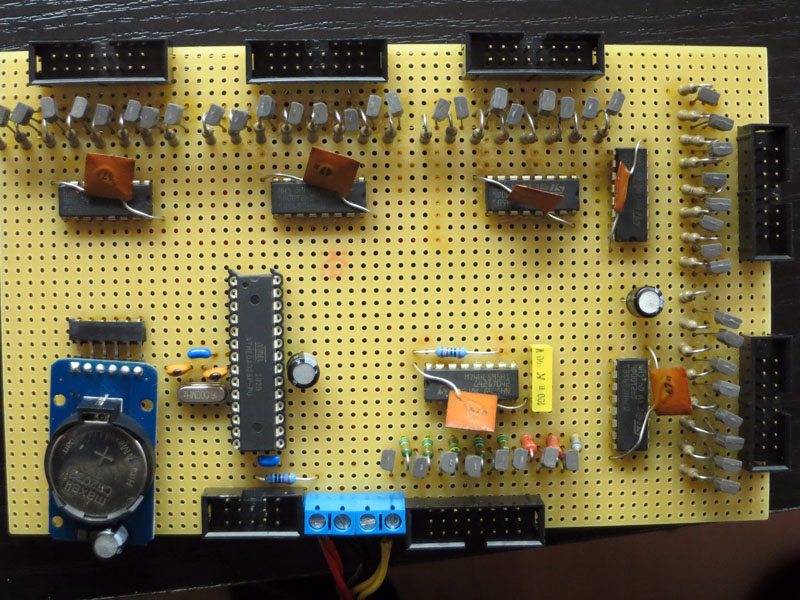
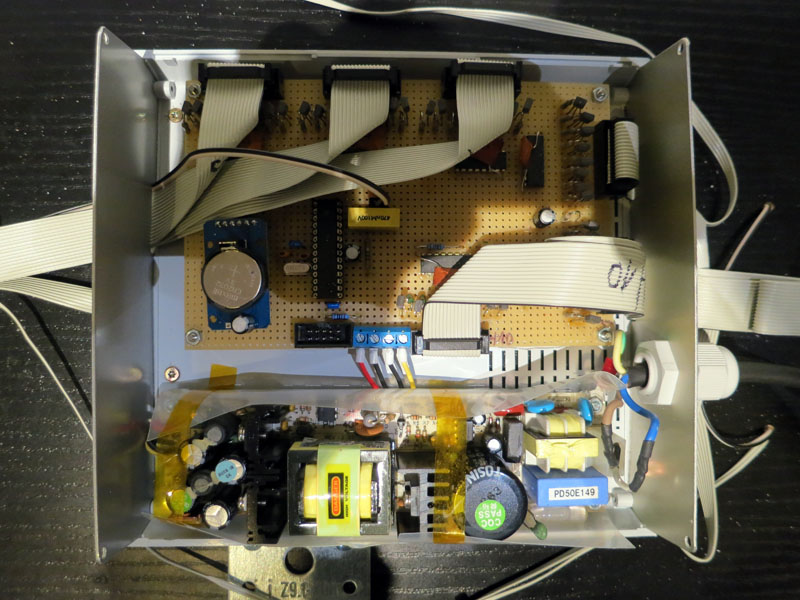
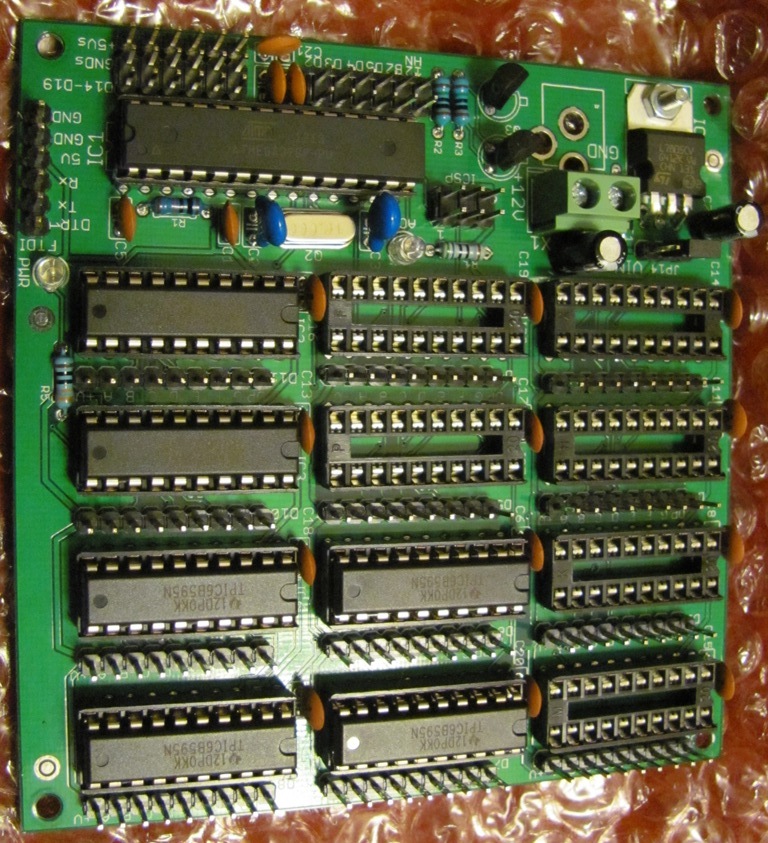
schematic isn't big deal. 6x 74HC595 shift registers, a lot of small transistors and resistors. Timebase is a RTC module with DS3231. This module I adjust 2 times per year on breadboard.
The digits are self adhesive LED-stripes with 120 LED per meter. You can cut this stripe each 2,5 cm. My segments are 12,5 cm long (hours and minutes) seconds 7,5cm. A big digit is 26 cm. My board is a rack board from DIY-market with 30 x 120 cm
You can scale up this digits so big, as you want and it's much easier as handle with some dozen 5mm LEDs
The stripe is really bright. Next step was a phototransistor to dimm the display per PWM with the output enable pins from shift registers.
/* based on LucidTronix 4 Digit sketch
 * modifyed by Ger@ld 1/2014
 * Daisy Chained Shift Registers
 * 6x 74HC595 connected to 7-Segment LED display
 * with DS3231 Real time clock chip
 * Tutorial at:
 * http://www.lucidtronix.com/tutorials/52
 * September 2013
 */
#include <Wire.h>
#include "RTClib.h"

RTC_DS1307 RTC;

int dataPin = 10;
int latchPin = 8;
int clockPin = 9;
int fotPin = 3;    // select the input pin for phototransistor; GND to E phototransistor C to input + 1M --> +5V
int dimPin = 6;    // select the pin to drive Output Enable from shift registers (pin 13)
int fotVal = 0;    // variable to store the value coming from the sensor

byte dec_digits[] = {0b10111111,0b00000110,0b11011011,0b01001111,0b11100110,0b01101101,0b11111101,0b00000111,0b11111111,0b01101111 };

void setup() {
  //set pins to output so you can control the shift register
  pinMode(latchPin, OUTPUT);
  pinMode(clockPin, OUTPUT);
  pinMode(dataPin, OUTPUT);
  pinMode(dimPin, OUTPUT);  // declare the Dim_Pin as an OUTPUT

  Wire.begin();
  RTC.begin();
  if (! RTC.isrunning()) {
    RTC.adjust(DateTime(__DATE__, __TIME__));
  }
}

void loop() {
  DateTime now = RTC.now();
  int thehour = now.hour();
  // switch between 24 hour clock and 12 hour clock
 // if (thehour > 12 ) thehour -= 12;
  int hour_tens = thehour / 10;
  int hour_ones = thehour % 10;
  int minute_tens = now.minute() / 10;
  int minute_ones = now.minute() % 10;
  int second_tens = now.second() / 10;
  int second_ones = now.second() % 10;

  digitalWrite(latchPin, LOW);
  shiftOut(dataPin, clockPin, MSBFIRST, dec_digits[second_ones]);
  shiftOut(dataPin, clockPin, MSBFIRST, dec_digits[second_tens]);
  shiftOut(dataPin, clockPin, MSBFIRST, dec_digits[minute_ones]);
  shiftOut(dataPin, clockPin, MSBFIRST, dec_digits[minute_tens]);
  shiftOut(dataPin, clockPin, MSBFIRST, dec_digits[hour_ones]);
  shiftOut(dataPin, clockPin, MSBFIRST, dec_digits[hour_tens]);
  //take the latch pin high so the LEDs will light up:
  digitalWrite(latchPin, HIGH);
  {
  fotVal = analogRead(fotPin);            // read the value from the sensor
  fotVal = map(fotVal, 0, 1023, 0, 254);  // scale it to use it with the LED - map to 254, cause 255 is complete off

  analogWrite(dimPin, fotVal);            // set brightness
 }
  // pause before next value:
  delay(100);
}
A better description from my project is on german board:
http://forum.arduino.cc/index.php?topic=207948.0
Gerald