We are trying to measure the speed of a wheel chair, using some type of an encoder. We need suggestions about the hardware that we should use.
Thanks,
giodamelio
We are trying to measure the speed of a wheel chair, using some type of an encoder. We need suggestions about the hardware that we should use.
Thanks,
giodamelio
a bicycle speedometer uses a reed switch mounted on the frame with a magnet on the moving part of the wheel. Every time the magnet passes it closes and opens the switch. The speedo won't display a reading at very low speeds but you could put several magnets on the wheel and get a realiable reading. If you used 10 magnets your speedo would certainly read reliably but you'd probably have an upper limit of 5-10 mph.
The reed switches are easy to read with an arduino though you sill might want more than one magnet on the wheel.
what kind of speeds are we talking about and what precision were you hoping for?
Thank you for the quick reply!
So I was thinking of using that too, but I need higher accuracy. Our wheel on the wheel chair has a diameter of about 10" and I am working with speeds around 1-7 mph. I will be moving rather slowly, and would like to know our speed better, so we can more accurately determine our rotation, and distance.
oh, 10" wheels so like a power chair - i was thinking a real wheel chair with big wheels!
still, 10 magnets and one switch would give you a transition every 3 inches and the ease of trying out a bike speedo seems pretty appealing.
There are things called shaft encoders that work optically but i don't know much about them.
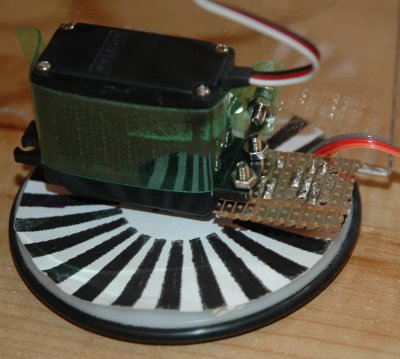
The wheels on that project look about your size: http://www.alanmacek.com/robot/
I have also seen variants on those encoders with multiple sensors and more complex patterns that (I guess) report absolute position and direction rather than just transitions but i know zip about them. good luck and happy googling.
Exposed optical units are vulnerable to dust and dirt. You're better off with Hall sensors and hub-mounted magnets.
I'd go with magnets and a hall-effect sensor, I've got that arrangement underneath my truck that gets covered on all sorts of crap and still works after 2 years.
Rob
A bicycle speed indicator is definitely what you need but a hall sensor is a bit over the top. Most (if not all) bicycle units use simple reed switches, which are more than up to the task. With an expected life of around 100million transitions you will be long gone before you wear it out. I once used one to measure engine speed (around 45 years ago) driven by the distributor contacts, on my fathers car and after many thousands of miles of travel it was still working.
Exposed optical units are vulnerable to dust and dirt. You're better off with Hall sensors and hub-mounted magnets.
Unless the wheel chair is going to be used in a harsh enviroment, the optical solution may be simpler.
What's so difficult about Hall sensors as opposed to light and photosensor combinations?
With light you need a spoked/toothed/holed or marked wheel/hub/contact-roller. With Hall you need 'a' bar magnet.
I don't have practical experience of this but here is my input;
The speed range is 1-7mph and the wheel diameter is 10"
10" diameter wheel so 31.4" circumference.
1 Mile = 63 360 Inches
1mph = 63360/31.4 rotations per hour= 2018 rotations per hour or 0.56 rotations per second
7mph = 3.92 rotations per second
Some of the Hall Effect sensors I have seen have a minimum input frequency of 20Hz.
With a small wheel only rotating 0.56 times per second that does not sound practical to me as it would be difficult to mount enough magnets to get the required minimum frequency.
It sounds pretty good though for reed switches which I like just because they are simple and they are already used on bicycles which is a very similar application. I would go for reeds rather than optical because of the mentioned problems of dirt etc.
Very happy to be corrected on this I am just thinking out loud.
I've never heard of a minimum frequency for a HE sensor, maybe you've been looking at something designed to sense AC current or something.
All those I've see are simple magnet near -> on, magnet not near -> off.
Some are "bipolar" which is a gotcha, they need the N pole to switch one way and the S pole to switch the other. I got caught with that and had to mount two magnets the opposite way around to each other.
BTW some HE sensors have built-in buffering and schmitt triggers so there's no bounce, nice clean signal.
Rob
If you can get a PS2 mouse, there's already an Arduino project to read those. I have at least 2 with dead buttons....
Hall sensors come in a few types for different apps including high-precision joysticks. They have 3 leads and look like pots to analog inputs. They don't wear out that I have ever heard of, unlike for example leds.
For a wheelchair, I would make the speedometer as a contact roller. That could be moved to any other wheelchair without need to change programming to account for wheel diameter since you'd be measuring the speed of the roller and it would equal the speed of the wheel. Fun part is when you're not going in a straight line what you will be measuring but that probably doesn't matter anyway. A laser mouse mounted right over the wheel would do all that without any moving parts but those don't last forever either.
Reed switches compared to Hall sensors are like tubes compared to transistors.
I've never heard of a minimum frequency for a HE sensor, maybe you've been looking at something designed to sense AC current or something.
Here is where I got the idea Hall sensors were frequency dependent
http://www.allegromicro.com/en/Products/Part_Numbers/1425/index.asp
I was just googling and skim reading but the sensor appeared to be for the aplication and it does have a frequency range.
That site actually seems to be a goldmine of information on hall effect
http://www.allegromicro.com/en/Products/Design/hall-effect-sensor-ic-applications-guide/#Q5
From the page you linked to
The A1425 AC-coupled Hall-effect sensor
So that explains the frequency range. Interesting chip though, saved for future reference.
Rob
You might be able to drive a small stepper and pick up rotation from the wires.
So that explains the frequency range
The blurb does say the A1425 chip is AC-coupled but, after another look, I cannot see any description of what that means.
It is not even clear to me where AC applies at all.
If possible can you give a simple explanation of what AC-coupling is and why some hall effect chips might have it and others not?
If you look at the block diagram of the sensor you'll see that the signal passes through two capacitors, that's AC coupling, DC won't pass through a cap.
Why they do this is beyond my ken, but I'm sure there's a good reason. If you notice the range it's 20 Hz to 20 kHz which just happens to be the standard audio range so maybe it's for that but then they say "excellent repeatability and accuracy for crankshaft applications".
Rob
Seems an interesting point of view, Can you please give me more info about the "PS2 mouse" speedometer?
Interesting idea, not only for a wheelchair......( I'm a wheelchair user....)
Thank you for your help
GoForSmoke:
If you can get a PS2 mouse, there's already an Arduino project to read those. I have at least 2 with dead buttons....Hall sensors come in a few types for different apps including high-precision joysticks. They have 3 leads and look like pots to analog inputs. They don't wear out that I have ever heard of, unlike for example leds.
For a wheelchair, I would make the speedometer as a contact roller. That could be moved to any other wheelchair without need to change programming to account for wheel diameter since you'd be measuring the speed of the roller and it would equal the speed of the wheel. Fun part is when you're not going in a straight line what you will be measuring but that probably doesn't matter anyway. A laser mouse mounted right over the wheel would do all that without any moving parts but those don't last forever either.
Reed switches compared to Hall sensors are like tubes compared to transistors.
With ten magnets you have an accurate reading every three inches, or at 1mph every 200ms. A second reed switch will double that
adepalo:
Seems an interesting point of view, Can you please give me more info about the "PS2 mouse" speedometer?Interesting idea, not only for a wheelchair......( I'm a wheelchair user....)
Thank you for your help
See the shaft encoder in reply #3? That wheel is small, maybe 1" (2.5cm) or less. It could be turned by friction against a bigger wheel.