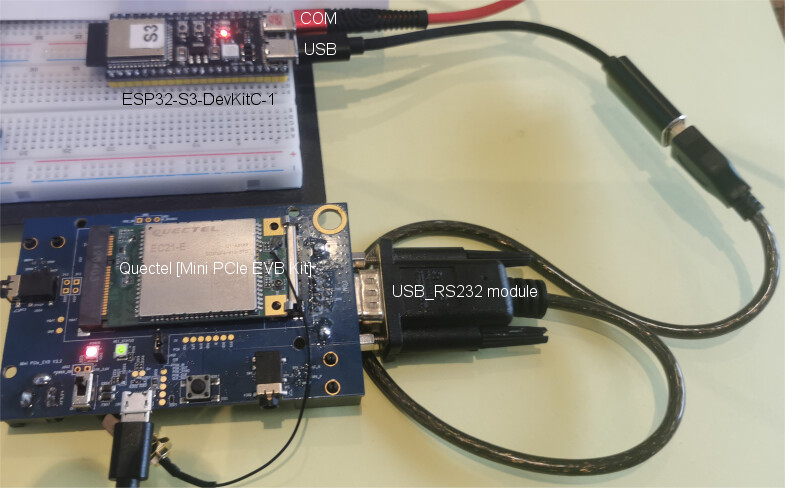
looks like you are attempting ESP32S3 OTG Host serial (Virtual COM Port)
the ESP32S3 File>Examples>USB all appear to be OTG device examples (composite, serial, etc)
there is a ESP-IDF ESP32S3 OTG VCP example - see USB CDC-ACM Virtual COM Port example
I adapted it to connect to a Quectel Mini PCIe EVB Kit (with Quectel EC21-E modem) via RS232
// ESP32-S3-DevKitC-1 USB CDC-ACM Virtual COM Port example

// adapted from https://github.com/espressif/esp-idf/blob/master/examples/peripherals/usb/host/cdc/cdc_acm_vcp/README.md

/*
 * SPDX-FileCopyrightText: 2022-2025 Espressif Systems (Shanghai) CO LTD
 *
 * SPDX-License-Identifier: CC0-1.0
 */

#include <stdio.h>
#include <string.h>

#include "esp_log.h"
#include "freertos/FreeRTOS.h"
#include "freertos/task.h"
#include "freertos/semphr.h"

#include "usb/cdc_acm_host.h"
#include "usb/vcp_ch34x.hpp"
#include "usb/vcp_cp210x.hpp"
#include "usb/vcp_ftdi.hpp"
#include "usb/vcp.hpp"
#include "usb/usb_host.h"
#include "esp_task_wdt.h"

using namespace esp_usb;

// Change these values to match your needs
#define EXAMPLE_BAUDRATE     (9600)//115200)
#define EXAMPLE_STOP_BITS    (0)      // 0: 1 stopbit, 1: 1.5 stopbits, 2: 2 stopbits
#define EXAMPLE_PARITY       (0)      // 0: None, 1: Odd, 2: Even, 3: Mark, 4: Space
#define EXAMPLE_DATA_BITS    (8)

namespace {
static const char *TAG = "VCP example";
static SemaphoreHandle_t device_disconnected_sem;

/**
 * @brief Data received callback
 *
 * Just pass received data to stdout
 *
 * @param[in] data     Pointer to received data
 * @param[in] data_len Length of received data in bytes
 * @param[in] arg      Argument we passed to the device open function
 * @return
 *   true:  We have processed the received data
 *   false: We expect more data
 */
static bool handle_rx(const uint8_t *data, size_t data_len, void *arg)
{
    printf("\e[0;33m%.*s", data_len, data);
    return true;
}

/**
 * @brief Device event callback
 *
 * Apart from handling device disconnection it doesn't do anything useful
 *
 * @param[in] event    Device event type and data
 * @param[in] user_ctx Argument we passed to the device open function
 */
static void handle_event(const cdc_acm_host_dev_event_data_t *event, void *user_ctx)
{
    switch (event->type) {
    case CDC_ACM_HOST_ERROR:
        ESP_LOGE(TAG, "CDC-ACM error has occurred, err_no = %d", event->data.error);
        break;
    case CDC_ACM_HOST_DEVICE_DISCONNECTED:
        ESP_LOGI(TAG, "Device suddenly disconnected");
        xSemaphoreGive(device_disconnected_sem);
        break;
    case CDC_ACM_HOST_SERIAL_STATE:
        ESP_LOGI(TAG, "Serial state notif 0x%04X", event->data.serial_state.val);
        break;
    case CDC_ACM_HOST_NETWORK_CONNECTION:
    default: break;
    }
}

/**
 * @brief USB Host library handling task
 *
 * @param arg Unused
 */
static void usb_lib_task(void *arg)
{
    while (1) {
        // Start handling system events
        uint32_t event_flags;
        usb_host_lib_handle_events(portMAX_DELAY, &event_flags);
        if (event_flags & USB_HOST_LIB_EVENT_FLAGS_NO_CLIENTS) {
            ESP_ERROR_CHECK(usb_host_device_free_all());
        }
        if (event_flags & USB_HOST_LIB_EVENT_FLAGS_ALL_FREE) {
            ESP_LOGI(TAG, "USB: All devices freed");
            // Continue handling USB events to allow device reconnection
        }
    }
}
}

/**
 * @brief Main application
 *
 * This function shows how you can use Virtual COM Port drivers
 */
extern "C" void app_main(void)
{
    printf("\n\nESP32-S3-DevKitC-1 OTG Host VCP serial test\n");

    device_disconnected_sem = xSemaphoreCreateBinary();
    assert(device_disconnected_sem);

    // Install USB Host driver. Should only be called once in entire application
    ESP_LOGI(TAG, "Installing USB Host");
    usb_host_config_t host_config = {};
    host_config.skip_phy_setup = false;
    host_config.intr_flags = ESP_INTR_FLAG_LOWMED;
    ESP_ERROR_CHECK(usb_host_install(&host_config));

    // Create a task that will handle USB library events
    BaseType_t task_created = xTaskCreate(usb_lib_task, "usb_lib", 4096, NULL, 10, NULL);
    assert(task_created == pdTRUE);

    ESP_LOGI(TAG, "Installing CDC-ACM driver");
    ESP_ERROR_CHECK(cdc_acm_host_install(NULL));

    // Register VCP drivers to VCP service
    VCP::register_driver<FT23x>();
    VCP::register_driver<CP210x>();
    VCP::register_driver<CH34x>();

    // Do everything else in a loop, so we can demonstrate USB device reconnections
    while (true) {
        const cdc_acm_host_device_config_t dev_config = {
            .connection_timeout_ms = 5000, // 5 seconds, enough time to plug the device in or experiment with timeout
            .out_buffer_size = 512,
            .in_buffer_size = 512,
            .event_cb = handle_event,
            .data_cb = handle_rx,
            .user_arg = NULL,
        };

        // You don't need to know the device's VID and PID. Just plug in any device and the VCP service will load correct (already registered) driver for the device
        ESP_LOGI(TAG, "Opening any VCP device...");
        auto vcp = std::unique_ptr<CdcAcmDevice>(VCP::open(&dev_config));
        if (vcp == nullptr) {
            ESP_LOGI(TAG, "Failed to open VCP device");
            continue;
        }
        vTaskDelay(10);
        ESP_LOGI(TAG, "Setting up line coding");
        cdc_acm_line_coding_t line_coding = {.dwDTERate = EXAMPLE_BAUDRATE,
            .bCharFormat = EXAMPLE_STOP_BITS, .bParityType = EXAMPLE_PARITY, .bDataBits = EXAMPLE_DATA_BITS,
        };
        ESP_ERROR_CHECK(vcp->line_coding_set(&line_coding));

        printf("\n\nenter text to transmit over VCP serial\n");
        // loop reading characters from keyboard and serial and displaying
        while(1) {
          vTaskDelay(10);                   // cleat WDT
          char ch;
          ch=fgetc(stdin);                  // read character from keyboard?
          if(ch!=0xFF) {
             if(ch>=' ' || ch=='\n'){       // character read if OK
                if(ch=='\n')ch='\r';        // \r is line terminator
                printf("\e[0;32m%c",ch);    // print character and transmit over serial
                ESP_ERROR_CHECK(vcp->tx_blocking((uint8_t*) &ch, sizeof(ch)));
                ESP_ERROR_CHECK(vcp->set_control_line_state(true, true));
                }
          }
         }
        // We are done. Wait for device disconnection and start over
        ESP_LOGI(TAG, "Done. You can reconnect the VCP device to run again.");
        xSemaphoreTake(device_disconnected_sem, portMAX_DELAY);
    }
}
the ESP-IDF Powershell monitor displays (transmitted characters blue received characters yellow)
test setup
note that GPIO19 and 20 are used for USB D- and USB D+ respectively therefore you cannot use them as general GPIO
note to enable USB host 5V you have to solder a link on the rear of the PCB