the Espressif ESP32 family is supported by the Arduino IDE
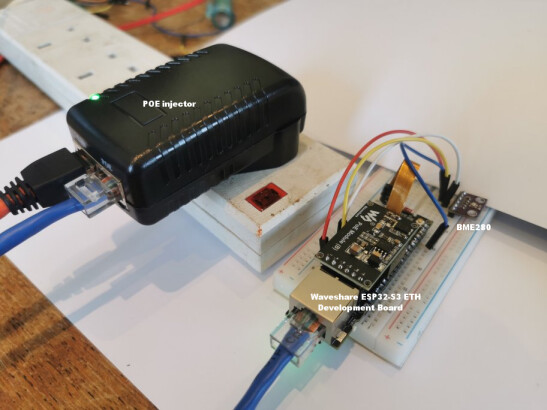
e.g. a BME280 connected to a Waveshare ESP32-S3 ETH Dev board (referenced in post 4) transmitting results over Ethernet using UDP datagrams
// UDP chat program Waveshare ESP32-S3 ETH Development Board (W5500)
// **** change IP addresses and ports to suit requirements *****

#include <EthernetESP32.h>
#include <EthernetUdp.h>  // for UDP

// Define Waveshare ESP32-S3-ETHW5500 pin assignments
#define W5500_CS 14    // Chip Select pin
#define W5500_RST 9    // Reset pin
#define W5500_INT 10   // Interrupt pin
#define W5500_MISO 12  // MISO pin
#define W5500_MOSI 11  // MOSI pin
#define W5500_SCK 13   // Clock pin

// W5500Driver(int8_t cs = SS, int8_t irq = -1, int8_t rst = -1)
W5500Driver driver(W5500_CS, W5500_INT, W5500_RST);

// *****   IP of this machine and remote machine *********
IPAddress localIP(192, 168, 1, 174);  // local static localIP address
IPAddress remoteIP(192, 168, 1, 65);  // local static localIP address
unsigned int port = 10000;            // port to receive/transmit


// Enter a MAC address
byte mac[] = { 0xDE, 0xAD, 0xBE, 0xEF, 0xFE, 0xAA };

unsigned int localPort = 10000;   // local port to listen on
unsigned int remotePort = 10000;  // remote port to transmiit too

// An EthernetUDP instance to let us send and receive packets over UDP
EthernetUDP Udp;
SPIClass SPI1(SPI);

// BMP280 setup
#include <Wire.h>             // include Wire library, required for I2C devices
#include <Adafruit_Sensor.h>  // include Adafruit sensor library
#include <Adafruit_BMP280.h>  // include adafruit library for BMP280 sensor

// define device I2C address: 0x76 or 0x77 (0x77 is library default address)
#define BMP280_I2C_ADDRESS 0x76

Adafruit_BMP280 bmp280;

#define I2C_SDA 16
#define I2C_SCL 17


void setup() {
  // Open serial communications and wait for port to open:
  Serial.begin(115200);
  delay(2000);
  Serial.println("\nWaveshare ESP32-S3 ETH Development Board (W5500) Ethernet UDP chat program");
  // Check for Ethernet hardware present
  // bool begin(int8_t sck = -1, int8_t miso = -1, int8_t mosi = -1, int8_t ss = -1);
  SPI1.begin(W5500_SCK, W5500_MISO, W5500_MOSI, W5500_CS);
  driver.setSPI(SPI1);
  Ethernet.init(driver);

  Serial.println("Initialize Ethernet with DHCP:");
  if (Ethernet.begin(mac)) {
    Serial.print("  DHCP assigned IP ");
    Serial.println(Ethernet.localIP());
  } else {
    Serial.println("Failed to configure Ethernet using DHCP");
    Serial.print("\nDefault localIP");
    displayIPaddress(localIP, localPort);
    Serial.println("Failed to configure Ethernet using DHCP - using static IP");
    getIPaddress("local IP address (<return> use default)? ", localIP, localPort);
    Ethernet.begin(mac, localIP);  // static IP initialize Ethernet shield
  }
  Serial.print("My localIP address: ");  // print local localIP address:
  displayIPaddress(Ethernet.localIP(), localPort);
  // Initializes the ethernet UDP library and network settings.
  if (Udp.begin(port)) Serial.println("UDP begin() OK");
  else Serial.println("UDP begin() failed!");

  // get remote IP and port
  Serial.print("\nDefault remoteIP ");
  displayIPaddress(remoteIP, remotePort);
  //getIPaddress("remote IP address (<return> use default)? ", remoteIP, remotePort);
  Serial.print("\nRemote ");
  displayIPaddress(remoteIP, remotePort);

  // initialize BMP280
  Wire.begin(I2C_SDA, I2C_SCL);
  Serial.println(F("Arduino + BMP280"));
  if (!bmp280.begin(BMP280_I2C_ADDRESS)) {
    Serial.println("Could not find a valid BMP280 sensor, check wiring!");
    while (1)
      ;
  }
  Serial.println("Found BMP280 sensor!");
}

void loop() {
  char text[100] = { 0 };
  // get temperature, pressure and altitude from library
  float temperature = bmp280.readTemperature();    // get temperature
  float pressure = bmp280.readPressure();          // get pressure
  float altitude_ = bmp280.readAltitude(1013.25);  // get altitude (this should be adjusted to your local forecast)
  // print data on the serial monitor software
  // 1: print temperature
  sprintf(text, "\nBMP280 data\nTemperature = %.2f °C\nPressure    =  %.2f hPa\n",
          temperature, pressure / 100);

  Serial.println(text);                   // start a new line
  Udp.beginPacket(remoteIP, remotePort);  // transmit datagram
  Udp.print(text);
  Udp.endPacket();
  delay(2000);  // wait 2 seconds

  // if there's data available, read a packet
  int packetSize = Udp.parsePacket();
  if (packetSize) {
    Serial.print("Received packet of size ");
    Serial.println(packetSize);
    Serial.print("From ");
    displayIPaddress(Udp.remoteIP(), Udp.remotePort());
    // read the packet into packetBuffer
    char packetBuffer[100] = { 0 };      // buffer to hold incoming packet,
    Udp.read(packetBuffer, packetSize);  //UDP_TX_PACKET_MAX_SIZE);     // receive datagram
    Serial.print("Contents: ");
    Serial.println(packetBuffer);
    // if (strcmp(packetBuffer, "OK") != 0) {

    // send a reply to the IP address and port that sent us the packet we received
    //   Udp.beginPacket(Udp.remoteIP(), Udp.remotePort());
    // Udp.write("OK");
    //  Udp.endPacket();
    //}
  }
  delay(10);
}


// read IP address and port from keyboard and check it
void getIPaddress(const char* prompt, IPAddress& defaultIP, unsigned int& defaultPort) {
  IPAddress ip;
  while (1) {  // read  IP (end with new line)
    char text[40] = { 0 };
    Serial.print(prompt);  // prompt and wait for input
    while (Serial.available() == 0) delay(10);
    Serial.readBytesUntil('\n', (char*)text, 40);
    for (int i = 0; i < 40; i++)  // convert IP address
      if (text[i] < ' ') text[i] = 0;
    if (text[0] == 0) return;  // ig just <enter> return  defaultIP;
    //Serial.println(text);
    if (ip.fromString(text)) break;  // if IP OK break while
    Serial.println("\ninvalid IP try again");
  }
  char text[40] = { 0 };
  // read port number
  while (Serial.available()) Serial.read();
  defaultIP = ip;
  Serial.print("\nport ? ");  // prompt and wait for input
  while (Serial.available() == 0) delay(10);
  Serial.readBytesUntil('\n', (char*)text, 40);  // read value
  sscanf(text, "%u", &defaultPort);              // convert value
}

// print IPAdress and port
void displayIPaddress(const IPAddress address, unsigned int port) {
  Serial.print(" IP ");
  Serial.print(address);
  Serial.print(" port ");
  Serial.println(port);
}
UDP datagrams received on a PC using a Java program
F:\Ardunio\Networking\Ethernet\Waveshare ESP32-S3 ETH Development Board\ESP32-S3-ETH-chat>java UDPchat
chat program: IP address BB-DELL2/192.168.1.65 port 10000
UDP datagram length 64  from IP /192.168.1.106 received:
BMP280 data
Temperature = 24.68 ?°C
Pressure    =  1016.52 hPa

UDP datagram length 64  from IP /192.168.1.106 received:
BMP280 data
Temperature = 24.72 ?°C
Pressure    =  1016.59 hPa

UDP datagram length 64  from IP /192.168.1.106 received:
BMP280 data
Temperature = 24.69 ?°C
Pressure    =  1016.51 hPa

UDP datagram length 64  from IP /192.168.1.106 received:
BMP280 data
Temperature = 24.70 ?°C
Pressure    =  1016.48 hPa

UDP datagram length 64  from IP /192.168.1.106 received:
BMP280 data
Temperature = 24.68 ?°C
Pressure    =  1016.48 hPa

UDP datagram length 64  from IP /192.168.1.106 received:
BMP280 data
Temperature = 24.72 ?°C
Pressure    =  1016.58 hPa

UDP datagram length 64  from IP /192.168.1.106 received:
BMP280 data
Temperature = 24.69 ?°C
Pressure    =  1016.57 hPa

UDP datagram length 64  from IP /192.168.1.106 received:
BMP280 data
Temperature = 24.71 ?°C
Pressure    =  1016.47 hPa
photo showing BME280 connected to a Waveshare ESP32-S3 ETH Development Board powered over Ethernet using a POE injector