I am trying to find the best way to power my project whit 18650 cells. It is basically a ws2812b led strip (100 leds) and a microcontroller (ESP-01) to control the leds.
Each LED needs around 60 mA or 55 mA max while shining white at full power so the maximum power it would require might be around 5.5A, but as the LED flash at different color patterns it would use around 60% of said current most of the time.
I know 18650 cells need special circuitry to protect them from over discharge and I will also need a DC to DC boost converter to keep a constant 5v output.
Here is where I need help. How can I get 5v 5.5A from two or three 18650 cells?
I know there are a lot of places where I can get boards with the over discharge protection and boost converter components and I found this one that even comes whit a cell holder
It has a problem tho. Even if the shield states on its back side that it can output 5v 4A, some internet reviews discovered that in reality if you draw more than 1.7 Amps from its USB port it would shut off automatically. Maybe if you draw current from its side 5v pins you could get 5v 4A? I do not have a way to test it.
So I was thinking that a solution might be to wire three or four 18650 Battery Shields in parallel from its side pins in order to get 5v 4.8A or 5v 6.4A?
I would only turn on my project when the cells are completely charged and turn it off even if just one of the 18650 shields turns off.
I would like the cells to power my project for around one hour. If I can power it with one or two cells it would be amazing.
Thanks in advance for your help and I apologize if this topic is in the wrong category. Pardon my English as it is not my native language.
I have a couple more questions. I am not really an expert when it comes to electronics, everything I have learn comes from YouTube and forums like this one.
Why would it be better to wire the cells in series to boost up the voltage and then use a buck-converter to step it dow?
If I use the solution you provided I would still need to find a way to protect each cell from over discharge, right?
Connecting multiple cells in parallel can result in energy loss due to circulating current, and series connections are probably more efficient at using power.
Also, parallel battery boxes have a higher risk of overheating when you insert batteries with different charge levels (that is, different voltages) than in series.
(Even in series, it is still bad to set batteries with different remaining charges.)
Also, in the case of parallel battery boxes, it is possible to operate with one battery, but it is not preferable to draw a large current from one cell.
In a series battery boxes, the device cannot be turned on without inserting everything, so the expected number of batteries will always be used.
Yes.
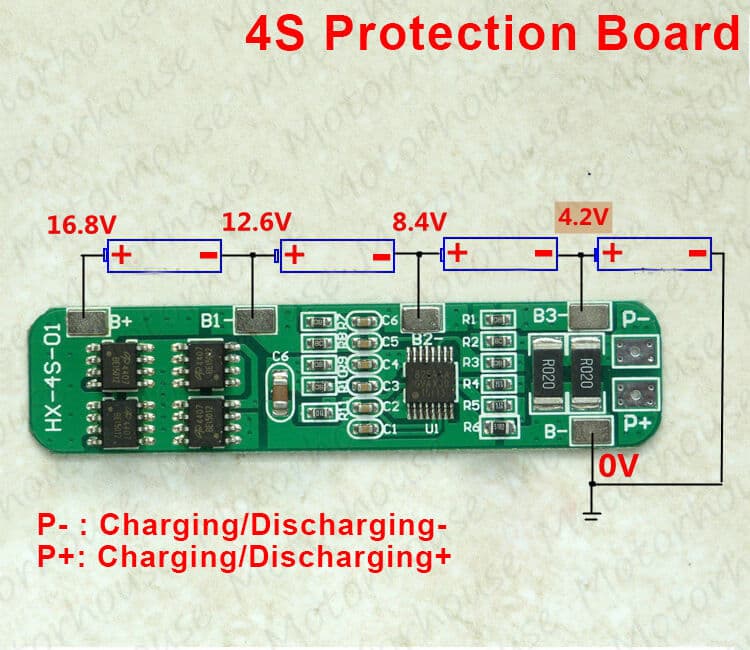
Please use a protective board for 3S or 4S.
Something like this.
Using the side 5V headers of the V3 shield does not give you any additional current. The 5V boost converter drives all of those and the USB output together. There are three ganged 3.3V linear regulators for the 3.3V output headers, but only one boost converter.
There is a 4-cell version of that shield, which is V9. The cells are wired in parallel, and the output rating at 5V is 3A. Of course that's just what they claim, and in reality it may be somewhat less, as with the V3. But I think with four 18650s in parallel, the limitation has to be in the boost converter, not the batteries. Is there any chance you could power the LEDs directly from the parallel batteries? At full charge they would be 4.2V, but of course as they discharge the voltage would drop somewhat. It might be worth experimenting with 25 LEDs and one 18650, just to see what kind of performance you get.
There is also a V8 which has two cells in parallel, but it is also rated at 3A. There might be a way to use two of them in parallel to get the 5.5A you need. But mixing the output of two switching regulators could be a challenging task.
It might also be possible to use the V9 as a parallel battery holder and as a charger, but find a separate boost converter module that can actually deliver 5A. Maybe something like this would work: