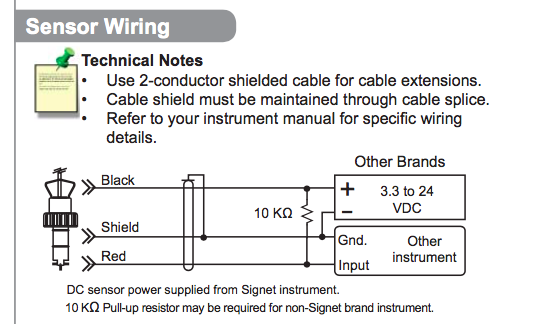
I'm looking into the possibility of monitoring the flow of my small self propelled irrigator with this flow sensor: GF Piping Systems
In the attached screenshot are the specs of the voltage input and output. Due to my inexperience I have no idea what I need to add to the system to have it work with a MEGA, if it is even possible.
The 515 sensor delivers an AC signal, which should not be applied directly to a port pin.
You could use a 10K series resistor and apply that to an analog input, which would then read only the positive peaks.
A better approach would be to bias the sensor so that the average voltage is 2.5V (for a 5V Arduino), and that way you could read the full swing of the signal using analogRead().
This page and this page describe how to read household AC current and voltage using that approach.
It may be possible and, if it is, you would only need a Mega if you were doing a swag of other things as well, but I'm sure it would not be worth the effort - and almost certainly not worth the cost.
All paddlewheel sensors work the same way - except possibly this one. The specs are so opaque that it is not even clear if the device is analogue or digital, and it is possible that it is both. It is clear that it works by measuring the velocity of liquid through a pipe and they talk in terms of feet per second. This makes me think the device is made in Germany. Only the Germans would think like that, and you can expect to pay a premium for the pleasure. Everybody else talks in volume/time e.g. litres/minute.
The reason why the specs are this way might be because the sensor is incomplete and you are expected to use it in conjunction with some compatible device. Having said that, I imagine it can still be used with Arduino but, since you are exploring the possibility, you might consider ignoring it for something that can be used with certainty.
There is a swag of hall effect paddle wheel devices readily available. They come in a range of standard pipe sizes up to at least 2" BSP, and the bigger ones cost about $30. They can also be had with an on-board meter for about $20 extra, so, if that is all you want, you probably don't need an Arduino. The value of Arduino would be in recording, controlling, and communicating - not just measuring.
All you need to know in order to use these things is your anticipated range of flow rate, then choose the sensor accordingly. The pre-existing pipe size may also be a factor if you are using lower pressures. The sensors deliver pulses per litre, you use Arduino to count them. Most standard programmes for this calculate the rate of flow but I guess you are only interested in quantity and that may mean simpler programming.
Thanks for the inputs - I am using a mega because I monitor other sensors and send the data to Ubidots, UNO just doesn't cut it.
The pipe size I need to monitor will be 2", if it works ok I'd like to monitor bigger sizes, up die 10" or so. So I'm looking for a solution that would be both semi decent quality and also not too hard on the pocket. These units are quite expensive.
Nick_Pyner:
There is a swag of hall effect paddle wheel devices readily available
Nick could you help me find these? All my search results ever delivered were tiny things for 1/2" pipe or hugely expensive industrial units.
This is one axial flow. Maybe that is normal when you get to this size. You need to check the flow range and the calibration factor, which is often on the label, but apparently not here. If you are working with 10" pipe, you can afford the sensors to go in them, and I don't know what they will be.
heinburgh:
Thanks for the inputs - I am using a mega because I monitor other sensors and send the data to Ubidots, UNO just doesn't cut it.
The pipe size I need to monitor will be 2", if it works ok I'd like to monitor bigger sizes, up die 10" or so. So I'm looking for a solution that would be both semi decent quality and also not too hard on the pocket. These units are quite expensive.
Nick could you help me find these? All my search results ever delivered were tiny things for 1/2" pipe or hugely expensive industrial units.
Are your large pipe completely filled with liquid? If not, the flow sensor is meaningless.
Nick_Pyner:
LOL I don't think you have been looking very hard. The suppliers of the tiny ones should have the bigger ones, as you select according to need.
I have seen these, but they won't do. If the sensor is inline like this it has to be brass or some other metal that can withstand quite a bit of strain since it has to support quite a bit of weight. I like the GF paddle wheel sensors because they can be used on a wide range of pipe sizes.
I got the details of the signal from the manufacturers - they have another model that can return 5V digital signal. Perfect. Still just a bit too pricy for my liking.
Nick_Pyner:
It is clear that it works by measuring the velocity of liquid through a pipe and they talk in terms of feet per second. This makes me think the device is made in Germany.
Germans would never give feet, always meters. Normally not even both (it seems that the specs are based on round numbers in ft/s which were then converted to metric).
Looking at the last image of OP it seems that this is a sensor that is stuck through the side of the wall, so indeed can only measure the speed of the flow, as it doesn't know the size of the pipe. It doesn't look like an inline sensor, which of course also measures the speed of the flow, but then knowing its own size the manufacturer can calculate volume for you.
wvmarle:
Germans would never give feet, always meters. Normally not even both (it seems that the specs are based on round numbers in ft/s which were then converted to metric).
Looking at the last image of OP it seems that this is a sensor that is stuck through the side of the wall, so indeed can only measure the speed of the flow, as it doesn't know the size of the pipe. It doesn't look like an inline sensor, which of course also measures the speed of the flow, but then knowing its own size the manufacturer can calculate volume for you.
Yes I'm sure you are right, and it isn't that hard to add the cross section into the calcs. The sensor may be installed in a proprietary fitting rather than something cobbled. I suppose having a tiny paddlewheel as that appears to be in a 10" pipe is OK, but it doesn't sound like a great idea.
They are sold with different sized stems, longer stems for bigger sized pipes so that the paddle is just at the right position within the pipe. I have seen a table somewhere in their docs with the formulas for calculating flow - the paddle just measures fluid speed, the pipe diameter determines flow rate.
The more accurate method is electromagnetic sensors, but the cost is above my level of existence.