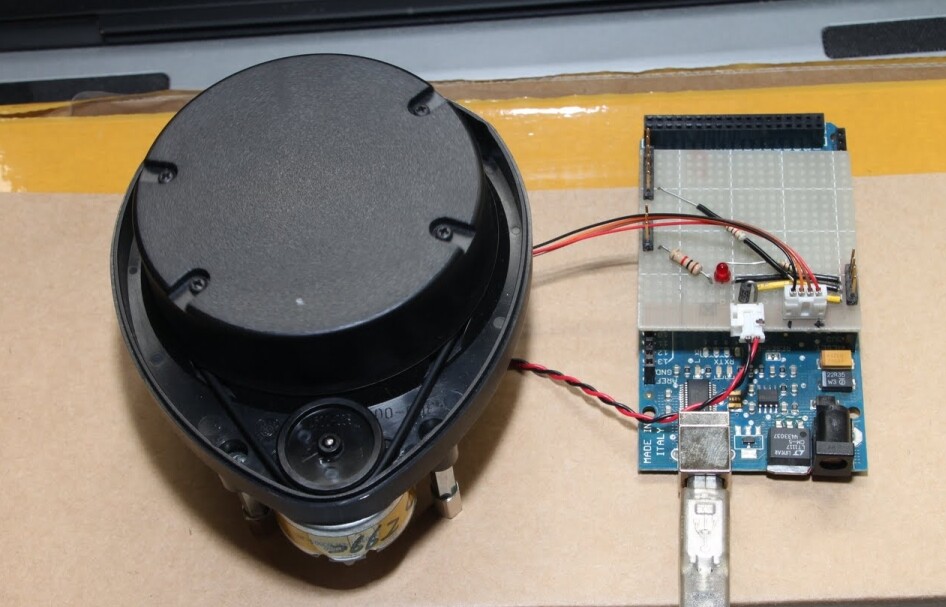
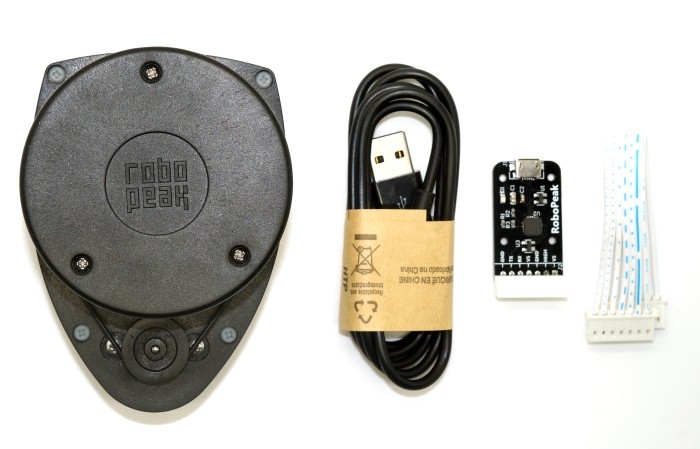
Laser scanners are commonly used in mapping, localization and obstacle avoidance in robotics. While professional scanners are usually expensive and sometimes unfriendly to developers, we've got a new 360 Degree Laser Scanner Development Kit (RPLIDAR) which provides high performance yet at a relatively affordable price.
This 360 Degree Laser Scanner Development Kit (RPLIDAR) is a low cost 360 degree 2D laser scanner (LIDAR) solution developed. The system can perform 360 degree scan within 6 meter range. The produced 2D point cloud data can be used in mapping, localization and object/environment modeling. With a scanning frequency of 5.5 hz when sampling 360 points each round, it can be configured up to 10 hz maximum. It works excellent in all kinds of indoor environment and outdoor environment without sunlight.
By using RPLIDAR, developers working on robot navigation system or indoor mapping system are able to shorten the development cycle and save lots of money. After purchase, you will also get datasheet and SDK for RPLIDAR to facility your development. A reference design of simultaneous localization and mapping (SLAM) solution for indoor robot based on RPLIDAR will be showed in the coming Maker Faire Bay Area, 2014. The reference design can sketch out a plan for the unknown environment and achieve indoor positioning with mm-level accuracy. In addition, it contains the feature of destination path searching, navigation, obstacle avoidance and so on. Also, RPLIDAR can be integrated to ROS which is widely used in many researches and fun projects.
Does the laser scanner have other control connections besides the USB connection? If USB is the only interface, then that might be a show stopper for use with microcontrollers.
While the price for that sensor is certainly lower than many other similar options, it still is way over the top of where it needs to be: As a hobbyist, for $400.00 USD, I could easily purchase a Neato Robotics vacuum, tear it down, gain the sensor (which this sensor seems to be an almost direct copy of), plus a host of other useful parts. It seems like the more sensible option.
A very good description of one of the sensors used in the 2005 DARPA Grand Challenge. Wikipedia even has a link to WMV Video showing the world through Stanley's laser-beam eyes. The Neato folks did not include any prior art reference to Stanford's sensor. I wonder if that makes Neato's patent bullshit.
That appears to be a patent application. Do you have a link to the actual patent issued for this application? Below is what appear to be the patents neato holds.
How is this based on "Laser triangulation ranging principle" ? Doesn't it measure the distance by measuring the travel time for the light pulse to the reflecting object and back again ? That isn't.. triangulation....
michinyon:
How is this based on "Laser triangulation ranging principle" ? Doesn't it measure the distance by measuring the travel time for the light pulse to the reflecting object and back again ? That isn't.. triangulation....
The below shows the angular setup. The laser dot will be detected at a point on the sensor's x active area depending on the distance the reflecting object is from the laser.
cr0sh:
As a hobbyist, for $400.00 USD, I could easily purchase a Neato Robotics vacuum, tear it down, gain the sensor (which this sensor seems to be an almost direct copy of), plus a host of other useful parts. It seems like the more sensible option.
That would make for a very cool robot. Well the Neato already is a very cool robot of course (we love ours!)
I seem to remember reading that the creators of Neato had originally planned to make their low cost lidar technology more widely available to third parties, but I haven't seen or heard much more about that.