Hi,
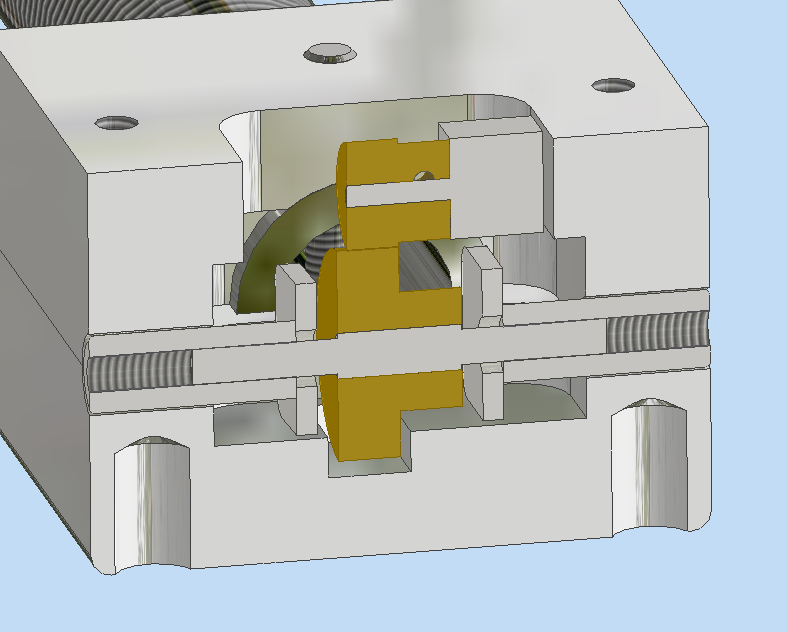
I want to use Arduino to control a mechanical locking device. A motor drives a threaded bolt, which drive two locking bolts.
There is not sufficient space for mechanical or optical limit switches.
Is it possible to measure the motor torque or power instead using arduino?
I'm experiences in mechanical design, but these are my first steps into electronic. It would be great if someone could give me a hint.
I assume that you are considering detecting the fact that the motor has stalled when the bolt reaches the end of its travel
You can measure the current taken by the motor and/or the voltage across it, but you need to be careful that its stall current does not exceed the current capability of whatever is driving it
It may also be wise to limit the run time of the motor when activated as a fail safe
You'd need to have some current sensing circuitry - DC motor torque and winding current are proportional (although friction will typically steal some of that torque).
Thus when a motor stalls due to an endstop the current will jump up. Many DC motors are not rated for continuous mechanical stall and simply cook themselves rapidly though (burning out in a matter of seconds) - at stall the current is higher and there's no cooling due to ventilation by the rotor spinning. Heat generation in motors goes with the square of the current (its the I-squared-R dissipation in the windings), so even a doubling of current can have a huge effect.
It may be wise to use a current-limiting circuit (especially if it can generate a logic output to indicate overload). That way you can mitigate the heating problem and indicate stall without needing to actuall measure the current explicitly.
Thanks for your replies! You helped me alot, as I don't need to incorporate limit switches. There is no space for limit switches and wiring would become messy.
Have a nice day
Sensing the travel limit by a motor's stall current is often done in inductrial application (low cost and good reliability; no switches to potentially fail).
As MarkT advises, beware of 'cooking' the motor or driver.
For high(ish) reliabilty a hardware over current detection and a hardware latch is less likely to fail than micro's software. The hardware latch would require resetting. I maybe overegging the engineerng here,
You can just monitor using your Arduino and control accordingly.