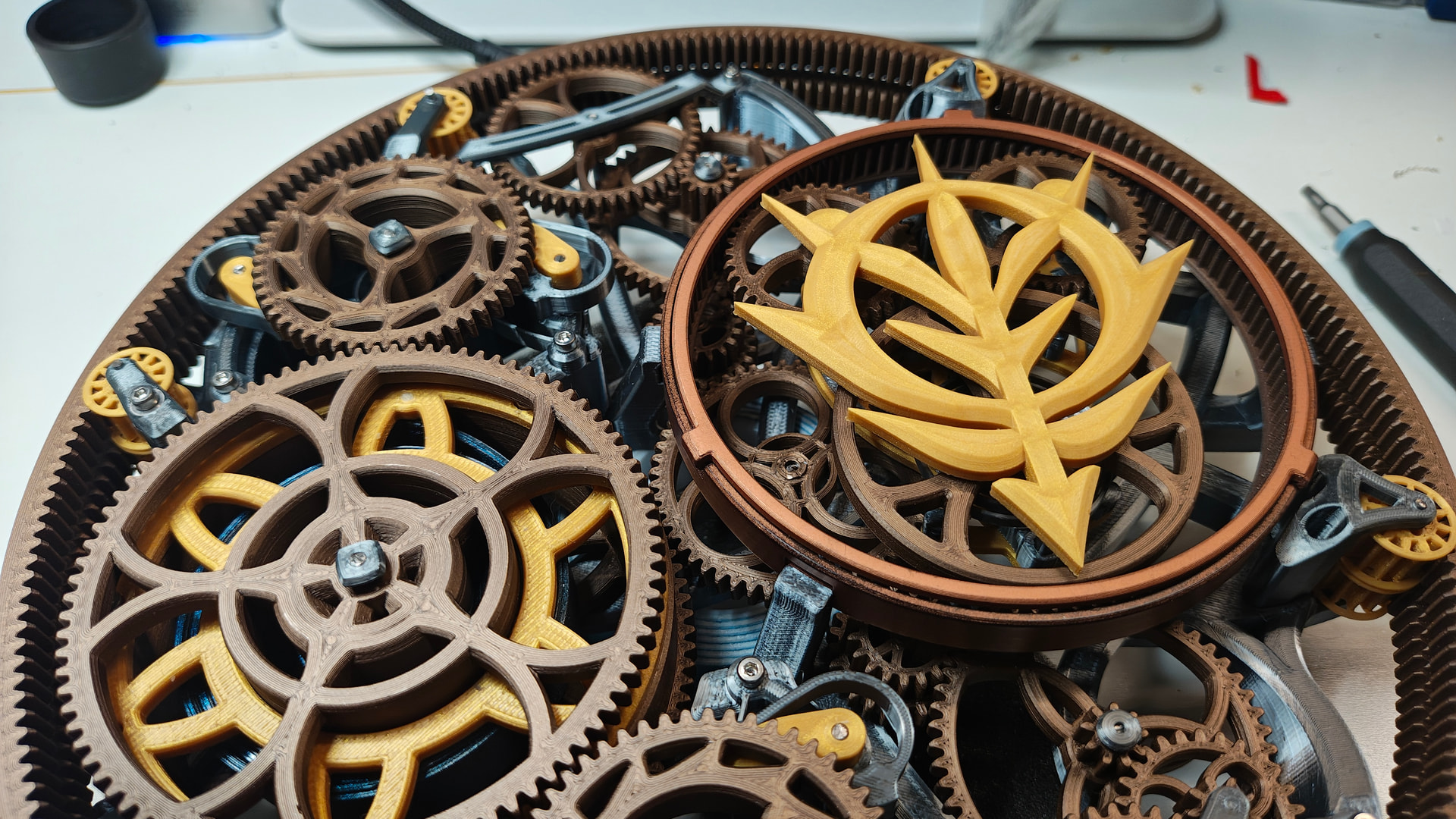
I’m currently building a 3d printed mechanical clock and i need to power it from a motor instead of the PETG spring. It’s working perfectly, but the spring goes on only for 8 minutes…
This clock will be placed under a circular rotating glass and it’s not needed to be accurate as a clock itself, but only to move the gears and the tourbillon.
I have a pair of 24BYJ that maybe wil be enough to power the clock. I know that they can be modded to bipolar and in that way they have more torque.
The tourbillon limits the movement of the gears, so an arduino is required to add a pause between movements to avoid too much force on the gears teeth.
The motor needs to rotate at 3 rpm minimum if I use a 9 teeth gear on the tourbillon directly, at 7 rpm if I use the central gear and at 11 rpm if I use the barrel gear.
There is not so much space to place the motors, so if the one i want to use is not enough i need something small.
The material used for the clock is PLA, and it soften at around 50C so the motor and the driver needs to stay cool enough. Eventually i can put a metal plate on the bottom (it’s 20 cm of diameter) to help dissipate the heat. Because it will powered by a battery i don’t want to add a fan or to be power hungry.
The battery is a 12.000 mAh PD Powerbank connected with a USB-C selector to provide 5V, 9V or 12V. The MCU will be an Arduino Nano.
I was thinking about a TMC 2208 or a 2209, or even a TMC2130 (but I saw that they are quite expensive)
I have some questions:
To only move the gears like I said, do I need to setup the UART connection or the advanced features of the driver (silent operation and power efficiency when not moving) are automatic and I can connect it in legacy mode?
I was thinking to power all from 9V, is it ok for the 28BYJ or it needs to be over 10V because of the bipolar mod?
Is it correct that I need to turn on the driver before the Nano?
Are these driver the optimal choice or i need to choose something else?
The motors are from a security camera, they have a hole with a screw in the middle. For the motor gear I can use PLA CF reinforced, PETG CF reinforced, PLA tough+, ABS or PETG. I’m using a PLA gear on a servo from January and it’s still good.
Car battery?
A stepper motor is an inefficient type of motor.
Modding it to bipolar will double the generated heat.
Did you first try without the mod. They are already quite strong.
You're not powering the motor, you're powering the driver
The driver converts the supply into the right motor current.
Stepper driver supply is usually two to four times motor voltage.
Do you really need a stepper motor. Maybe a geared DC motor is a better solution.
Leo..
I wrote about he battery. The battery is a 12.000 mAh PD Powerbank connected with a USB-C selector to provide 5V, 9V or 12V.
Ok, the motor is rated at 5V as you can see from the photo.
Probably yes. The gears of the clock moves every second, so they are not in constant rotation. With a stepper and an Arduino I can move the gear and add a pause to wait for the tourbillon to allow the movement.
The bipolar mod allow the use of the TMC silent drivers, they are quite noisy without modding.
Sadly… no. I have only the motors and i need the drivers. I removed them yesterday from a Provision dome camera and it was fully working before disassembling them. Maybe i can buy a ULN2003 (or an A4988) to test the motors without modding, but i know they are quite noisy
Not now that they are disconnected. As I replied before I can buy an ULN2003 (or an A4988) to test them not modded. I don’t know which driver was used inside the PCB of the security camera, but the movement had a very noticeable low pitch when moving “fast” from the web interface. I cannot measure the rpm precisely, but I think it was near 10 rpm.
If you are referring to 5, 9, 12 from a USB PD connection, the consumer, which in this case is the driver, has to communicate to the power bank that it wants 9V; otherwise, you only get 5V. You can still have a 9V setup by using a Boost converter to go from 5 to 9.
Noise is so relative...
I remember when playing with those + uln many years ago that at high speed they were noisy. On the other hand they are commonly used for mini-split AC flaps which I have many as well and I don't consider them noisy. But I don't compare them to Rolex...
A current controlling stepper driver is like a buck converter.
It's not uncommon to see a stepper driver powered with 24volt for a 3volt motor.
9-12volt seems the sweet spot for your 28BYJ-48.
Leo..
The ULN2003 arrived and I tinkered a little bit. I used the sample Stepper sketch. I powered the ULN2003 from a 5V powerbank and the Arduino Nano with the PC USB.
I found a sweet spot setting 150 step per revolution, 46 rpm and a delay of 75ms. When I return home I’ll try with 2048 steps, 3.37 rpm and the same delay.
I used a 12 teeth gear as the 9 teeth was too little for the shaft. With the above setting it completes a full rotation in 57 seconds… Not bad. If I tweak the settings maybe I can use it as a real clock
I tested all for about 15 minutes and it worked fine. The motor was quite warm, but I admit it was not bad as I imagined. The noise is noticeable, but it’s covered by the ticking of the tourbillon. I need to measure the power consumption…
If I use the AccelStepper library I will gain efficiency with this setup? I need another motor to rotate the glass plate and the sample stepper sketch doesn’t allow multiple motors…
Maybe I can use a simple DC motor with a potentiometer for the glass…
P.S. I used a 28BYJ-48 that was sent with the ULN2003, not the 24BYJ-48
Ok, I succesfully connected the two steppers using AccelStepper. I used the run() command because it’s non-blocking. Is it possibile to change the speed of one of the stepper using a potentiometer using the run() command?