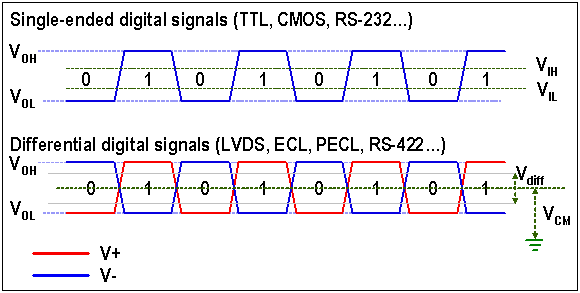
I am trying to integrate an optical transceiver on an Arduino UNO and the transceiver uses PECL (which is similar to ECL +5 V). Here is what it looks like (the bottom trace) http://www.ni.com/cms/images/devzone/tut/a/07c0be30313.gif.
Where would I start with this? Just a simple loop making one pin HIGH and one pin LOW and then delaying it and swapping the pins?
ECL is what you might consider up side down,
a '1' in ECL is about -1v , and a '0' in ECL is about -2 volts.
This was done for noise reasons, as the ground is normally lower noise than the 'other' supply,
PECL changed this, so '1' is about 4 volts, '0' is about 3 volts .....
please check the data sheet of the source as to what you have.
PECL is normally used in devices that are expecting to be 'fast' , so surprising to see in an opto sencor.
if its driving over any distance, its best to use a PECL to TTL translator chip,
such as these http://www.onsemi.com/PowerSolutions/product.do?id=MC100ELT21
You can get away with circuits, such as if you are only detecting a change, then a capacitor can be used in series to generate a TTL spike the arduino can see,
If you are not familar with ECL be careful ECL logic is very particular.
With the ECL load resistors are not included in the integrated circuit you have to add it, is mandatory..
Also if you use it at fréquency above few MHz you have to use line impedance matched 50 ohm.