PWM Motor Driver

¡Hello!

I am trying to implement a control system for a massage chair. This equipment has two DC Motors, but they work with 110VDC, so I’ve been thinking to use a ESP32 with a PWM output to control the power of a Motor Driver, but I would like to know which Motor Driver is recommended to use with this board or is anyone had been in this situation?

I found this:

But don’t know if this one works with an ESP32

So any comment would help

Thanks

Try to find technical documentation at the producer's site.

Have You verified that the driver can handle that motor current?

1 Like

You would need additional hardware, such as a DAC.

1 Like

You could use pwm to 0-10V converter like this to control that Daedalus:
https://aliexpress.com/item/1005006582755517.html
But you need also min 12V power supply.

1 Like

I tried, but I does not find too much information about that motors. The label on it says Ou Yuan DC Motor 110V. If you find something please let me know. :folded_hands:

Got it! That is a good detail, because the ESP32 gives me just 3.3V right??

Not likely because of the information You give.

That device need a min of 4.5V so you will need a level translator to use it with a 3.3V ESP or use a 3.3V DAC

Right.
I have used that module with Esp32 without problems, but like jim-p commented above, description of that module doesn't confirm compatibility with 3.3V PWM signal.
To be sure, better to pick converter that clearly confirms that.
https://www.aliexpress.com/item/1005006246726187.html

I don't know how you want to control your setup, but if it fits your use case, I can recommend Shelly dimmer 0-10V Gen3. More expensive solution, but certified European product with lot of features. Esp32 on-board.

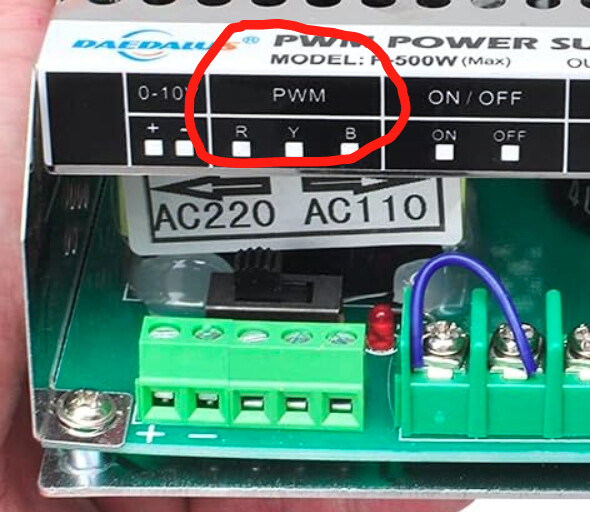
Well this is confusing:

Maybe it can use PWM

If it's any help, I use an MIC4426 MOSFET gate driver (DIP-8) to drive a MOSFET.

The MOSFET switches a 240-V AC/DC universal motor powered by 160-V DC PSU (transformer-bridge-large capacitor).

Arduino Nano provides the PMW output and a potentiometer provides the 0-5 volt control signal. The MIC4426 needs 12-V DC to work reliably as I recall.

Very simple arrangement, nothing gets even warm, and control right down to a crawl.

Costs are minimal, the main cost being the transformer.