Sorry for the confusing headline, but I'll try to explain better here.
In my code, I have used the commonly known code for reading the 5v input as described here: GitHub - Yveaux/Arduino_Vcc: Arduino library to read VCC supply level without external components with some small modifications. In addition I have added code for reading internal temperature as outlined in this post: Arduino Playground - InternalTemperatureSensor.
The strange thing that I cannot wrap my head (nor code) around, is that when I'm reading both V_in and Temperature, the Temperature reading returns a value of -186,89 (raw value from ADC = 88). V_in returns 5.033v which is close to actual input.
Reading only internal temperature (that is, commenting out the call read_vi_mv), the reading returns just fine, with a temperature of 27 degrees uncalibrated, which starts rising if I touch the chip.
The same result is happening if I try to read Temperature and any other analog input. The analog input reading go okay, but the Temperature return a constant of -186,89.
Any suggestions?
double temperature = 0.0;
double vIn_mv = 5000; // best guess. Is updated periodically in software
const long SlowUpdateInterval = 200; //[ms]
long LastSlowUpdate = 0;

double read_vin_mv(boolean init) {
 static double vIn = 0.0;
 // Read 1.1V reference against AVcc
 // set the reference to Vcc and the measurement to the internal 1.1V reference
 if (ADMUX != (_BV(REFS0) | _BV(MUX3) | _BV(MUX2) | _BV(MUX1)))
 {
 ADMUX = (_BV(REFS0) | _BV(MUX3) | _BV(MUX2) | _BV(MUX1));

 // Bandgap reference start-up time: max 70us
 // Wait for Vref to settle.
 delayMicroseconds(350);
 }

 // Start conversion and wait for it to finish.
 ADCSRA = _BV(ADEN) | _BV(ADPS2) | _BV(ADPS1);       // enable the ADC div64
 ADCSRA |= _BV(ADSC);
 while (bit_is_set(ADCSRA, ADSC)) {};

 // Result is now stored in ADC.

 // read result
 unsigned int adc;
 adc = ADCW;
 // data sheet 24.7 ADC Conversion Result
 // ADC = vref * 1024 / vin
 // notice that vin and vref have exchanged roles because we
 // measure the reference voltage against vin
 // ==> vin [V] = vref [V] * 1024 / adc
 // ==> vin [mV] = 1.1 * 1000 * 1024 / adc
 if (init) {
 vIn = (Vref*1024.0) / (double)adc;
 }
 else {
 vIn -= vIn / 10.0; //Recursive filter averaging over 10 samples
 vIn += ((Vref*1024.0) / (double)adc)/10.0;
 }
 return vIn;
}

double GetTemp(boolean init)
{
 static double temp;
 unsigned int wADC;
 if (ADMUX != (_BV(REFS1) | _BV(REFS0) | _BV(MUX3))) {
 ADMUX = (_BV(REFS1) | _BV(REFS0) | _BV(MUX3));
 // Bandgap reference start-up time: max 70us
 // Wait for Vref to settle.
 delayMicroseconds(350);
 }

 // Start conversion and wait for it to finish.
 ADCSRA = _BV(ADEN) | _BV(ADPS2) | _BV(ADPS1) ;       // enable the ADC div64
 ADCSRA |= _BV(ADSC);
 while (bit_is_set(ADCSRA, ADSC)) {};

 // The offset of 324.31 could be wrong. It is just an indication.
 // The returned temperature is in degrees Celcius.
 // Reading register "ADCW" takes care of how to read ADCL and ADCH.
 wADC = ADCW;

 if (init)
 temp = (((double)wADC - 324.31) / 1.22);
 else {
 temp -= temp / 20.0; //Recursive filter averaging over 20 samples
 temp += (((double)wADC - 324.31) / 1.22) / 20.0;
 }
 return (temp);
}

int ReadADC(int channel, int AverageNum) {
 long adc = 0;
 for (int i = 0; i<AverageNum; i++) {
 //delay(1);
 adc += analogRead(channel);
 // wait for conversion to finish
 while (bit_is_set(ADCSRA, ADSC)) {};

 }
 return (int)(adc / AverageNum);
}

void setup() {
 // ***************************************************************************
 // ******* Initialize Serial port for use with Meguino GUI *******************
 // ***************************************************************************
 Serial.begin(115200);
temperature = GetTemp(true);
vIn_mv = read_vin_mv(true);
}

void loop() {

 if ((millis() - LastSlowUpdate) > SlowUpdateInterval)
 {
 LastSlowUpdate = millis();

 //delay(20);
 temperature = GetTemp(false);
 temperature = GetTemp(false);
 vIn_mv = read_vin_mv(false);
 updatePlot();


 }

}
Update:
Problem is solved. As it often is, the solution was pretty obvious.
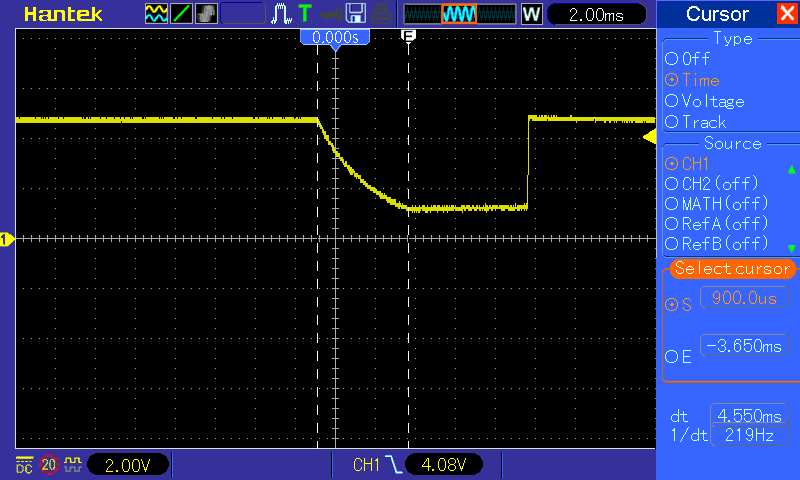
Reading with analogRead() and read_vin_mv() connects the ADC to 5v reference (Vin). Reading the temperature connect Aref to 1.1v. Lookin at Aref with a scope, it takes approximately 4.5mS to drop from 5v to 1.2v. Rising from 1.2v to 5v again take 9uS.
Adding a delay in the correct place solved the issue.
double GetTemp(boolean init)
{
	static double temp;
	unsigned int wADC;
	// Store current ADMUX in temporary
	uint8_t tempADMUX = ADMUX;
	if (ADMUX != (_BV(REFS1) | _BV(REFS0) | _BV(MUX3))) {
		ADMUX = (_BV(REFS1) | _BV(REFS0) | _BV(MUX3));
		// Bandgap reference start-up time: max 70us
		// Wait for Vref to settle.
		delayMicroseconds(350);
		delay(6); //Must delay at least 4.5mS for Avdd to drop
	}

	// Start conversion and wait for it to finish.
	ADCSRA = (_BV(ADEN) | _BV(ADPS2) | _BV(ADPS1)) ;       // enable the ADC div64
	ADCSRA |= (_BV(ADSC) | _BV(ADIF));
	while (bit_is_set(ADCSRA, ADSC)) {};

	// The offset of 324.31 could be wrong. It is just an indication.
	// The returned temperature is in degrees Celcius.
	// Reading register "ADCW" takes care of how to read ADCL and ADCH.
	wADC = ADCW;

	if (init)
		temp = (((double)wADC - 324.31) / 1.22);
	else {
		temp -= temp / 20.0; //Recursive filter averaging over 20 samples
		temp += (((double)wADC - 324.31) / 1.22) / 20.0;
	}

	ADMUX = tempADMUX;

	return (temp);
}