I'm trying to blend RGB to make other colors, so I was under the (wrong) impression that all the colors can be turned on at the same time with each one being able to dim independently. I tried connecting a power source with all three colors in parallel. It seems like R G B is prioritized, so only one color can be on at a time. Any way to turn all colors on at once? Looks like a standard emitter with R+, G+, B+, and -. I bought 10 for $16 from china.
Each of the three LEDs must have there own current control, you can not wire them all directly in parallel.
vd853:
I'm trying to blend RGB to make other colors, so I was under the (wrong) impression that all the colors can be turned on at the same time with each one being able to dim independently. I tried connecting a power source with all three colors in parallel. It seems like R G B is prioritized, so only one color can be on at a time. Any way to turn all colors on at once? Looks like a standard emitter with R+, G+, B+, and -. I bought 10 for $16 from china.
You haven't told us what the LED is. You haven't told us how you connected it. You haven't told us how you're trying to control it.
The best answer I can gave based on what you said is: "Fish".
Hi,
Adafruit has a nice tutorial for a lot of arduino stuff including RGB-leds.
Arduino boards are quite popular by the way, googling Arduino +component (and perhaps "tutorial") often shows tons of results.
I agree with simpson_jr here.
Adafruit does have some pretty nice instructions. Although, I find that Www.instructables.com has a more simple and easy view layout, and has their projects in steps that you can click.
anyway, I hope you find a good and effective tutorial!!
kind regards,
-Goldfile
Simpson_Jr:
Hi,
Adafruit has a nice tutorial for a lot of arduino stuff including RGB-leds.Overview | Arduino Lesson 3. RGB LEDs | Adafruit Learning System
Overview | Arduino Lesson 7. Make an RGB LED Fader | Adafruit Learning SystemArduino boards are quite popular by the way, googling Arduino +component (and perhaps "tutorial") often shows tons of results.
Mines are emitters, the tutorials show that they can be connected 3 current(+) in and 1 current (-) out. However, my emitters only work by 1 current (+) in and 3 current (-) out. Anyways, I figure out that if I activate each one color at a time without delay, then they are pretty much all on at once. I still have a big problem controlling them with tlc5940 because it is (-) in LED (+) out, therefore I cannot use it to control high current transistors. It can dim the LED, but the LED would not turn off completely so switching color is impossible.
Anyways, I figure out that if I activate each one color at a time without delay, then they are pretty much all on at once.
No no no.
Just connect the 1 current in to +5V then each current out to a resistor of between 299 to 500 ohms. Then each resistor to an arduino pin. Then each pin will turn each colour on when it is low.
I still have a big problem controlling them with tlc5940 because it is (-) in LED (+) out, therefore I cannot use it to control high current transistors
Show your schematic, you are doing tihis wrong.
Pleas try and use the correct words for things. You seem to have a common anode LED, what sort of LED do you have? You can not control power LEDs with a simple resistor.
Here are the connection if I'm trying to just fade one color. I am using these emitters:
http://www.ebay.com/itm/320938690780?ssPageName=STRK:MEWNX:IT&_trksid=p3984.m1439.l2649
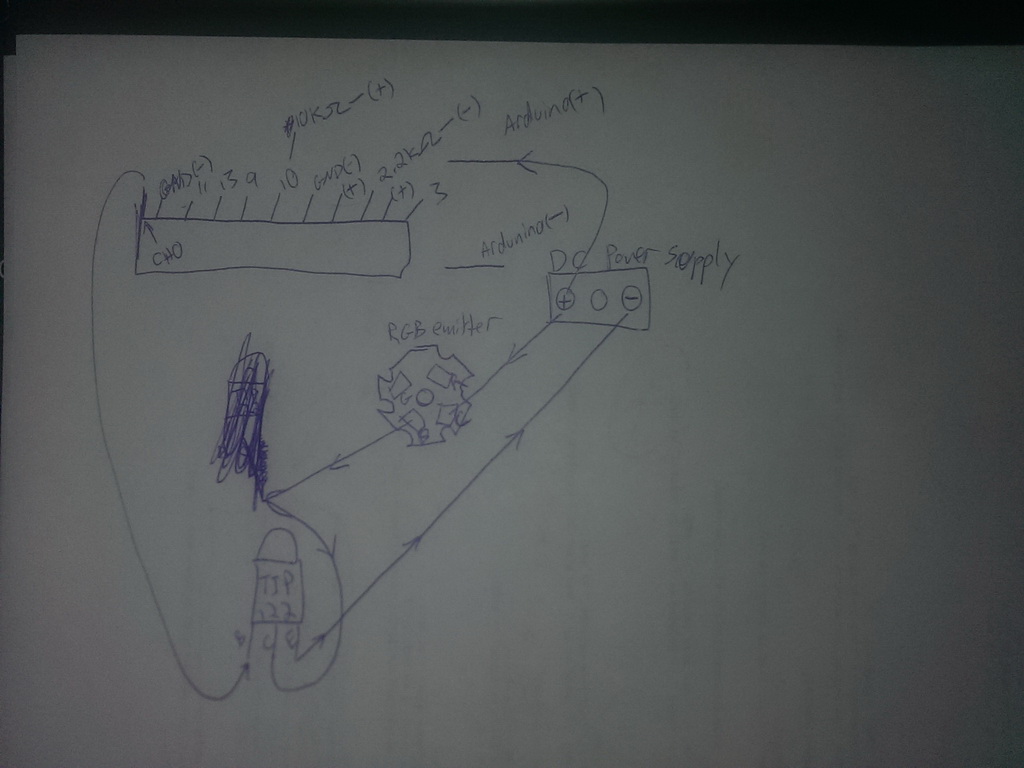
Those are power LEDs, there is no way you can control these without a constant current supply.
They should not be connected directly to an Arduino nor the transistor in the circuit you posted.
Google "constant current supply" for circuits.
They are not connected directly to the Arduino. They are using TIP122 transistors which should be able to handle at least one LED. Also, for testing purpose, I am supplying just one of them with something like this:
vd853:
They are not connected directly to the Arduino. They are using TIP122 transistors which should be able to handle at least one LED. Also, for testing purpose, I am supplying just one of them with something like this:
Why ask for help if you are only going to dismiss it?
Last time:-
You can not drive that LED with a transistor and no form of current control. At that power using a resistor as a form of current control is not good enough. You need a constant current supply.
If you know better than this then stop asking questions.