Tweezers #3
Tweezers, Must have Electronic Tools
Some of the following points will be obvious, however, they need to be emphasized.
New people to the electronics hobby might find the following discussion useful when selecting tweezers to buy.
What to get:
- Reasonable precision-made tweezers can be purchased for $10.00 to $15.00.
I use the following 3 tweezers most often.
MaAnt SS-J @ $7.50
MECHANIC KA-11 @$8.30
MECHANIC Aac14 @$7.00 - I purchased the above tweezers through AliExpress:
- Look for high quality Stainless Steel or Titanium construction.
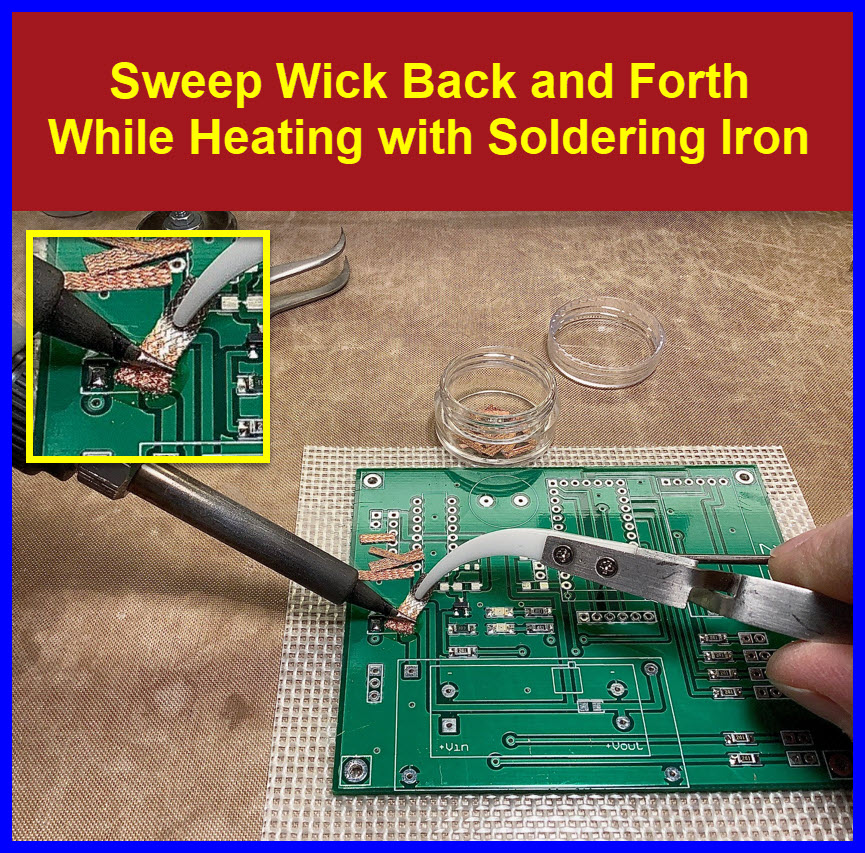
We use tweezer lengths between 11cm to 16cm in electronics. - Ceramic tweezers are great for sliding solder wick when desoldering, add solder flux paste to the wick to greatly increase its effectiveness.
Ceramic tweezers can withstand very high temperatures.
These tweezers can be fragile, avoid dropping. - Non-magnetic tweezers are a must as very light SMDs might be ferro magnetic.
You might want a set of magnetic tweezers if they are to be supported by a magnet. - I prefer non-serrated tweezers.
However, serrated tips help in grasping items (ex: soft wire insulation, cleaning wipes). - Tweezers tips can be bent inward to make them Rat Tooth tips.
This helps to prevent slippage on things like wires and when removing I.C.s etc. - Sharp tweezers allow you to pick up smaller dimensioned components like 0402 or 0603.
- Tweezers with holes in the arms provide a non-slip grip.
Polished arms might slip in your fingers. - Suggest you have 3 types of tweezers: precision tip, rough and tumble, and wide spade.
- Consider having a set of reverse (self-closing) tweezers.
Self-closing tweezers are highly effective in soldering male headers to a PCB. - In the event your working tweezers get damaged, buy a second set of tweezers to have on hand.
Suggestions:
- Close the tweezers on components lightly.
Only use enough pressure to grasp and manipulate the SMDs you are positioning.
Only use enough pressure . . ., this deserves repeating.
Let the tweezer’s resistance feedback tell you if enough pressure is being applied.
If the tips of your precision tweezers bend when you pick up SMDs, you are using too much closing force on the arms.
Too much pressure can launch the SMD across the room.
Too much pressure on an object can bend the tweezer’s tips. - To prevent dropped components from landing on the floor, work towards the center of your workbench.
- Curved Tweezers are great for reaching over other components on your PCB.
- Experiment/practice in grasping curved tweezers to achieve 45° 60° and 90° component grasping (see images below).
Do not overlook your grip on the tweezers; it can make a world of difference in comfort and in the ease of accurate component placement.
Curved Tweezers can be used perpendicular or parallel to the work surface. - A rubber “O” ring can be added to normal tweezers to keep them closed on SMDs.
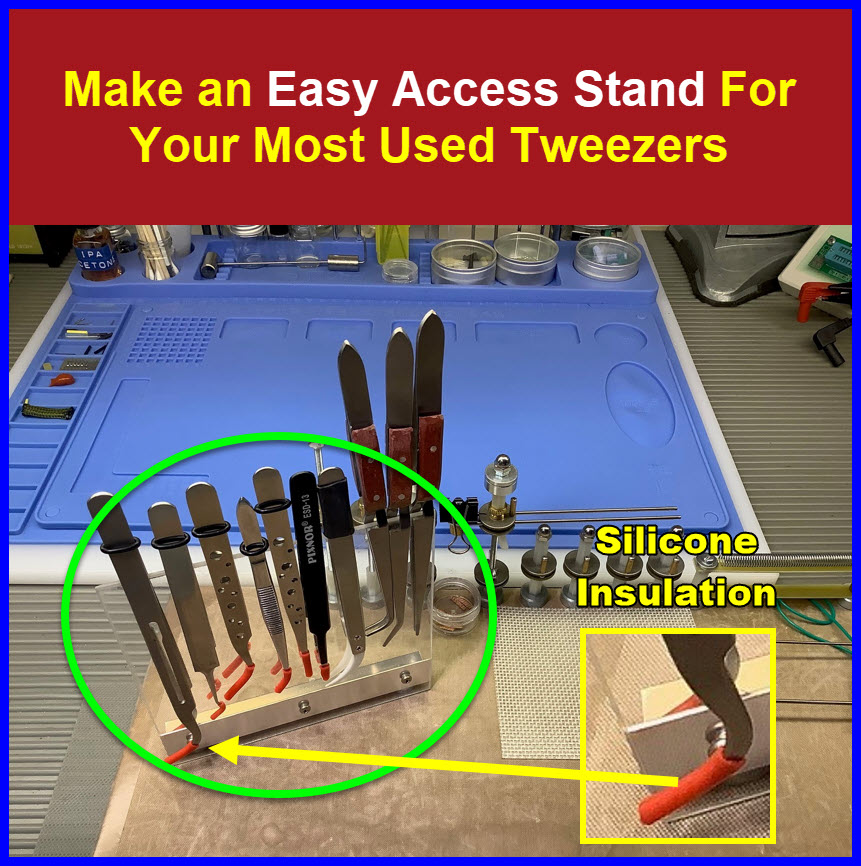
- Add stripped silicone wire insulation to tweezer tips for extra friction and to keep the metal tips from touching components.
Also gives tip protection when the tweezers are not being used. - Wear an antistatic wrist strap when manipulating static sensitive components with tweezers.
- When soldering, make sure tweezer tips do not extend below your SMD component.
If they do, you might be soldering the component above the PCB, i.e., not flush to the PCB.
After soldering one lead of the SMD, apply slight pressure to the center of the SMD component with closed tweezer tips. Remelt the solder on that same SMD lead.
Alternatively, position the SMD with the tweezers, use a magnetic hold down clamp to keep the SMD in place while soldering, see previous YouTube video. - To keep tweezer tips from sticking to components, use IPA routinely to clean soldering flux from tips.
- If necessary, you can tune tweezer tip surfaces with folded fine grit sandpaper.
Rules of use:
- Do not use your precision tip tweezers for picking up larger, heavier objects.
Avoid using them with hardware like screws etc. - Never pry with your precision tip tweezers.
- Keep tweezer tips away from flames as the precision tips can be damaged.
- Avoid using your precision tip tweezers to scratch surfaces.
Use a dental pick instead. - When not in use, store your tweezers in a safe protected location.
When not in use, protect tweezers tips with silicone, surgical or plastic tubing.