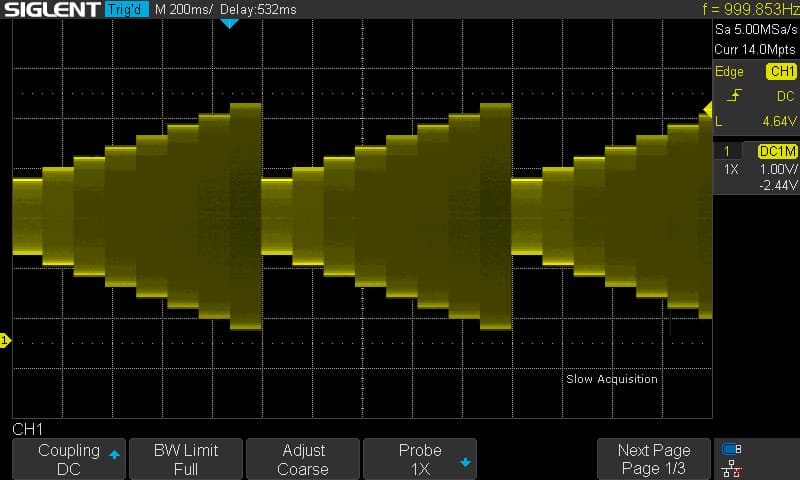
Hi
How to join orange line on serial plotter as red line drowned by hand?
Average is causing too much delay.
const int sensorIn = A1;
double Voltage = 0;

const int numReadings = 50;
int readings[numReadings];  // the readings from the analog input
int readIndex = 0;          // the index of the current reading
int total = 0;              // the running total
int average = 0;            // the average
int inputPin = A1;

void setup()
{
  Serial.begin(115200);
  for (int thisReading = 0; thisReading < numReadings; thisReading++) {
    readings[thisReading] = 0;
  }
}
void loop()
{

  Voltage = getVPP();

  total = total - readings[readIndex];
  readings[readIndex] = analogRead(inputPin);
  readings[readIndex] =   Voltage;
  total = total + readings[readIndex];
  readIndex = readIndex + 1;
  if (readIndex >= numReadings) {
    readIndex = 0;
  }
  average = total / numReadings;

  //Serial.print(" v = "); Serial.print(analog_value*5);
  Serial.print(" Amps RMS = "); Serial.print( Voltage);
 //  Serial.print("  average = "); Serial.print(average);

  Serial.println();
}
float getVPP()
{
  float result;
  int readValue;             //value read from the sensor
  int maxValue = 0;          // store max value here
  int minValue = 1024;          // store min value here, 4095.0
  //int minValue = 4095.0;

  uint32_t start_time = millis();
  while ((millis() - start_time) < 10)
    //while((millis()-start_time) < 100)  //sample for 1 Sec
  {

    readValue = analogRead(A1);


    if (readValue > maxValue)
    {
      maxValue = readValue;
    }
    if (readValue < minValue)
    {
      minValue = readValue;
    }
  }
  result = (maxValue - minValue);

  return result;
}
why are maxValue and minValue local to the function? If you make them global you might get a smooth update of peak-peak voltage without smoothing. What are you trying to measure?
OK, 1. have you biased the input voltage?
2. I think you're Algorithm in vpp gives a value close to zero when you have a value close to the top of the adc scale? Is this the intended behaviour? Could be wrong but I would like you do clarify.
can use leaky integration
avg += (samp - avg) * K K < 1
with a fast attack and very slow decay to capture close to the peak
K = 2 samp > avg
K = 100 samp > avg
you can keep track of the lastValue and if set readValue to lastValue if readValue == 0
curious what you're measuring? looks like you're reading values as quickly as possibly for 10 msec. such things are typically done with a periodic sampling rate