Open circuit voltage is just that, no output current.
The voltage will drop when you connect your pump because it will be drawing current.
I think you need to google PV how they work
A 12V panel will give its best output at around 12V depending on the solar radiation conditions.
Running a pump directly from a set of panels will not work reliably.
You can get special controllers to do the job, but most of the time you use some batteries to help with some storage.
How often do you want the pump to run, 100W solar panel will only give you about 80W in real life, a MPP Controller will help.
A 12V panel will give its best output at around 12V depending on the solar radiation conditions.
Simply not true. A "12V" solar panel (36 cells) is designed to charge 12V lead acid battery when its
cloudy, which requires 13.8V to reach full charge when the panel is receiving only 5 to 10% of full sun.
Expect such a panel to output something around 18V under full load in full sun, about 14V in cloudy
conditions.
Since solar panels are more like current sources than voltage sources, normally you'd run a
charge-controller and battery pack from the panels, and power your motor from the batteries.
starting time need to monitor voltage and current, one time establish the system then know need to monitor.
that's why i am searching one controller.
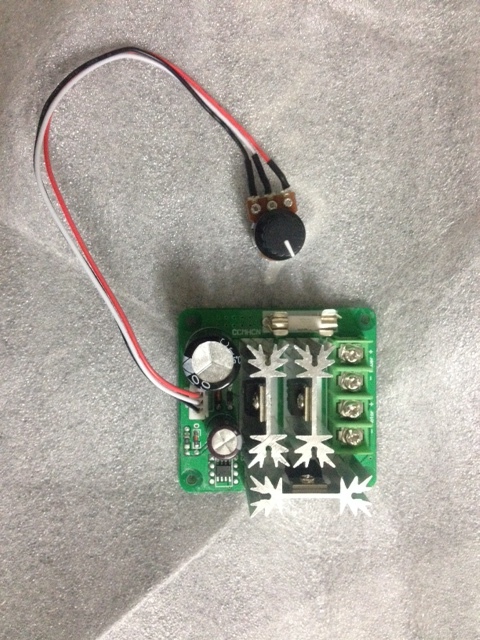
I found some controller and i try it, but it was a PWM type controller and PWM type controller was not suitable with my BLDC pump. (when i use PMW type controller pump was continuously start and stop)
If, i provide battery then cost will increase and my aim is energy & Cost saving.
I use BLDC pump and BLDC pump will automatic OFF when voltage will raise above 25V.
i connect 100W+100W panel in series so i have 200W and if, we calculate 80% efficiency then i have 160W power.
Then you'll have to use two panels in series and shunt-regulate the output to 24V.
Or find/design a current-sourced voltage output switch-mode converter,
or add some reasonable large capacitors to the output of the panels and use a standard
DC-DC converter (they come with 18..72V input range which is fine). They don't like
current sources (well they are not normally designed for them) so the extra capacitance is
probably needed to stabilize things.
Given your panels can put out about 5A in the sun and 0.5A when cloudy shunt regulation
would be enough, a big hefty darlington and a zener diode aren't too expensive (well you'll
spend more on the heatsink).
MarkT:
BTW what happens to the pump when the clouds appear and the available current drops to 0.5A or so?
TomGeorge:
If you go that way you will also have to monitor voltage and current, so that you don't run current through a stalled pump motor and burnt it out.
Exactly......
Like i said the OP has to do some research into PV and pumping.
Tom...
I put one timer for operation, Morning 8:45 AM turn on pump and Evening 4:00 PM turn off pump. right now summer going on so there is no problem with sun light, and i am also preparing temperature and LDR base circuit for sun light detection.
I made circuit(Input 40V and out put 24V) but above 2A heating( with Heat sink) was very high, so i am thinking. it is possible to connect two LM338 in parallel?
You need to do some really serious study into how Solar panels work and how they are rated, especially what STC
conditions are, and the effect of your latitude on solar power output.
A 100 W solar panel will only produce 100 W for a few hours a day, mainly around noon, and then only with the correct orientation.
As MarkT indicated earlier, you need to use a battery to run the pump, and use the Solar panels to charge the battery via some kind of charge controller.
How many hours per day does the pump have to run, and does it have to run in the middle of winter?
With projects like these, you start backwards, ie whats the total power consumption of the pump over a day
at the worst time of the year for Solar, (middle of winter), and then assume a worst case condition of 5 cloudy days in a row.