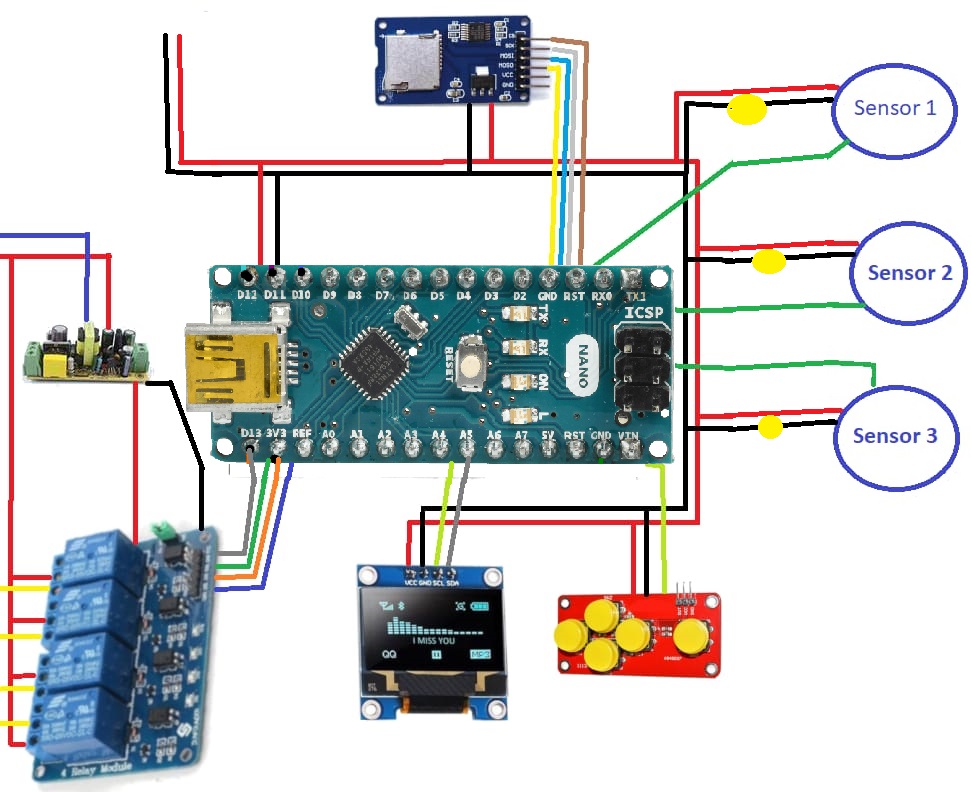
Hi everyone, this is the first time that I write on this forum and I don't know if I should introduce myself. Let me know if I should do it. However I am developing an IOT architecture where I am using the Arduino nano board, some sensors and relays. I would to turn on this sensors only when the timer of the board needs to get the measures. My target is to save the battery ampere and I read on the web about MOSFET logic level n, I would like to know if I can use them to switch on/off the sensors or should I use other component?
First, you did not identify the two sensors. You only listed specifications. It's hard to answer about turning them on/off without knowing what they are.
How are you going to power down the Nano? It has on board regulators and other components that continue to draw current even when the processor is sleeping.
If it's an IOT, it must have internet connectivity. How is that achieved? How will it be powered down?
Thanks for your answer. I Will add a wifi or bluetooth module to send data to web site lately, but at the moment I am developing the timer with Arduino nano to get values and show them. The sensors are:
Gravity: Analog TDS Sensor/ Meter for Arduino
Signal Transmitter Board
Input Voltage: 3.3 ~ 5.5V
Output Voltage: 0 ~ 2.3V
Working Current: 3 ~ 6mA
TDS Measurement Range: 0 ~ 1000ppm
TDS Measurement Accuracy: ± 10% F.S. (25 ℃)
Module Size: 42 * 32mm
Module Interface: PH2.0-3P
Electrode Interface: XH2.54-2P
DFRobot Gravity: Analog Signal Isolator
Operating Voltage: 5.0V
Response Time: 4 seconds (Typ)
Analog Error (both ends): <± 20mV (Typ)
Interface Type: PH2.0-3P
No load Current: 75mA
Dimension: 42 * 32mm / 1.65 * 1.26 inch
Non-isolated Terminal (Arduino Side)
Supply Voltage: 5.0 ± 0.1V
Analog Output: 0 ~ 5.0V
Isolated Terminal (Sensor Side)
Output Voltage: 5.0 ± 0.2V
Analog Input: 0 ~ 5.0V
This Is connect to Gravity: Analog pH Sensor / Meter Pro Kit V2 with this specification:
I power directly all the sensors with 5V externally and I reduce the voltage to 3.3V with a Voltage Regulator to Power Arduino. So each component has its own source. I thought to MOSFET to give Power or not to the sensors from Arduino.
Please have a good read of the introductory guidelines. There are important instructions there about what you have to post, in order to get effective, quality help with your question: https://forum.arduino.cc/t/how-to-get-the-best-out-of-this-forum/681311
There are other useful suggestions there, besides the one about providing a diagram...
What are the yellow blobs on the sensor ground wires?
I really, really don't want to offend you, but as a pure fact, your diagram isn't really useful for what we need to know. Mainly, you can't really confirm where things are connected (which is the main point of a schematic).
No problem, I accept your opinion and I consider all that you say like suggestion to improve myself. However the line Red and black are two Wires that they belong to the battery. Each sensor board takes the powet from term.
Okay. I understand that people have different priorities. However, if you are declining to provide a real schematic then I can't help. Also, I'm not speaking for others, but it is very likely the case that many other helpers will lose interest if you don't.
I want to show you a correct scheme, but I don't know how can I improve my scheme... Should I add the sensors ? Should I connect the Pin?
I Will be very happy of you let me see an example please...
Of course you should add everything! It would be incomplete if not.
Of course you should connect the pin! The whole point is to show how the wires are connected!
So, that's sort of better. You began to add labels to parts, but didn't bother to do that with some of the modules (see the white connectors). Then, you removed large parts of the circuit so they are not visible at all. You don't show 3.3V power distribution.
Sorry, that is really not helpful. It's really 1 step forward and 2 steps back. Did you have a look at the guide I linked to, or not? Did you see my request that you add everything? What happened?
Also, what technology of battery produces 5V? I know of none. So that isn't likely to be a battery...
One important detail, you have connected an external 5V to Vin. That is a no-no.
At the moment I connect a power supply with constant 5v. My plan is to use two battery 18650 in series if it is possible. I am sorry for my bad diagrams, but I am choosing a good architecture for my project and I would like to find all the component to built it. For this I am asking advice. I will use DC-DC step-down to use 3.3V with the termomether and other componebt to save power. I am sorry but it is a little time that I started with this field and I don't know some basis argument, like diagrams.
It's a basic skill. If you want to go further, you can't make much progress without it. Now is a good time to learn. It might be more important that anything else you do.
If you want to simulate a dual Li-Ion which would produce about 7.4V, using a 9V adapter would make a lot more sense. 5V is not enough, if you are having troubles with your circuit you will never discover what is going on if you contribute multiple uncertainties to it. The idea is to make everything that you can think of or learn about, correct. By elimination, you might find the cause. If you deliberately flaunt engineering rules, you will never solve your problem. Additionally, it makes it nearly impossible for other people to help you.
The minimum input voltage at Vin, is specified by the Arduino designers, on the Nano product information web page.


 .
.