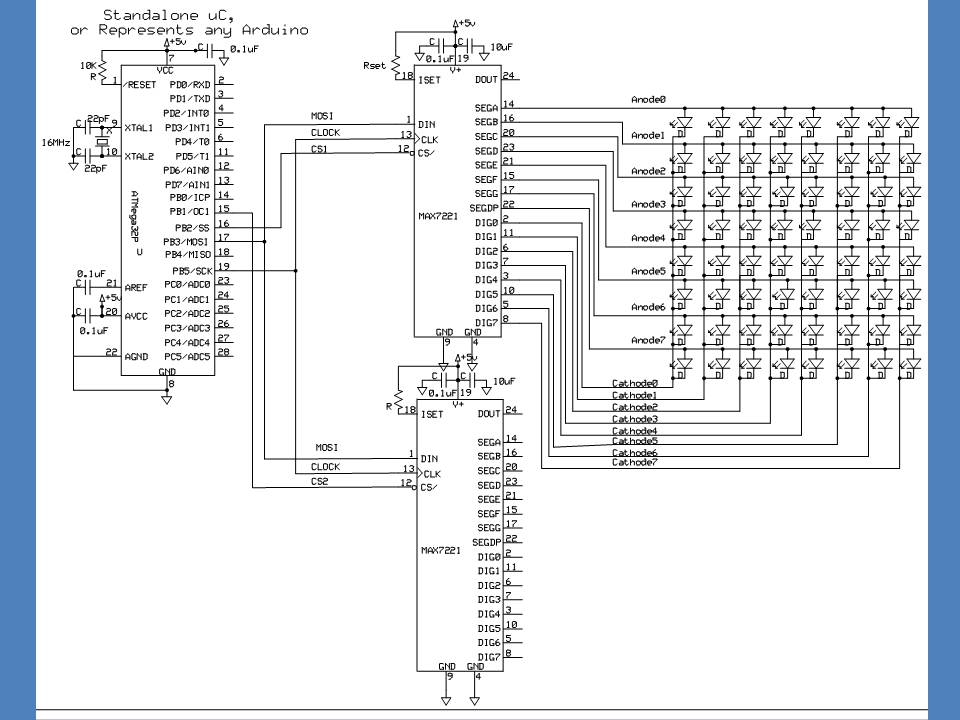
Hey everyone, I was wondering how could i construct an LED clock attached below.. I did some research and came across TLC5925 which worked soley for this type of clock. I know only basic arduino programming and I'm a Computer Science student and wish to do this as mini project. Could you please help me in learning more about connections and coding part of TLC5925. Thank you 

Where did you find this project ?
Have you Googled this subject yet ?
Did you find this ?
which (if you click on "hacked gadgets" INSTEAD of "arduino clock", leads to THIS:
http://hackedgadgets.com/2012/08/12/rgb-arduino-led-clock/
which leads to this:
http://hackedgadgets.com/alan-parekh-hacked-gadgets-author/comment-page-2/#comment-1647961
This is useless because the resolution is so bad the schemtics are unreadable:
http://electronprojects.blogspot.ie/p/arduino-led-clock.html
At the bottom where it says "Links" there is no link (that works).
BOTTOMLINE:
I can't find the code or a usable schematic. All I can find is lots of photos of the clock.
raschemmel:
At the bottom where it says "Links" there is no link (that works).
BOTTOMLINE:
I can't find the code or a usable schematic. All I can find is lots of photos of the clock.
The links work, it link to Google Doc. to clock.rar had all the files "Eagle files, HEX & Arduino code + script for LED placement & rotation"
Clock.rar (184 KB)


[quoteauthor=BillHo link=topic=261353.msg1845045#msg1845045 date=1408244563]
raschemmel:
At the bottom where it says "Links" there is no link (that works).
BOTTOMLINE:
I can't find the code or a usable schematic. All I can find is lots of photos of the clock.
The links work, it link to Google Doc. to clock.rar had all the files "Eagle files, HEX & Arduino code + script for LED placement & rotation"
[ / quote]
yes the link actually worked and i had downloaded clock.rar earlier but i couldn't understand much. Could someone please walk me through the basics of this stuff as in connections, programming . Thanks in advance
And you didn't think to tell us you already had a link to all the documentation ?
I don't know why but I couldn't open the clock.rsr file. Can zomeone upload the clock.rar file ? I can open .rar files but all I found was a.html file. No archive.
raschemmel:
And you didn't think to tell us you already had a link to all the documentation ?
I don't know why but I couldn't open the clock.rsr file. Can zomeone upload the clock.rar file ? I can open .rar files but all I found was a.html file. No archive.
Clock.rar (184 KB)
Cool design
I managed to read the rar file ok. Basically there are 9 P-channel mosfets supplying the high side (RGB for each of hour,min,sec) and then 180 low side channels (60 for each of hour,min,sec) controlled by 5925s, plus another two 5925 driving 4 digit 7 segment leds.
The PCB is 20cm diameter, so it would cost $20/PCB at cheap suppliers like iteadstudio.
@ Billho & Sugosh,
Thanks for uploading those files. I was able to download and open everything (except the board files because I don't have Eagle).
I don't know if anyone notice the digitalWriteFast Library ? (in the code)
Library link:
https://code.google.com/p/digitalwritefast/downloads/list
According to Reply#1 in this post, you don't have to worry about this :
#include <avr/wdt.h>
For anyone who plans to include the DHT11,
The PWM for every LED is overkill.
Two MAX7219 can drive 128 LEDs with 15 levels of brightness control.
I have this little breakout board that allows individual LEDs to be connected and then spaced out as needed.
http://www.crossroadsfencing.com/BobuinoRev17/
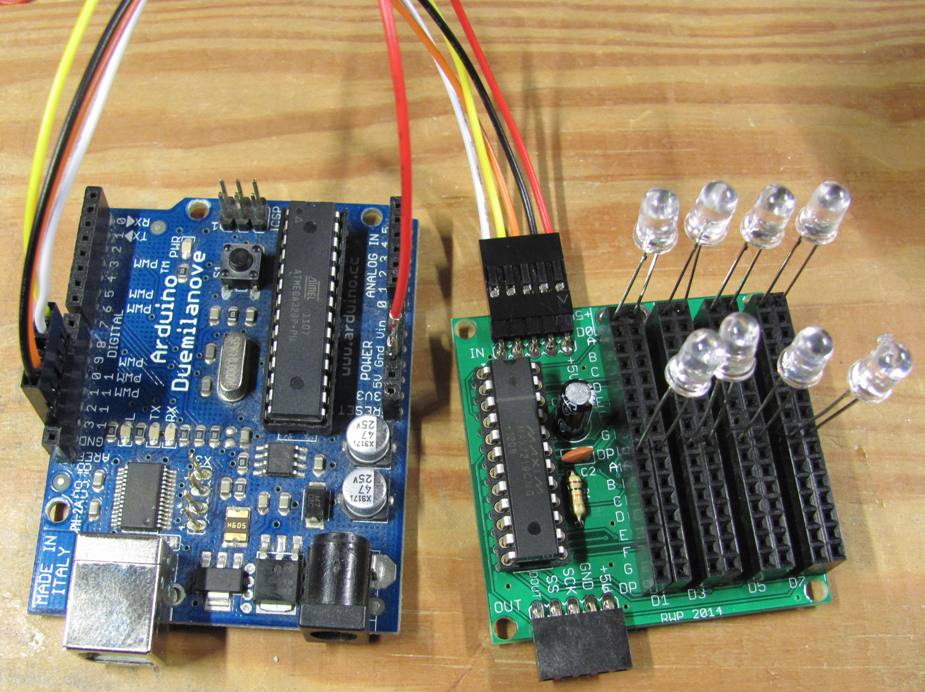
Or just wire up 2 MAX7219s per the attached schematic, keeping the matrix wiring intact.
A 16 byte array is then used to keep track of which LEDs are on/off on a second by second basis, and send the updated bytes to the MAX7219s using SPI.transfer.
Pretty straightforward.