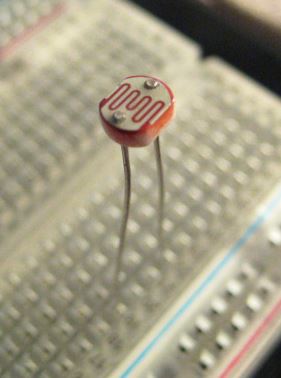
There was a photo-resistor that came with this Arduino Uno kit I got awhile back. Looks like the one in the attachment. Anyways i'm trying to find a SMD version of it and I'm having a hard time locating one on mouser. Can someone help me out with this? I've never ordered a photo-resistor before especially in a SMD package. Thought maybe someone has done this before.
The one in the kit I got works great in my test application so would like to keep the specs as close to it. I can't seem to find out much about this one I got in the kit. I measured the range of resistance in no light and max light conditions and it went roughly from ~470ohms --> ~6.22Kohms I would prefer a 0603 SMD size but i'll go with whatever I can find that is close to this.
I'm designing this PCB in Eagle and would prefer a part that already exists in the libraries but its looks like i'll have to build my own part in Eagle which is cool. Therefore, if anyone can point me to a link where I can order this thing I would greatly appreciate your help.
Yes, these are photosensors.
I don't know what you want to do with them.
Both LDRs and semiconductor sensors can measure light.
LDRs are pure resistors, and are not polarised. You can use them as normal resistors. And they are cheap. http://www.ebay.com/itm/20PCS-5MM-Photoresistor-GL5528-LDR-Photo-Resistors-Light-Dependen-t-/321503245893?pt=LH_DefaultDomain_0&hash=item4adb163645
Photo diodes are polarised, but can in most cases replace an LDR.
Study the specs. Things like the peak wavelength (colour) might be important.
Depending on the light intensity, semiconductor sensors might need amplification.
LDRs are slow. Semiconductors are relatively fast. e.g. remote control receivers have semiconductor sensors.
Leo..
I would have thought "cadmium sulfide cells are SO 1950's that nobody uses them anymore except in EE-101 classes and certainly there would not be SMD versions for modern production use".
I would suggest redesigning the circuit to use a silicon photodiode. That way you'll
respond to the whole spectrum too, CdS only does blue/UV due to its large bandgap,
and is very slow to respond (5 orders of magnitude slower than Si or thereabouts).
CdS is also strongly temperature sensitive, which photodiodes are not.
Photodiodes are faster and more linear, but phototransistors have lots
of gain so are simpler to use in low light (indoors). If its outdoor use I'd suggest
diode, indoor, perhaps transistor.
One advantage of CdS, thinking about it, is they do not respond to the
flicker of fluorescent lighting owing to the slow time constant - you get low-pass
filtering for free.
Here is a PDF showing the structure of the CDS cell and a description of how it is made. The heat of the reflow oven used to solder a SMD device would destroy the CDS device!