Not unless they are simultaneously in two different countries or faking their IP addresses
please... don't confuse me even more. thanks.
can you convert that circuit in drawing 2 of that webspage into an actual - easy - example, say a simple sensor powered by 12V with a signal cable going to the Arduino and GND connected to the negative terminal of the external power source. With resistors and all that. I mean, that drawing 2 almost represents anything to me. I don't see any resistors, voltages across components ... I need something "handy", you know  if there's no voltage coming from the 12V circuit I need to know why
It depends on the device.
If the datasheet for the device does not state that a voltage is present, then you have to assume there won't be a voltage. You can't make generalizations for every 12V device in existance.
that drawing 2 almost represents anything to me.
It is supposed to represent anything.
example, say a simple sensor powered by 12V with a signal cable going to the Arduino and GND connected to the negative terminal of the external power source.
My generic diagram would look exactly the same.
If you have something specific in mind, I will study the datasheet and determine the proper way to connect it to an Arduino
I don't know, please take any you like, preferably the easiest example you know. Perhaps one where there is "no fraction of the power source voltage across the signal line" as you said above.
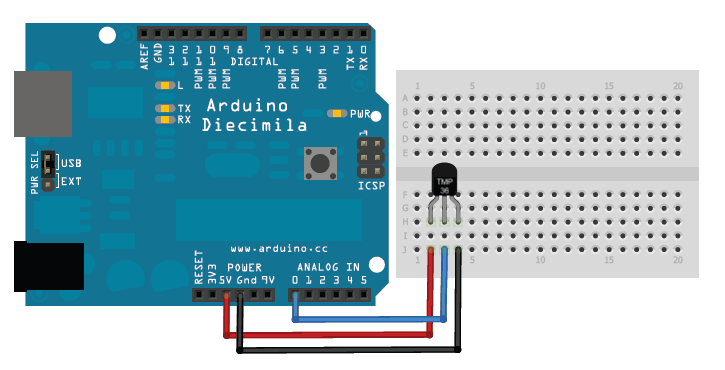
ok, thanks, that doesn't have an external power source though. But I believe I'm slowly getting it. The probable mistake I've made can perhaps be seen in the following two drawings I just made:

the upper drawing is what I assumed previously and probably shows the situation as with the flow meter. The lower one is, if I see that correctly "voltage-free" in regards to the external power source. I guess that's even the case without the diode because incoming current would be cancelled out by outgoing current. Is that what you meant by "no voltage across the signal line"?
What is the little square block. Can't make out your handwriting.
"no voltage across the signal line"?
I don't remember saying that.
see post #52
the square is a sensor
What kind of sensor?
One that produces energy? Like a thermo couple?
Or a wind turbine?
Most sensors come with 3 wires...
Gnd, vcc and signal.
Or two wires and you have to add a resistor to vcc. (Ptc, ntc, ldr, photo diodes etc.).
a photoresistor for example (with internal resistor if you like  )
)
No fraction of it should be across the signal line, because it is an input and not an output.
You are right I should have been more precise.
I should have said that no fraction of the 12V supply would appear between the signal wire and and gronnd wire because it is an input and not an output.
Then I don't understand your diagram. What does the 12V device do?
The sensor has no power source!
I was just replicating the situation of my flow meter, sorry, there should be a third terminal for the 5V pin. I was just trying to get rid of the necessity of additional components like a resistor which is also inexistent in drawing #2 of said wegpage.
that's okay, because that's what I understood. So I was just trying to figure out how to accomplish that in my last two drawings: no external voltage on the signal line.
Your drawing do not indicate if a voltage would be present or not and unless you specifically state so we can only guess
I'm lost, what do you mean?
Basically I don't understand your diagrams.
You have a sensor and a 12V device. The sensor is connected the the arduino but the 12V device does not seem to serve any purpose. Whether the ground wire is connected to the arduino or not would not affect the sensor in any way.
Maybe you could work with this schematic of an Arduino plus two sensors that are powered by 12V. One has an output that can be safely connected to the Arduino with no additional components and one has an output that is too high and must be scaled to be safely compatible with the Arduino input.
Assume that +5V and +12V come from suitable power supplies and have their ground common to GND on the schematic.

1 Like
please feel free to give it a purpose. You haven't yet shown a diagram as I had asked you to that shows an example for an actual sensor which is powered by an external power source and which corresponds to drawing #2 on that webpage. The example you showed was a sensor powered by the Arduino. I've given it a shot, obviously you don't see it work, so please show me one that does. I'm running out of ideas 