Smaller Arduino like Uno has 19 pins that can be used for input and output. The next one I know of is Mega and Due which has over 60 pins available. Is there any Arduino in between that, around 30 pins?
1284 would work for me. I need to get that board when it's available assembled for prototyping, and to figure out how to program the DIP version for finished project.
Same 3 wires + reset + power as other chips via ISP I hope.
Interesting question. Because what Arduino is, the official boards are only part of!
Arduino Products Page -- many details, pin maps, etc.
I'm pretty sure that the UNO has 20 I/O pins, all capable of digital I/O and Mega2560 has 56.
The ATmega328 is very capable and cheap and at the heart of much Arduino and the larger ATmega2560 was the big dog until the ARM Duinos came out. The 2560 can directly address external RAM, Rugged Circuits makes (made?) plug in RAM modules with up to 8 banks of 56KB usable RAM.
And the rest? The in-betweens? That is the world of Compatibles and DIY!
In this tutorial, Nick Gammon (member here) shows how to "roll your own";
How to breadboard your own Duino with 328P and 1284P examples and all software.
The ATmega1284P in DIP form has 40 pins, 36 are I/O when an external clock source is used.
It has 2 serial ports to the 328P's 1. Not that all ATmega serial ports are master mode SPI capable.
It has 16KB RAM, 128KBflash and 4KB EEPROM. No other AVR has so much internal RAM.
I find them at Futurlec (in China) for $6.90 each where 328P is $2.20.
(You can also buy 1284P boards from the member here named Crossroads, the Bobuino.)
That should get you started if you care to try, there are core files for most all the AVR chips. The range is from 8 pin ATtiny's on up though if you stick to DIP chips then 40 pins is the limit. If you can do surface mount then you can do more chips and have my envy.
Futurlec ATMEL page with datasheet links and prices.
If all you want is more pins and perhaps RAM and don't mind trading some speed for more capacity then you can hang shift registers (aka pin multipliers) and serial RAM on your SPI bus... along with your SD adapter and co-processors and other SPI bus addons.
A 328P is very capable here and remember that 328P has the same 'brain' as the 2560.
Really, I have seen a number of times that a Mega2560 was used when 2 x 328P would be better.
And now I see Budvar10's post! Yo Man! Where you find that? Ooooh-la-la!
GoForSmoke:
And now I see Budvar10's post! Yo Man! Where you find that? Ooooh-la-la!
Thx. :-[ It's my own.
@wilykat
You have a message.
Or DIP based 1284P:
http://www.crossroadsfencing.com/BobuinoRev17/

Or smaller

Or smaller

Or maybe larger, with SD card, battery backed RTC, RS232 buffer, signal-power-gnd at all headers, with or without screw terminals, USB on board or off board options
http://

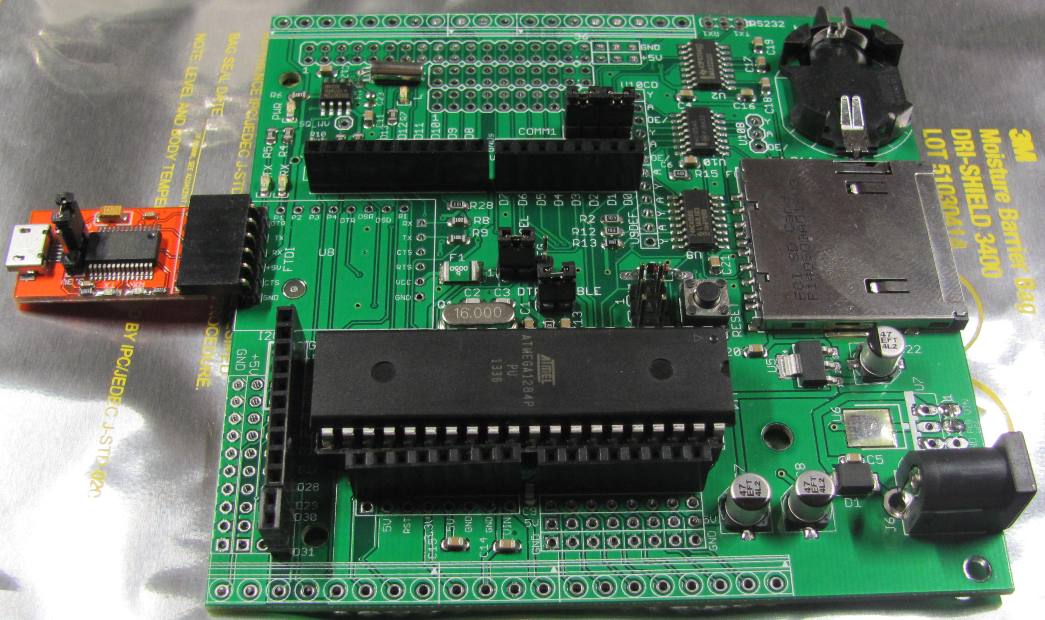
1284P has 32 IO when external clock is used, the other pins are VCC, AVCC, Gnd, Gnd, Aref, Reset, Xtal1, Xtal2.
Atmega has 0-53 as digital, and A0-A15 that can be analog in or digital. 70 total.
I didn't think Futurlec was in China: http://www.futurlec.com/AboutUs.shtml
Or just a port expander?
Depends what the user wants to do. Port expander won't provide 2nd serial port, or fast 16K SRAM, and accessing the IO will be slower, way slower compared to direct port manipulation if program execution speed is a concern.
Everything is an engineering tradeoff.
Yep, it sure is. But in the opening post he was only talking about IO. Not RAM, Serial etc. It's indeed slower, especially if you use a I2C version. But a SPI version can be a couple of times faster then the I2C version. Of course, still slower then direct port manipulation but okay for a whole lot like reading switches and blinking leds.
CrossRoads:
1284P has 32 IO when external clock is used, the other pins are VCC, AVCC, Gnd, Gnd, Aref, Reset, Xtal1, Xtal2.Atmega has 0-53 as digital, and A0-A15 that can be analog in or digital. 70 total.
I didn't think Futurlec was in China: Futurlec.com - About Us
Okay, I should look up # of pins from yesterday on.
I order from them and guess where the bag or box comes from?
For single AVRs, they have good prices and big selection.
All my shift registers are SPI capable. Default /4 SPI clock on 16MHz Uno is still 512KB/s.
As usual, what are the needs of the project? I got output shift registers 5/$1 at Yourduino.
Last time I ordered from Futurlec (thinking they were in NYC for some reason) it took what seemed like forever for the parts to be delivered from Australia, vs a few days from Digikey or Mouser or Dipmicro in Niagara Falls or TaydaElectronics (which shipped from Colorado, maybe a reshipping point from Thailand for them?).
So depends on what kind of delivery time is needed.
I like SPI for shift registers, I run them faster even, 8 MHz clock, for 1KB/s on PCBs. I like SPI for all kinds of things. Sometimes for DACs and ADCs you have to run slower. Depends on the part being used.
What if any kind of comm-connection do the 328's on your dual-328 board have?
You can set up whatever you'd like; Serial, I2C, SPI, etc. I think I put in plenty of pins to support them all.
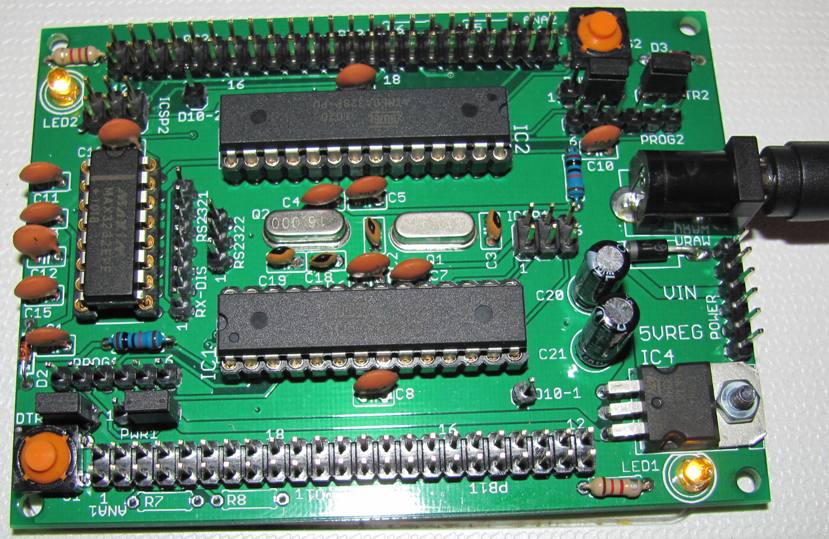

For offboard comm's - there is also an FTDI header for each chip for USB comms, and a RS232 buffer if you want serial to go thru that instead.
For running parallel, I can't think of a better AVR bus than SPI.
The RS232 would be cool if I still had my Wyse 100.