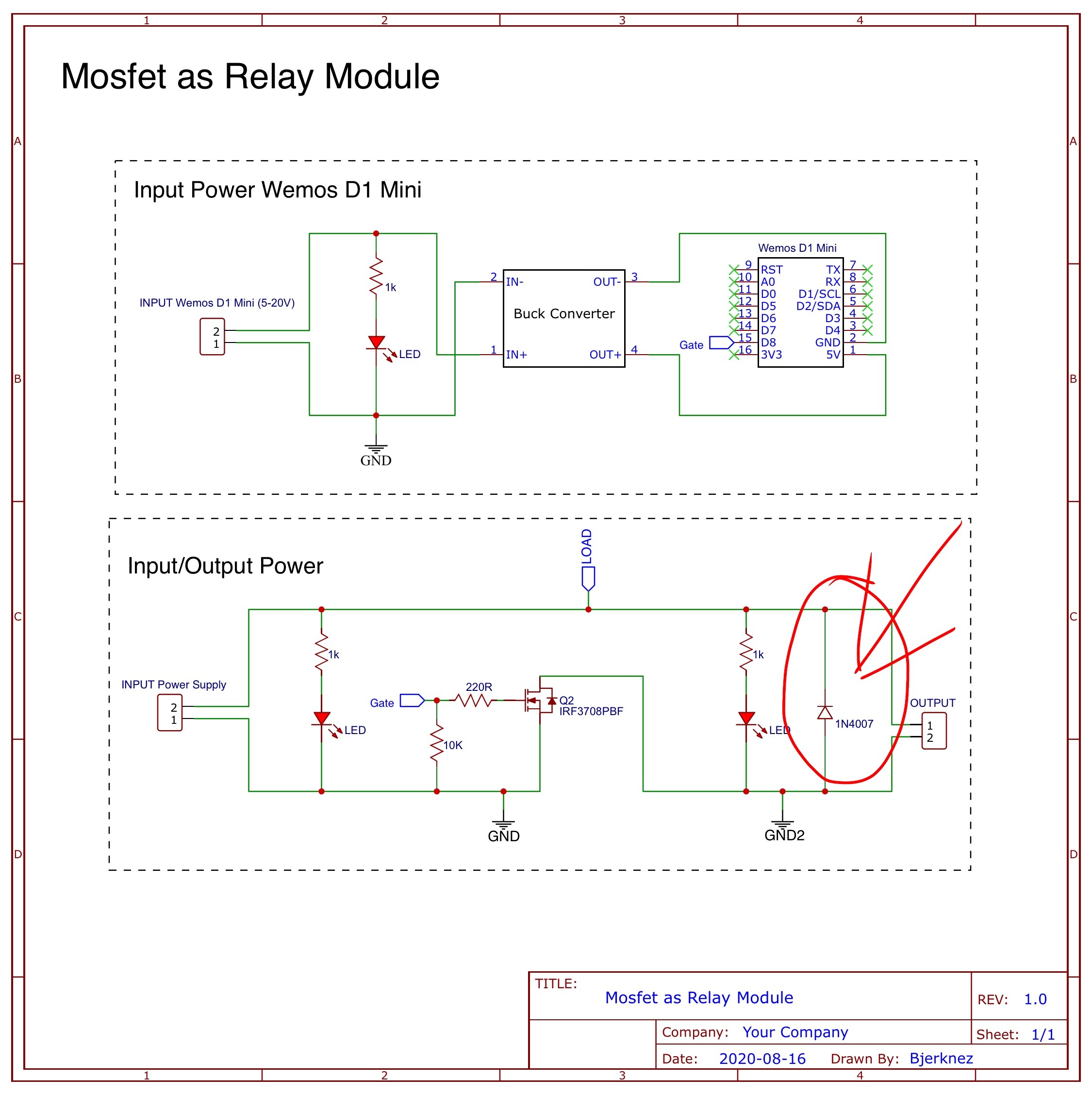
I know that a diode only allow current/voltage go one way. I made this schematic for a long time ago, and i just do not remember the function of the diode in the chematic under.
This is an general "Mosfet as relay" module.
Can someone explain why that diode is important in this spesific circuit?
Looks like a free wheeling diode for an inductive load connected to the “output” terminals. The GND2 symbol makes no sense as shown, adding to the confusion.
Yes, this diode protects the MOSFET from self-induction emf when the inductive load is disconnected is switched off by the MOSFET. If the load is active, it is not needed.
"Lost in translation" by Google Translator.
Of course, "the inductive load is disconnected", should be read as "the inductive load is switched off by the MOSFET".
Thank you.
Actually arcs are very destructive, sometimes generating high levels of RF voltage, so it may apply a whole mess of alternating voltages, so both forward and reverse over-voltage can happen - a TVS diode or MOV might be needed to increase the protection against an arc - a freewheel diode isn't enough.
But this is not going to be relevant here as this can only happen while the FET is switched on and "locking" the voltage at the output terminals to the supply voltage.
Just to note that the MOSFET already has a body diode that'll protect it when switching inductive loads. You should probably remove the GND2 symbol (output pin2) as this is actually the switched output (LOAD) signal (see reply#2). Also, output pin 1 is actually +DC power.
Gladly, it really is true, that the body diode protects it (the MOSFET). I didn't say to remove the IN4007 which is still needed in this low-side switching application.
The problem can arise when an inductive load is used at the drain side of the device, and during the MOSFET switch OFF periods the inductor's reverse EMF passing through the MOSFET body diode becomes too high, causing a sudden rise in the MOSFET's junction temperatures, and its breakdown.
I still don't understand. An inductive load doesn't create a reverse EMF over the switching transistor, it creates the reverse EMF over the inductor itself.
At the transistor, this looks like a high forward EMF. Assuming a positive supply and a low-side switch, the inductor creates a very high positive voltage (higher than Vcc) at the drain/collector when the transistor is switched off. With a high-side switch, the inductor creates a high negative voltage (lower than GND) at the emitter/source. In both cases this reverse biases the internal diode.
That is why, when a switching transistor needs protection, the protection diode is never connected across the transistor, it is connected across the load. A diode across the transistor does nothing to protect it. This is very well known.
It is known that a flyback diode connected in parallel with an inductive load reduces the self-induction emf to the level of the forward voltage drop across the diode and somewhat slows down the current decrease. This is a well-known practice that has been in use for decades. What is there to argue about is unclear.