WS2812B Project Breaking Issues

I've been building a stand alone arcade controller with a raspberry pi built in. You plug in any monitor or tv to the back HDMI port and just play.
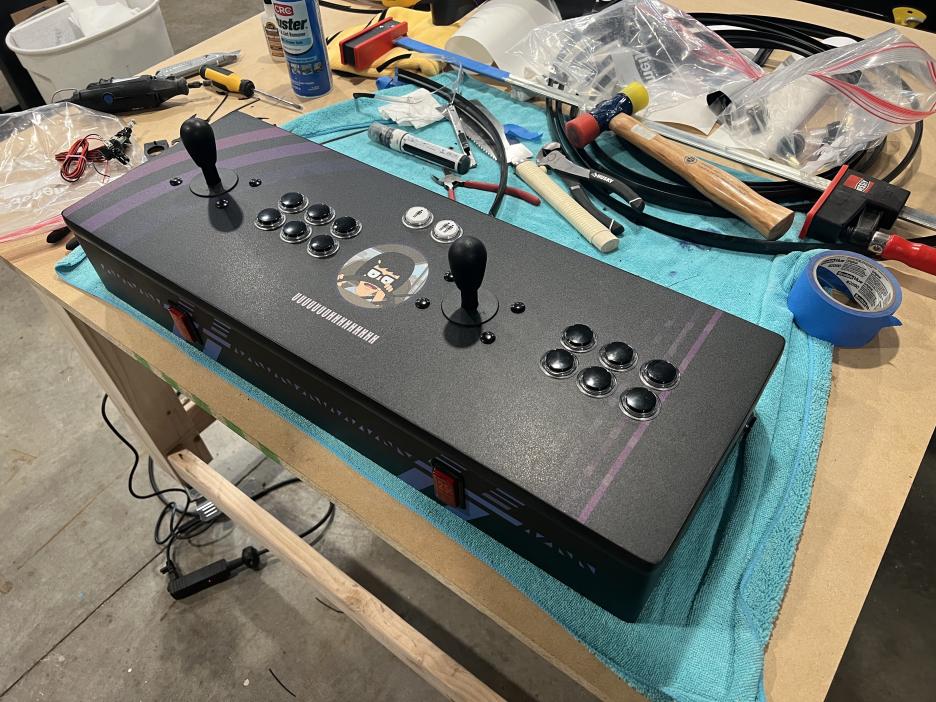
I decided to put some WS2812B strips on the bottom and program them with a button changing the code that is running.

I'm using the Arduino Uno.
This is cool looking and all, but I've burned through 5 rolls of leds. They work correctly for about 10 minutes on average and start freaking out.

I'm using 4 runs of leds, cut and soldered so I can make the 90deg turns.

The first section of leds always seems to be fine, but any that are added and soldered past the first section, after about 10 minutes, they start flickering and eventually just stop working.

As seen here...
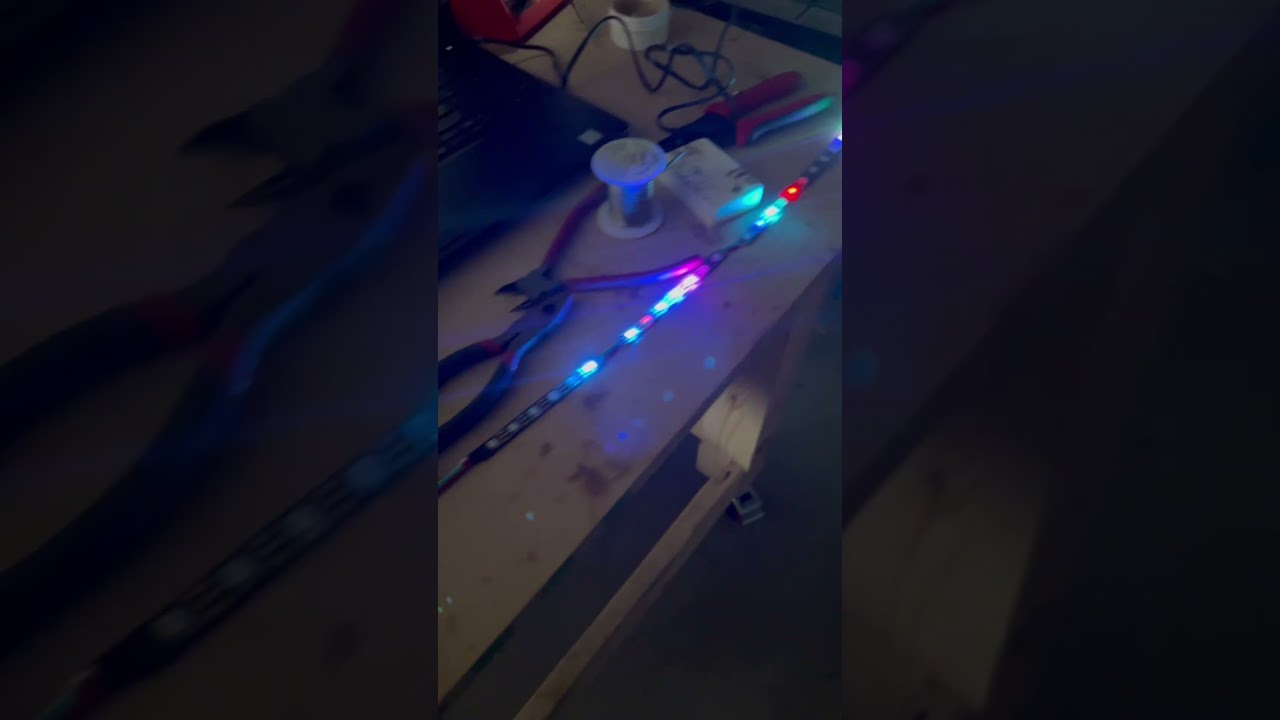
I have an extra Uno that I've been testing with outside of my arcade controller. The results have been the same. I am not using my button in this testing. Just running straight to the board and letting it run one program of lights.

Data Line - 220 resistor in line. (I've tried going up to 470, same result)
Power is coming from the Arduino, I've got a 1000uf capacitor between the ground and 5v line.

**I'll add that having those in line or not hasn't mattered.

It also doesn't matter which program I have pushed to the Arduino. Could be the one I've modified or a stock example from fastled. The issues continue exactly the same.

I've tested with my meter, getting a good solid voltage to the leds.
Consistently, they run for about 10 minutes and then any section past the first freaks out and usually doesn't come back.

Are they just bad rolls of leds? I'm at a complete loss at this point.

It's been 3 12 hour days of testing and trying things. Thanks for any help.

I guess you have a "monday-morning-product".
I use them quite a lot and they work for years and more.
As long as 5V is 5V and GND is 0V there can't be anything else to destroy it.
One thing maybe: if you drive them to max brightness they can get hot when the strips are in free air, but you can feel that (voltages are not lethal :wink: )
I seldom (=never) use a dataline resistor. they are included in the strip, as far as i know..

Check your 5V (and ground) and make sure it's holding-up, especially at the far-end where the LEDs are failing. It's normal to get some voltage-drop through the thin conductors built-into the strips but if you've got a good-solid 5V at the beginning it should be OK for at least a meter...

The data is buffered through each stage so the data resistor only affects the 1st LED. I'm not sure about the purpose of the resistor... Maybe it's only so you don't accidently short-out the Arduino?

But since the data flows through the LEDs/chips serially, that also means that one bad LED/chip can kill or corrupt the data to the following LEDs.

it is actually worth checking to see if it is just one led on the strip is broken or that all of them are. cut the first faulty one of and check the first beyond that.

I have not destroyed any strip other than thru incorrect connection, which does not apply here really.

could it be that there is excess solder flux left somewhere and that is has melted and shorted ?

that is a bit iffy. How much current are you using you think ? and where does that 5v come from ? The PI i guess... it is better to power the UNO and the strip from a dedicated 5v power supply, still that shouldn't cause the issue, i would look more closely at the soldering. Are you injecting power at the 90 degree turns as well ? how many leds per section etc ..

I’ve been working on this with someone on Reddit for awhile.

Here is what’s been done.

3 different power supplies including a bench top supply have been used for the following test.

Cap in power line, 1000uf. Also without.

220 resistor on data line. Also without.

Running 12 LEDs. Nothing added on the end.
This seems to run with no issues.

Running a strip of 6 and a stop of 8 city and connect between.

It tends to run for about 5-10 minutes without issue. Then the second set continues to freak out and not do what it’s supposed to. I’ve done this run a few times with fresh LEDs. Sometimes the first set in the run also fails and strobes and stuff like the second. Sometimes. They will randomly work correctly if left on.

I’ve solder to the front contacts, to the back contacts. I’ve done no solder and used some heavy thing to hold the wires on to eliminate any potential heat issues from soldering.

Here is the Reddit thread, it will get you completely caught up on what’s been done, has videos and commentary included.

an unsigned int rolls over after 65535

if there are any wrong time calculations in your sketch - it might just be a program error after 65000 milliseconds ... roughly 10 minutes.

make a schematic of your setup how you have wired all.
make pictures where we see each and every module + wiring and power sourcing.
upload the smallest sketch where this happens and state exactly when it happens - reproduce able all the time!

A few things I've done here. I've got both 5v and 12v led strips.

I noticed a couple of things. I took the 12v strip (sharing same ground with Arduino supply) I hooked it up with no splicing, just the straight roll of leds. It ran for about 35 minutes until, it started to flicker and not function correctly anymore.

I did find some information online, it was suggested to separate the first led. So I cut the first led, soldered it into the start of the circuit, then put he rest of the leds soldered on after that. It turns out, the first led always keeps functioning just fine, it's always everything after that, it goes wrong after 5-20 minutes. I'm not sure what to make of this.

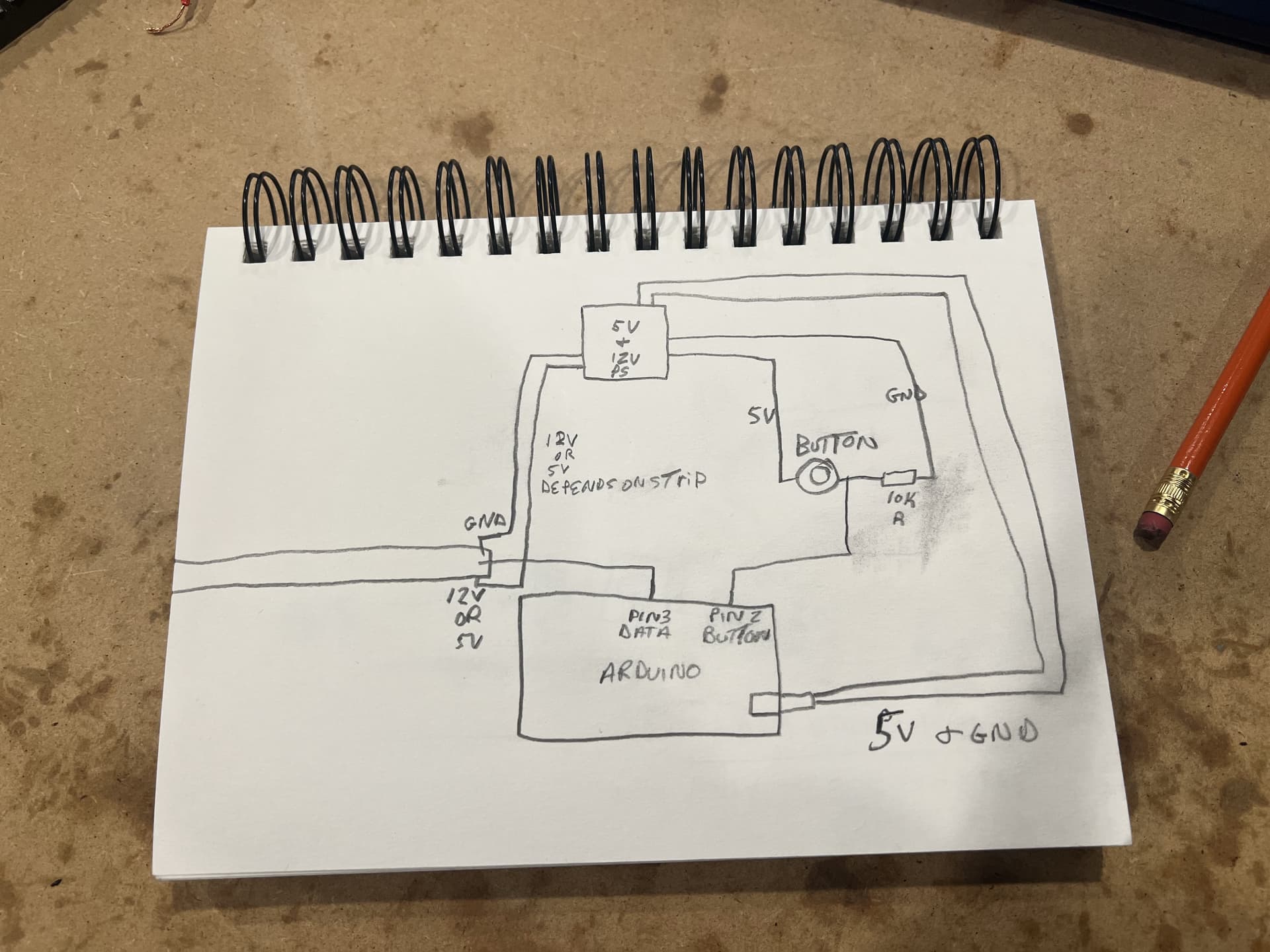
I drew up what's going on her. Keep in mind, I've done a lot of testing with the button, not plugged into anything, just to eliminate any potential issues.

What you are describing is unexpected and must in someway be hardware related. You did not tell me if it is only the first LED of the 2nd strip that 'fries' or the whole strip. (i did request that info) , Clearly either the output of the last LED of the 1st strip becomes faulty, or the input of 1st LED of the 2nd strip, or the whole 2nd strip, but that sounds rather unlikely. I can not explain it in any other way than that something goes wrong with your connections, either through overheating (maybe already during soldering) or through a bad contact possibly on the GND line, or because of electromagnetic interference. I have never experienced this myself other than with long data lines of a thick wire gauge, which in your case does not apply, or as a result of short circuits between data & VCC (or GND) or because of bad connections.

You have not shared your code, so we can not rule that out as a possible cause.

as a rule we don't visit other forums from here. We help you here the best we can, you provide us with the info the best you can. If you cross-post on another forum it is your responsibility to keep everybody updated, we are lazy. (and with 'we' i mean most users and moderators, and by 'lazy' i mean that we don't go surfing to find what you have already done.)

65 seconds, no? a bit more than a minute?

How many LEDs powered from the Arduino(5V output, correct?)

This topic was automatically closed 180 days after the last reply. New replies are no longer allowed.