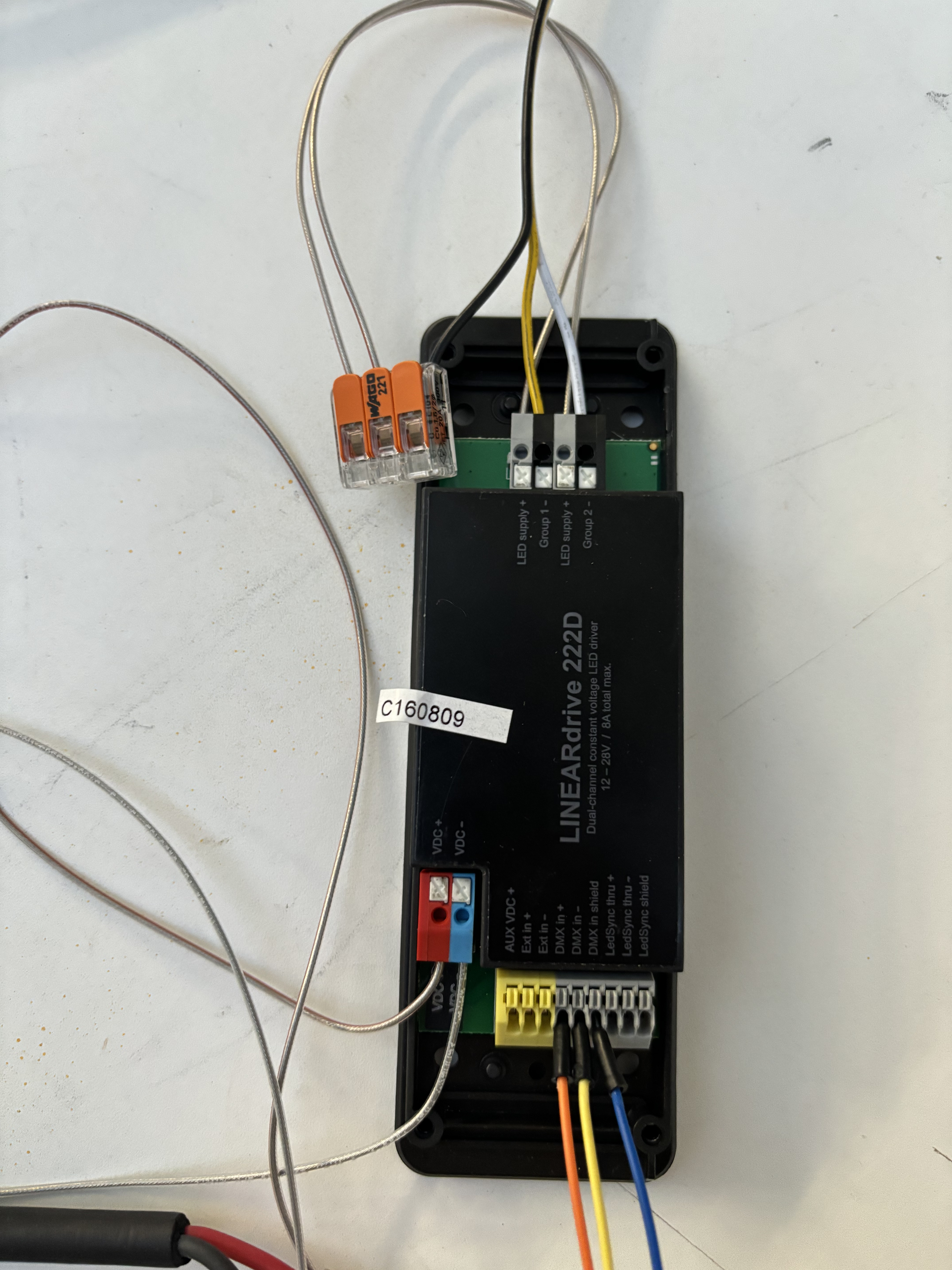
Im currently working on a project in which we need to control around 4M of Tunable White LED strip. We have the model all made up, we just need to get the program working.
The hope is that we use a potentiometer to input into the Arduino Uno and then those values dictate the signal it send to the DMX Driver (LINEARDrive 222d). The values sent to the DMX driver would then alter the colour temp of the white light as well as dim or brighten the output. I've had a look around and as of yet, I haven't found anything of any use. I am by no means an avid Arduino user so some help would be appreciated.
Would any additional components be required to get this functionality or does the Arduino paired with the LINEARDrive have enough control?
I moved your topic to an appropriate forum category @rohanholl.
In the future, please take some time to pick the forum category that best suits the subject of your topic. There is an "About the _____ category" topic at the top of each category that explains its purpose.
Thank you, I'll experiment with that now, how would we wire the arduino into the DMX driver? Shield to pin 3, DMX + to 5V and DMX - to GND? all the talk of analog pins has somewhat confused me. It sounds like things are being connected directly to the arduino?
From what I can tell the LINEARDrive is for driving series LEDs (or high-power LEDs), with constant current/controlled current. That's NOT how most LEDs strips are wired.
Addressable LED strips have drivers built-into the strip (but not DMX). They can be controlled directly from the Arduino with no additional hardware. (i.e. NeoPixels)
Most non-addressable strips have current-limiting resistors built-in and are "voltage operated". Those can be controlled from an Arduino with MOSFETs (or with a relay if you don't need dimming).
If you are using DMX, you need DMX on both ends (a DMX controller and one or more DMX devices).
You can get a little DMX driver-interface board for the Arduino, which can be used as a controller or on the other end as a device (built-into a light, etc.), depending on how you program it.
So we are using high output LED strips. at the moment were, testing with 24V, 16W/M tunable white LEDs, hence the LINEARDrive. all of this is powered by a separate mean well HLG-240H-24A. If we were using adressable LEDs like neopixels, I'm aware of the native arduino functionality. Unfortunately we've not really got any other option than DMX
Well let me see if i got right what you intend to do.
PotMeter -> Arduino -> the DMX Transceiver (MAX485 or equivalent) -> DMX-slave (LINEARDrive 222d)
hmm just googled LINEARDrive 222d and ended up here. It takes a 0-10v input as well as DMX and DALI, let's focus on the DMX (industry standard for clubs and theatres)
The MAX 485 transceiver can be wired to the TX pin on the Arduino to pin 4 of the MAX485. Pin 1 of the MAX485 should be connected to GND, and pins 2 & 3 should be pulled up (a 10K resistor to 5v) to set it to drive (transmit mode)
Pin 8 is VCC that goes to 5v, pin 5 goes to GND, and pins 6 & 7 go to the twisted pair for the DMX cable.
Pin 6 to XLR pin 3 & Pin 7 to XLR pin 2. XLR pin 1 is for GND from the transmitter.
The transceiver will use about 65mA in driver mode.
How much do you know about DMX (or DALI for that matter which is the industry standard for lighting systems in buildings like musea and such)
If what you explain is right, you may be able to just use a potentiometer straight onto the controller to dim the leds.
is the MAX485 a necessity to get the arduino to talk to the LINEARDrive? we don't have one at present...
And in response to you're questions about DALI and DMX, im not super clued up but I have a basic understanding as well as access to people with a wealth of knowledge on both protocols.
If you want to use DMX it is, or at least some kind of RS485 driver/ transceiver. Dali can be done with a simple 12v source and an opto-coupler.
That is one of the questions. If there is no DMX master available why would you go thru the trouble of creating one if you are only going to use a single channel to drive a single unit that also takes a 0-10v input (also that can easily be done with a 10v source and a potmeter.
probably, what have you got, how have you connected it and how does you basic setup work.
What and from where (distance ?) do you want to control.
as part of this assignment, we need to implement arduino, to control high output LEDs like the ones we are using, the only way I thought possible was through arduino talking to DMX? is there another way, still involving DMX?
Yes those are OK, Though i always suggest a small modification on them, Since the 120R resistor which terminates the chain should not be on the driver module (in fact not on any module unless it is the last in the chain) so it should be removed, of the top of my head it's marked as R7
All of the protocols that are supported on the Driver are an option.
You do not talk to DMX, it is a one way protocol, one master transmits, and many slaves can receive one or multiple channels.
You can yes, but the DMX specification dictates you use a twisted pair for the + & - lines, although for short distance this is not really needed (nor is the terminator or even the removal of it from the driver that i mentioned earlier.
DMX GND does not actually need to be connected on the controller (slave), a bit confusing to see it there.
So Arduino TX to DI, DE & !RE to Vcc(5v+) RO to GND, and at the other end + to Controller + and - to - or possibly inverted if you find that you are not getting a signal (DMX is inverted Serial at 250Kbps, The Driver changes the polarity of the + & - lines for a HIGH or LOW bit and at the receiving end the difference is measured to determine the HIGH & LOW state. Any way to set the channel of the DMX receiver ?
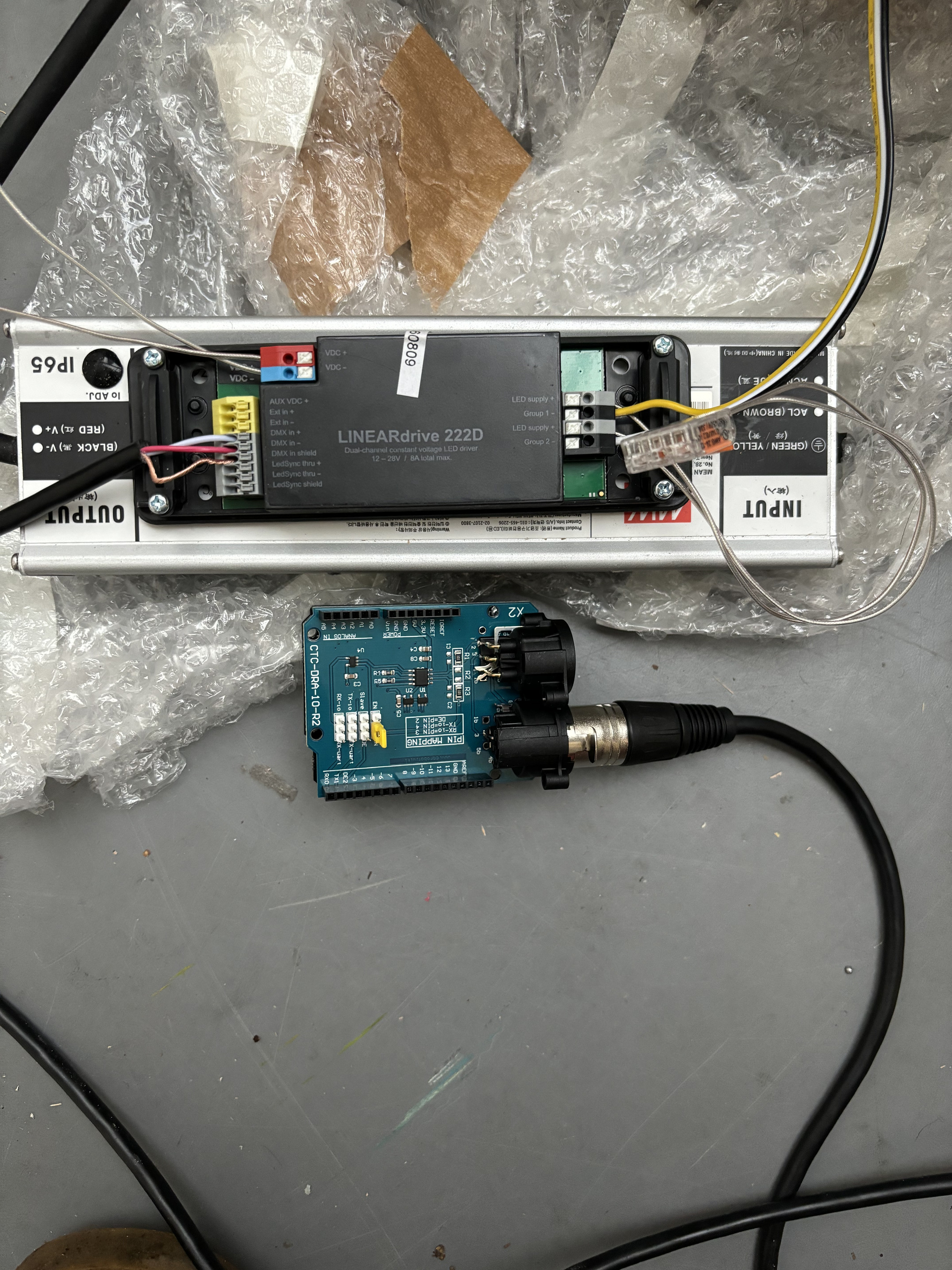
so we've done some more fiddling, sourced a MAX485 Shield and an XLR cable to connect to the DMX driver. We aren't entirely sure what to do in terms of wiring the shield and then programming that to talk to the driver.