I am attempting to create a power measurement system for car stereo amplifiers. The end goal will be to display the output wattage (0-5000 watts).
I am attempting the following:
Voltage measurement; ZMPT101B module
Current measurement; SCT013 clamp sensor (up to 15 amps)
I have used the ZMPT101B in a previous project with success (measuring the output voltage of a car stereo head unit (0-5 VAC), but I cannot replicate the results in my new project. I purchased a lot of 10 sensors from Amazon. Applying 5V and gnd from my arduino uno and measuring the output of the sensor with a DMM with scope function. I apply VAC from a car stereo head unit but the output measurement is erratic and/or not changing with the volume adjustment (signal is a test tone at 1kHz).
Could I have a bag of defective sensors?
Interesting application 
I would start using a test tone 1kHz (as you do);
Be sure to have a dummy load on your amplifier or an actual speaker (4 or 8 ohm)
Measure the output ac voltage with a meter.
Be aware that the voltages are much smaller here ..... 100watt over 8ohm -> 28V rms
You should then be able to measure 28V rms on the Uno (after calibration)
Thanks for the insight.
What would happen if I didn't have a dummy load attached? All of my testing so far has been without a load. Would I have damaged equipment (Sensor, arduino, etc)?
I think testing without the dummy load could burn your ZMPT101B.
The sensor is a small transformer with a very thin wire. Could easily be burned or short circuit.
The Arduino is isolated from the amplifier output so no damage here I think.
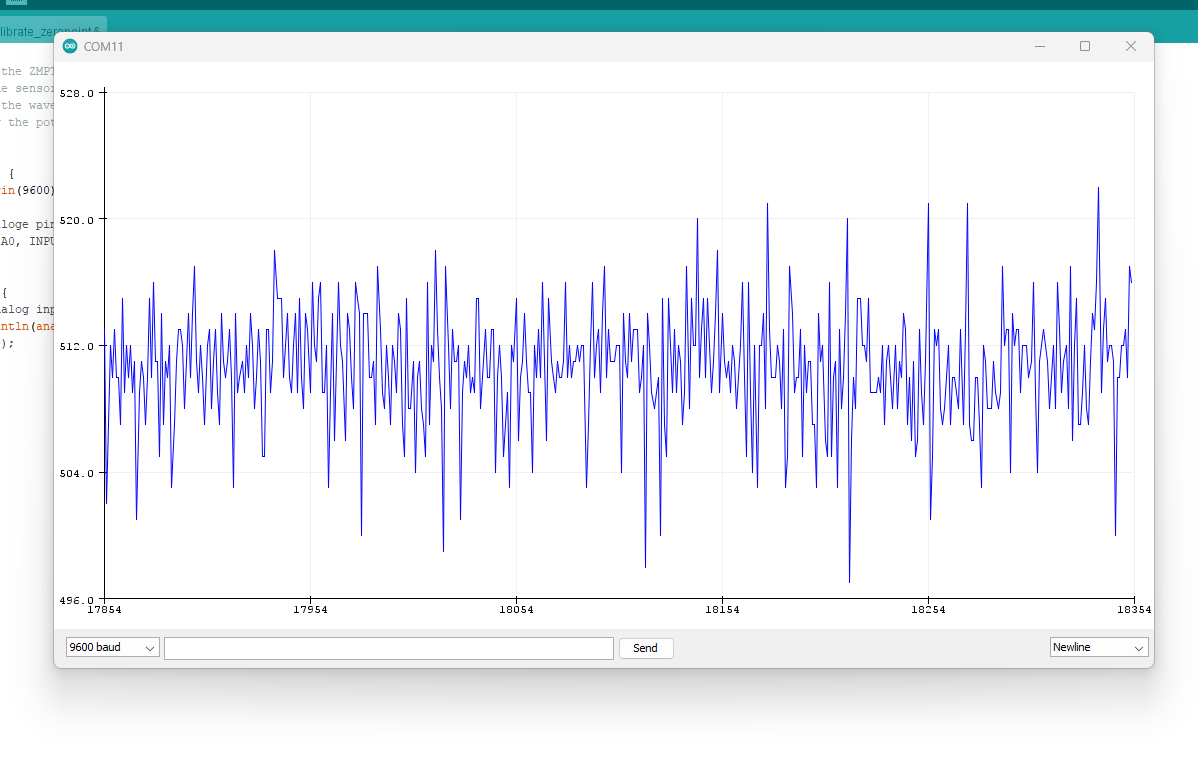
This is the output I am seeing on the monitor with no signal. But it just changed to something more stable.
And it is switching between these two states at idle.
Output widht no signal ?
If you have no 1kHz signal and this output you have a lot of noise.
It actually also looks like a noise signal.
I still think I will suggest you to establish the test I suggested with a dummy load and a 1kHz test signal. Because then you know where you start and can calibrate the unit.
Both of those images are with no input signal. I am taking additional measurements of the sensor itself right now.
Measure between L-N I am reading .47vac
Measure between N and start of R13 I get the same
Measure between N and after R13 I get strange/nothing readings.
Please post a wiring diagram (schematic).
L and N are hooked up to a single channel on my stereo head unit.

Resistor in question circled in red.
Module schematic says it is a 820k, and it checks out fine.
How often are you sampling it with the ADC? If you don't take more than 2,000 samples per second, you will not meet the Nyquist criterion.
At this point I am trying to get a reasonable reading on my meter/scope. I am now testing the legs of the transformer. In theory I should see a similar waveform on the output of the transformer?
At this point I am trying to get a reasonable reading on my meter/scope.
But the results you posted, aren't from that. They're from the serial plotter. What "point" are you trying to arrive at? Eventually you will have to sample at least 2 times the maximum frequency of interest. And, unless you low pass filter it, you will get intermodulation noise from any higher frequencies in the signal.
Shouldn't you try first, if you have the scope in front of you? Post a scope screen shot.
You shouldn't have to measure at the transformer. The module is analog all through, you should see a good signal at the module output.
My current goal is to make sure the sensor is working properly, starting from the signal through the transformer.
Image of signal.
Transformer output
Please post a schematic of your measurement circuit. The photos are interesting, but it is not possible to see how things are connected.
If you are trying to calculate power in software by computing it from the voltage and current vectors, you will need a sampling frequency greatly in excess of the Nyquist frequency. How do you plan to do that? What measurement accuracy are you aiming for?
This is the schematic of the sensor module.
Probing at these two points I get no reading.
The current into the primary is really tiny, using a 820k resistor... Is this the voltage measurement you are trying to make? The sensor is a current sensor, the primary has few turns and the secondary has many.
Correct, as this sensor module is designed for measuring mains voltages.
In theory, I should see some output from the transformer?