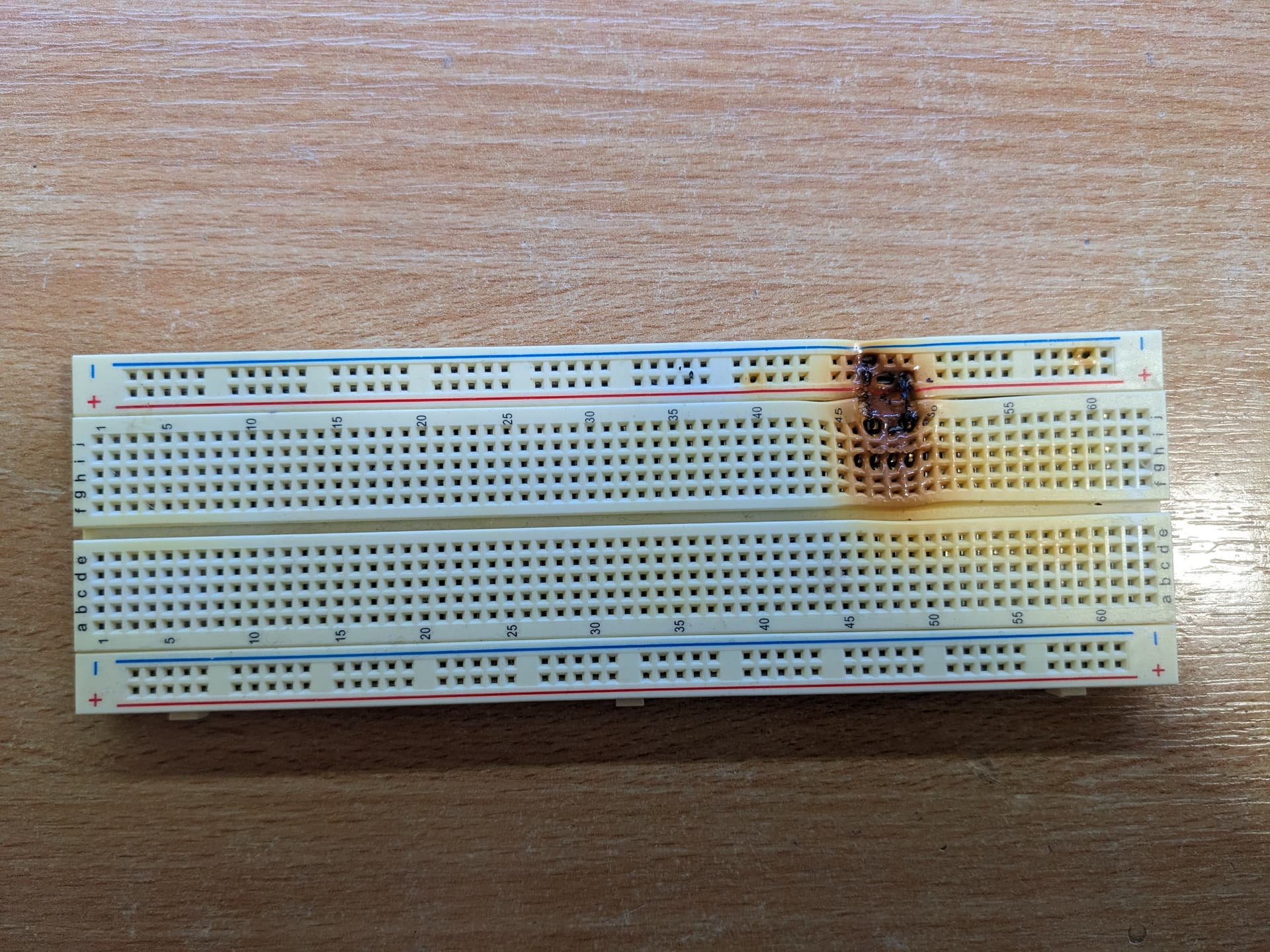
Often we tell newbies not to power motors and other high current devices through breadboard because it cannot carry the necessary current. The damage in the photo wasn't caused by a motor, it was caused by an accidental short I didn't notice until I smelled burning, but I think it illustrates the point.
In my lifetime? I don't know. Recently, apart from that breadboard, very rarely.
I did once undertake to fix an analogue amplifier for someone and managed to destroy several replacement transistors in the process. I gave up in the end, no schematic, not easy to know what might have caused them to die. I've not played with amplifiers for a long time so lack the experience to know what to be careful of.
Where have you placed the circuits on the breadboard?
Did you power the circuits using the 5V supply from the Arduino UNO or directly from the USB pin?
In the past, we powered our 5V circuits on breadboards using a PC's power supply capable of 5V/60A. However, we always ensured safety by placing a 500 mA fast fuse in series.
It’s unfortunate to see that the breadboard has been damaged. It’s a valuable tool, costing Tk 250/- in my country, and deserves proper handling.
This reminds me of an incident in 1982, when a senior Chinese colleague on a Malaysian shop floor picked up a resistor from the floor, cleaned it, and re-stored it properly, remarking that it cost only one cent (Malay). Even small components deserve care.
Engineers often learn through trial and error, sometimes damaging equipment in the process, whereas Doctors must learn their craft while keeping patients alive!
At the end where the burn is where I had a Nano Every. The whole thing was powered from the USB port, with wires from the 0V and 5V pins to the power rails, which is where the burn is. A stray jumper wire bridged the power rails, I didn't notice. As far as I know the Nano Every survived, it still shows up on my PC. Power was from a USB port hub with its own power supply.
The absence of poly fuse (protection mecanism) on Nano Every board explains that the BB has suffered from serious damage NOT for the fault (accidental short circuit jumper) of the Operator (Nano user) but due to design fault of Nano Every NOT containing a "current limiting poly fuse".
The 'errant' current node (what a lovely way to phase it!) was supplied from the 5V and GND pins of the Nano Every, which in turn was supplied from the USB port. D2 on the Nano Every links VUSB to 5V. D2 has not died. I note that the MEG6020 diode is rated for 2A.
Let me share my experience too here, for me i only did it twice i think. The first time i accidently supplied 12v 3A to a 5v Bluetooth speaker driver(the smoke released pretty slow though) and the second, I reversed polarity on a ESC. The explosion from the cap was deafening since i was next to it.
Working on a triac controlled 220V light dimmer for an incubator in my practical year at university.
Ready to demonstrate, lab table cleared but I left a pair of metal tweezers under the triac circuit. It was spectacular because the fuses on the lab table survived (possibly slow fuses) but a complete floor of the university building came without electricity.