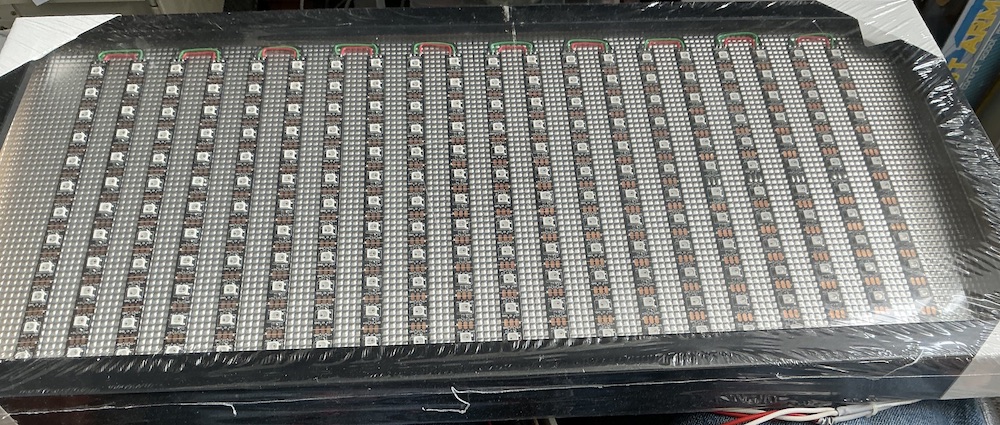
Have you considered making the matrix using WS2812b addressable strips? The big advantage to using them is that unlike a scanning matrix there is no need to constantly be refreshing the matrix if nothing changes.
No this is an absolute limit not an actual limit. You missed the disclaimer underneath that table.
Most 5mm LEDs have a maximum of around 20 to 30mA and would be destroyed by 35mA or higher. Please post a link to the datasheet(s) for the LEDs you are considering to use.
Question: when you say you need the LEDs to be bright with at least 20mA current, is that because you have tested them with 20mA continuous current and less than that will not be bright enough?
The reason I ask is that normally in a matrix, the current is not continuous. A matrix is usually multiplexed: only one row or column is lit at any instant.
In an 8x8 matrix, any individual led will only be lit for 12.5% of the time. So even if the current flowing through it is 20mA when it is lit, the average current will only be 2.5mA. The brightness will appear the same as an individual led with 2.5mA continuous current, so much less bright than you need.
In an 8x8 matrix, to achieve brightness equal to 20mA continuous current, the actual current will need to be 160mA. Most LEDs would be destroyed.
One solution could be to have your LEDs arranged physically as a matrix but not electrically a matrix. The ws2812 idea suggested by @Grumpy_Mike is one way. Or 8x tpic6c595 shift registers suggested by @ruilviana is another.
Definitely need to see the data sheet for the LED. A lot of LEDs have a "peak forward current" rating for multiplexing applications that is substantially higher than the maximum continuous current, but has specific limitations on duration and duty cycle. You do need to be careful when driving LEDs at high current, if the multiplexing stops for any reason the LEDs can quickly overhead and be destroyed.
As far as I understand using these addressable strips does not work for my needs. I have to put everey Single LED into a seperate little Box for an Art Installation.
Do you know the spacing of the boxes? WS2812 come in "LED/METER" spacing of 30/m, 60/m, 144/m... and the "IP" value of some of the lower LED/m are flexible so you can move the LEDs closer by flexing the cable.