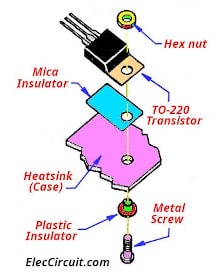
Thanks. The Datasheet says that the backplate is connected to drain as you proposed.
So I guess that'll mean that I need seperate, electrically isolated heat sinks for every Irf3205?
'electrically isolated' doesn't necessarily mean separate. If you have the correct mounting hardware and heat transfer compound, you could still use the cabinet to sink heat away.
You get a standard TO220 thermal pad
set - grey gel-like thermal pads are used these days, mica is very old-school (to say the least, its not very thermally conductive!).
I guess I am old. My bad. You're right. (again...)
I think that old school beats new school here heheheh. Although, if the plastic insulating sleeve diameter is a tad wider than the mica hole.... it can split/tear the mica..... which isn't necessarily a disaster, as it still creates an electrically insulating gap.
Question about your metal cabinet. Is it aluminum or steel? If it's steel the heat spreading will be much poorer than aluminum. Could still work but not nearly as well.
Regarding the well mentioned isolation. The goal (as others have said) is to have intimate contact between the MosFet to insulator and insulator to cabinet. So when you prepare your cabinet you should endeavor to make it as flat as practical.
This is why modern pads are rubbery, they make decent contact even it the surfaces aren't exactly
flat.
Aluminium cases (diecast especially) are great for heat-spreading, but sometimes its better to have an
external heatsink and let the case stay cooler - the rest of the electronics doesn't have
to bake then. Keep electrolytic caps away from the hot spots, their lifetime is dramatically
shortened if they get hot.
In terms of electrically isolating whilst conducting thermally, high powered LEDs on disc or star pcb boards have what appears to be bare metal backings to conduct heat, but the whole back surface is non-conductive. Touching two continuity probes next to each other on that bare metal looking surface do not have continuity.
Must be some layer of clear anodizing that electrically isolates. If it's something that can be applied as a clear coat like nail polish, that'd be great.