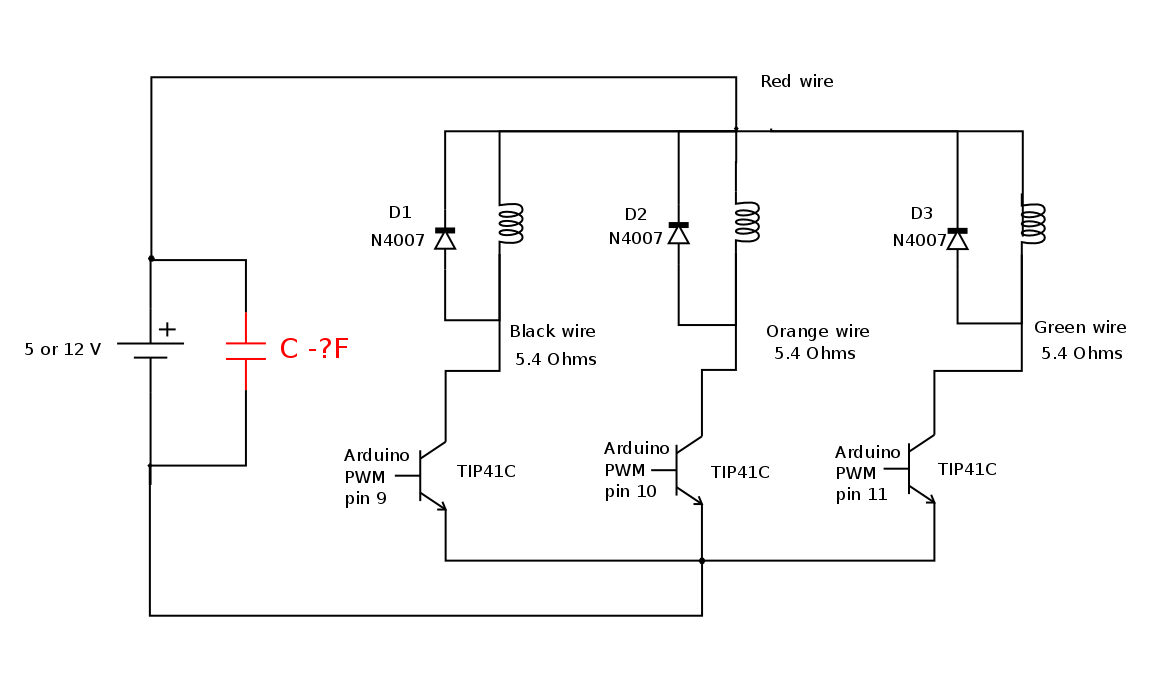
Controller with TIP41C for a BLDC (spindle) motor with 4 wires

Hi All,

I am planning to mount a controller according to the diagram:

I would like to know the opinion of the experts about the viability of this project.

What would be the most appropriate capacitor (parallel to the source) to control the BEMF?

I intend to use the PWM pins of Arduino to control the speed of the motor.

This motor has 4 wires (Black, Red, Orange and Green).

I measured the resistance and got the results:

Black - Red: 5.4 Ohms
Black - Green: 10.2 Ohms
Black - Orange: 10.2 Ohms
Red-Green: 5.4 Ohms
Red - Orange: 5.4 Ohms
Orange - Green: 10.2 Ohms

Is this circuit is feasible?

Thanks for your attention.
Markos

Not seen that circuit config before, but one thing is certain, the transistors
should be at the bottom and the diodes at the top.

You cannot turn on an NPN as a high-side switch without providing a drive circuit
at higher voltage than the supply.

Use the NPN's as low-side switches and you will be able to turn them on

However since the Arduino cannot give more than about 30mA without
hitting the abs max limits, and the TIP41 has a usable gain of 10 as a switch,
you won't be able to switch more than 300mA with this circuit. Logic-level
MOSFETs would be better.

The purpose of the resistors eludes me - is it waste power? :slight_smile:

first things first. need to post link to the motor. the motor would have connection diagrams that show how to connect it.
not all motors are steppers or even able to be run on DC

as for the resistors in the drawing, they are supposed to represent coils of the motor

I laid out a paint drawing to visualize the layout.

seems one might want to google star-delta and wye-delta to learn more about this motor.

if that is a 3 phase AC motor, then no, that circuit will not work.

star-delta.png

dave-in-nj:
first things first. need to post link to the motor. the motor would have connection diagrams that show how to connect it.
not all motors are steppers or even able to be run on DC

as for the resistors in the drawing, they are supposed to represent coils of the motor

I laid out a paint drawing to visualize the layout.

seems one might want to google star-delta and wye-delta to learn more about this motor.

if that is a 3 phase AC motor, then no, that circuit will not work.

Dear,

I am using a motor from HD but a don't have any information about it:

I tried to open the top of the motor but could not.

I'm using the motor connector to measure the continuity:

And with the measurements I'm considering the following configuration (star with common wire):

You are right, I corrected the diagram of the circuit and replaced the resistors by the coils :

What to you think about?

I intend to use a power supply with a maximum output of 1.5 A, so I think I'll have to add a resistor in series with the output of power to control the maximum output current. Am considering using something around 5 Oms.

What do you think?

Thanks for your attention.
Markos

MarkT:
Not seen that circuit config before, but one thing is certain, the transistors
should be at the bottom and the diodes at the top.

You cannot turn on an NPN as a high-side switch without providing a drive circuit
at higher voltage than the supply.

Use the NPN's as low-side switches and you will be able to turn them on

However since the Arduino cannot give more than about 30mA without
hitting the abs max limits, and the TIP41 has a usable gain of 10 as a switch,
you won't be able to switch more than 300mA with this circuit. Logic-level
MOSFETs would be better.

The purpose of the resistors eludes me - is it waste power? :slight_smile:

Dear Mark,

I corrected the diagram according to your suggestion:

Your suggestion called my attention to a feature of the transistors that I didn't know.

For me, a transistor would act as a switch, regardless of whether the load device is connected to the collector or the emitter.

You could indicate a tutorial about this topic?

At the moment I'm using the transistor TIP because it is the component that I have available on my desk.

I'll try to know more about the MOSFET.

Thanks for the tips.

Markos

Akvo:
I corrected the diagram according to your suggestion:
http://www.c2o.pro.br/en/automation/download/BLDC_controller_4_wires.png

Yes, that makes a lot more sense. You won't be able to switch 2.5A with a TIP41C
unless you provide 200mA or so to the base though. You could change to using
NPN Darlingtons like TIP120/1/2 - then only a few mA of base current is needed.

Your suggestion called my attention to a feature of the transistors that I didn't know.

For me, a transistor would act as a switch, regardless of whether the load device is connected to the collector or the emitter.

No, you have to saturate a transistor to act as a switch and that can only be done
if the base is at a higher voltage than the collector (for NPN) or at a lower
voltage (if PNP).

A transistor in saturation has minimal voltage difference between collector and emitter,
perhaps 0.05 to 0.2V, whereas the base-emitter voltage is always going to be ~0.8V or more
(for a power transistor).

Failure to saturate means a lot of power is dissipated in the device and it could overheat
or need a fan to cool it!

Alas darlingtons like the TIP120 have high power dissipation too...

logic level MOSFETs are much better for this application I reckon.

Dear Mark and Dave,

To share my tests.

As I have the circuit on the breadboard with TIP41C I decided to do some measurements for my learning.

I did some measurements of base current (Ib), collector current (Ic), and the potential difference between the collector and emitter (Vce).

These measurements were made by applying 5 and 12 volts on the coils while maintaining 5V at the base of transistor TIP41C, because I intend to use the Arduino to apply current to the base of the transistor.

I observed that the higher the voltage applied to the collector, the greater the current that must be applied to the base to saturate the transistor.

For example, applying 12 V in the coil and 15 mA in base (Ib) of TIP41, the Vce = 4 V and Ic = 1.04 A, and the transistor becomes very hot.

But applying 5 V in the coil and the same 15 mA on the base (Ib) applies, the Vce drops 10x (Vce = 0.4 V) and Ic = 0.63 A). But in this case the transistor does not heat.

Measurements with 12V in coil and 5V in base

Rb(Ohms) Ib (A) Ic (A) Vce (V)
820 - - 9,7
507 - - 8,3
256 0,015 1,04 4
110 0,035 1,18 0,4

Measurements with 12V in coil and 5V in base

Rb (Ohms) Ib (base current - A) Ic (colector current - A) Vce (V)
500 0,008 0,5 1,5
256 0,015 0,63 0,4
109 0,035 0,65 0,18

I did these tests in only 1 coil and wanted to check the torque generated in the motor.

With 12 V torque is very strong, but the heating of the transistor is very high, moreover the Ic current is very high (1.04 A) and in the case of energizing 2 coils simultaneously
(Switched reluctance motor - Wikipedia), I would consume ~ 2 A and would exceed the limit of my power supply (1.5 a).

In the future I plan to use the Darlington and MOSFET transistors, but for now I'll test this circuit with TIP.

Thanks for the "TIPs",
Markos

Forget darlingtons, MOSFET is always the way to go.