For a project I want to control 10 dc motors with a motion sensor. That would mean I need 3 arduino UNO's or 1 MEGA.
Since I have an UNO I started to try to control 4 dc motors with the following parts:
arduino UNO
wall adapter power supply: 12VDC 2A
dc motors: nominal current: 0,2 A; 3V-6V.18000-35000 rpm
motor driver: L293D
power supply converter: OT150-B75, 3.3V and 5V
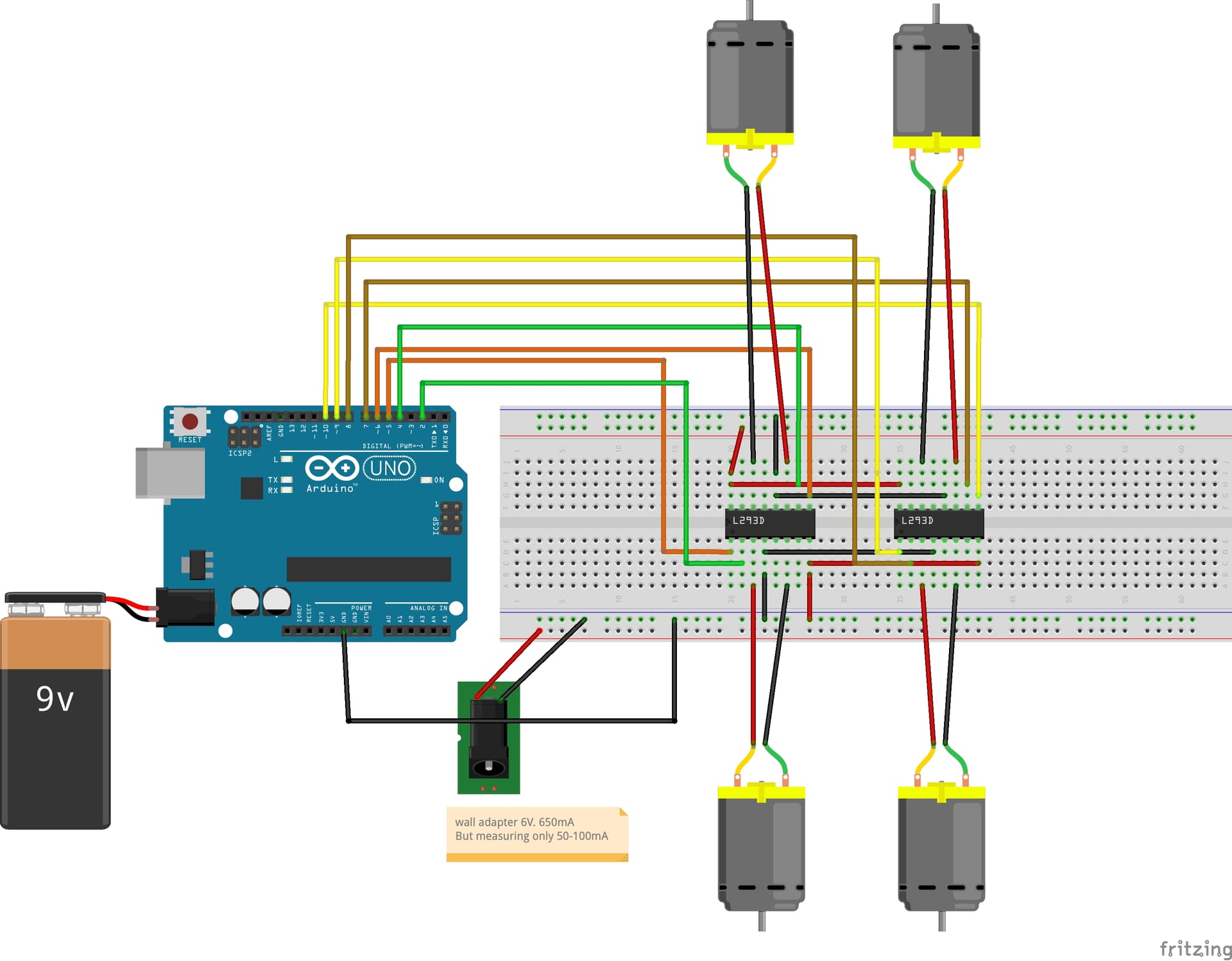
I've connected my power supply to my power supply converter and connected 4 dc motors with the help of 2 L293D motor drivers. Unfortunately I only succeeded to run one DC motor. What could be the problem?
I'm pretty sure I connected everything properly. Is my V and A too low for these type of motors?
Am I using the right parts or would it be better to use a L298N motor driver with geared motors? Or something else? Also If someone knows a similar project I would love to hear about it.
No, that is wrong. It is a common new user mistake to think that multiple processors are the answer. It is usually not. There are other, easier, ways to increase pin count such as I2C and SPI port expanders and shift registers.
What is the stall current of those motors? It should be listed on the motor data sheet.
Choose the motor driver based on the stall current of the motor and the motor supply voltage. The stall current can be several times the running current. The stall current will be drawn, briefly, every time that the motor is started. The stall current should be listed in the motor data sheet. In the absence of a data sheet, the stall current can be estimated. To estimate the stall current, measure the motor winding resistance. Zero your meter lead resistance before measuring the motor coil resistance. Take several measurements rotating the motor a bit between readings. Use the lowest reading in the calculation. The estimated stall current is the motor supply voltage divided by the measured resistance.
What do you mean by "control"? On/off/variable speed/forward/reverse?
As mentioned, a bad idea to use more than one Arduino in your project. Do you plan to use a shield? A shield is a PCB in same shape as Uno/Mega that fits on top. If you don't plan to use a shield, don't buy Uno or Mega.
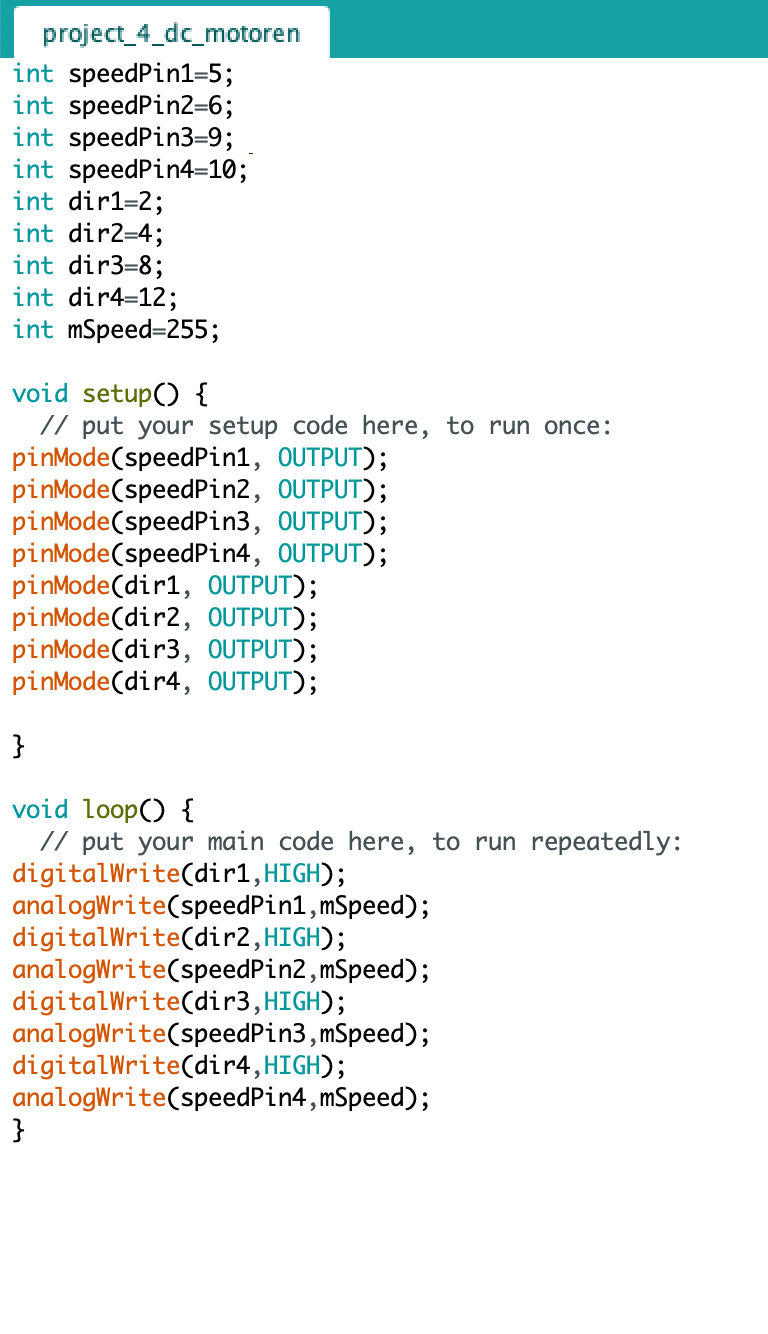
Your wiring is not correct. On each half bridge IN1 and IN2 control forward, reverse, start and stop, EN to control speed. You have left unwired one of the IN pins on each half bridge. The analog inputs (A0-A5) can be used as digital pins.
9V smoke alarm batteries do not have much current capacity so are poor choices for powering motors.
They are inefficient because of the nature of the bipolar transistor Darlington output stage. That configuration drops 2V to 4V of the motor supply voltage (depending on current) and wastes it as heat. So only 7V, at best, of the 9V is getting to the motors. Modern drivers have MOSFET output stages and waste little of the supply voltage.
I do not need to use IN2 when I only want them to move in one direction right? EN1 is connected to the pins with the little wave icon.
I've powered them now with a wall adapter - 6V, 650ma directly into the breadboard. But unfortunately while measuring the adapter with a multimeter it starts with 130mA and drops down really quickly to around 70/60mA. And then slowly drops down to 55mA. Not sure why.
Try wiring the unused IN pins to 5V or ground, whichever gives you the direction that you want. The INs on each bridge need to be opposite to move the motor. For example, IN1 high and IN2 low is one direction and IN1 low and IN2 high is the other. Both high or both low stops the motor. I do not know if an unconnected IN pin is high or low or indeterminate.
If you only want them to move in one direction use a MOSFET to drive them, not an H-bridge. 1 pin for each motor and, with a wise choice of MOSFET, high efficiency.
The 2 motors attached to the second H-bridge started spinning when I connected the 4's (0V) and the 8's (+V) to the first H-bridge.
Question: Why doesn't this circuit work when I move my PSU to the top left, right or bottom right corner of the breadboard? That shouldn't make any difference right?
And should I be careful while wiring PSU's on when my UNO is connected to my computer? I do not like the idea of burning down my laptop.
The top and bottom power rails are not connected, you need to jumper them to connect (green box). Also, some breadboards have the power rails split in the middle and you need to jumper them (black boxes).
I'd give it a go with the simplest/cheapest brushless 5V DC motors you can find and a couple of mosfets to switch them. I see a lot of 3-6V motors for something like $1 a piece that should pretty much fit the bill. For motion sensing most people use one of the ready-made PIR sensor modules that simply gives a pulse whenever motion is detected.