Hi, here I am again and my problem is solved.
When I started this thread, i did not know, how to use the MAX7219 in decodemode 0.
Before i used decodemode 0F, to drive a 4 digit 7 segment display, found in an old
microwave oven. This lost by and by several segments and I had to look for a substitute.
My program test1.ino shows all the necessary ten digits 0 . . 9 and a space, which I need for my clock.
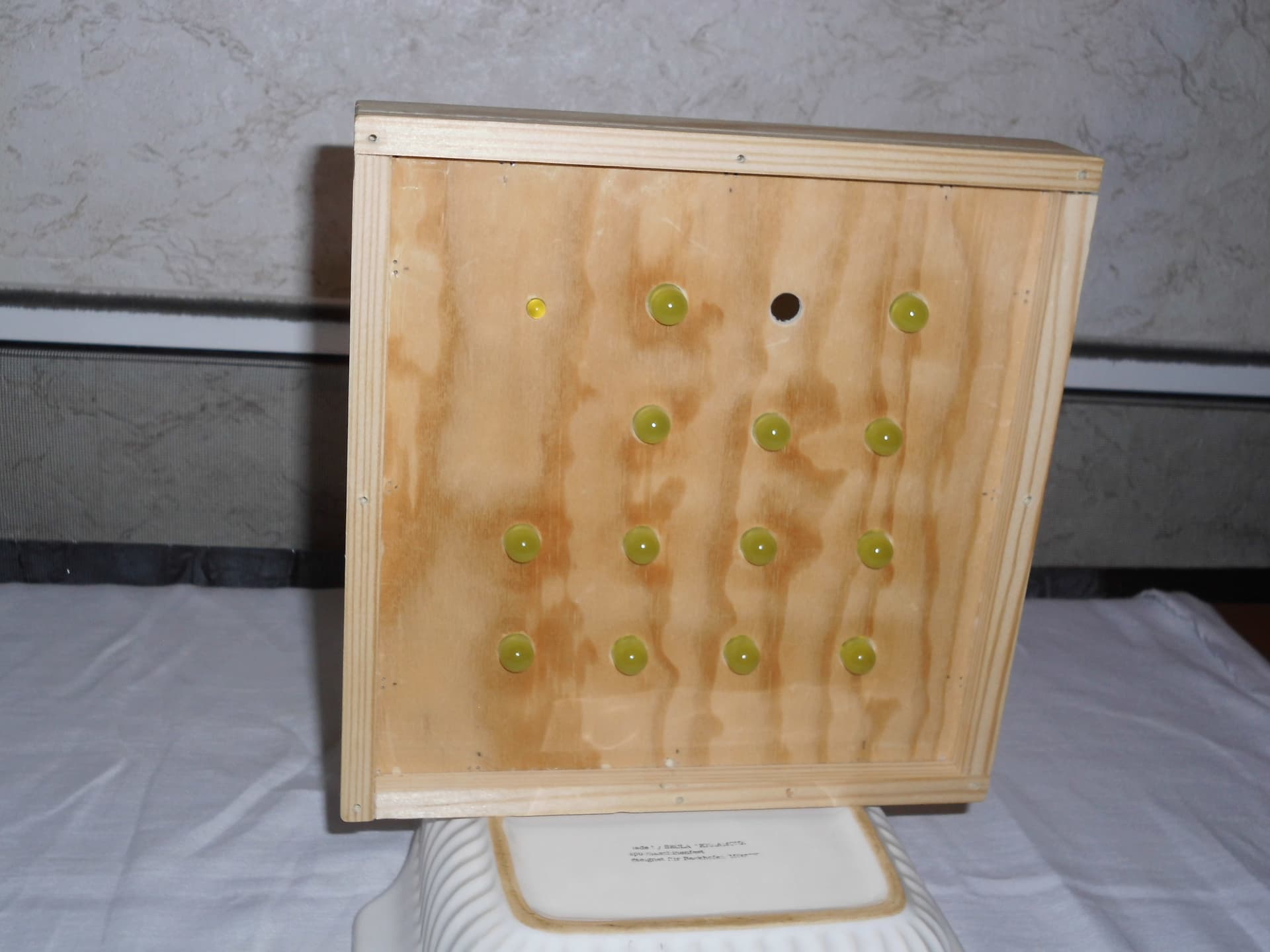
The double colon between the hours ones and the minutes tens are two extra leds, controlled by UNO port 18.
The array consists of 4 columns and 7 rows, so one MAX can drive 2 digits. In this case only 26 leds are necessary, two are not used.
/* test1.ino
  an array with 4x7 leds displays the digits  0.. 9 + space
the leds are wired as common cathode to replace a 7 segment display
as well as in my first program test.ino
*/

#define digit10 space

byte const digits_font [11][7] PROGMEM = {
  { 0x06, 0x09, 0x09, 0x09, 0x09, 0x09, 0x06 }, // 0
  { 0x02, 0x06, 0x02, 0x02, 0x02, 0x02, 0x07 }, // 1
  { 0x06, 0x09, 0x01, 0x02, 0x04, 0x08, 0x0F }, // 2
  { 0x0E, 0x01, 0x01, 0x06, 0x01, 0x01, 0x0E }, // 3
  { 0x08, 0x0A, 0x0A, 0x0F, 0x02, 0x02, 0x02 }, // 4
  { 0x0F, 0x08, 0x08, 0x0E, 0x01, 0x01, 0x0E }, // 5
  { 0x07, 0x08, 0x08, 0x0E, 0x09, 0x09, 0x06 }, // 6
  { 0x0F, 0x01, 0x02, 0x04, 0x08, 0x08, 0x08 }, // 7
  { 0x06, 0x09, 0x09, 0x06, 0x09, 0x09, 0x06 }, // 8
  { 0x06, 0x09, 0x09, 0x07, 0x01, 0x01, 0x0E }, // 9
  { 0x00, 0x00, 0x00, 0x00, 0x00, 0x00, 0x00 }, // = space
};

const byte ledPin =  19;
bool ledState = LOW;
unsigned long previousMillis = 0;
const unsigned long interval = 500;
unsigned long previousMillis1;
const unsigned long interval_1 = 10;

#include <SPI.h>

const byte MAX7219_REG_NOOP         = 0x0;
const byte MAX7219_REG_DIGIT0       = 0x1; // 1. LED-Reihe
const byte MAX7219_REG_DIGIT1       = 0x2;
const byte MAX7219_REG_DIGIT2       = 0x3;
const byte MAX7219_REG_DIGIT3       = 0x4;
const byte MAX7219_REG_DIGIT4       = 0x5;
const byte MAX7219_REG_DIGIT5       = 0x6;
const byte MAX7219_REG_DIGIT6       = 0x7;
const byte MAX7219_REG_DIGIT7       = 0x8; // 8. LED-Reihe
const byte MAX7219_REG_DECODEMODE   = 0x9;
const byte MAX7219_REG_INTENSITY    = 0xA;
const byte MAX7219_REG_SCANLIMIT    = 0xB;
const byte MAX7219_REG_SHUTDOWN     = 0xC;
const byte MAX7219_REG_DISPLAYTEST  = 0xF;

void setup()  {
  Serial.begin(115200);
  Serial.println("=======================================");
  Serial.println("======= 4x7.ino ======================");
  Serial.println("======================== 12.1.22 =======");
  SPI.begin();
  pinMode(ledPin, OUTPUT);

  sendByte (MAX7219_REG_SCANLIMIT, 7);   //  all, 0 ... 7
  sendByte (MAX7219_REG_DECODEMODE, 0);  //  single LED
  sendByte (MAX7219_REG_DISPLAYTEST, 0); //  Anzeige=0, Test=1
  sendByte (MAX7219_REG_INTENSITY, 0);   // 0 .. 15
  sendByte (MAX7219_REG_SHUTDOWN, 1);    // 1 = KEIN Abschalten

  for (byte col = 0; col < 8; col++)     // clear Display
  {
    sendByte(col + 1, 0);
  }
}

void sendByte(const byte reg, const byte data)
{ digitalWrite(SS, LOW);
  SPI.transfer (reg);
  SPI.transfer (data);
  digitalWrite(SS, HIGH);
}

void digit (const byte c)                // only 7 rows!!
{
  for (byte col = 0; col < 7; col++)
    sendByte (col + 1, pgm_read_byte (&digits_font [c] [col]));
}

void clear() {
  for (byte col = 0; col < 8; col++)     // clear Display
  {
    sendByte(col + 1, 0);
  }
}

void blink() {
  unsigned long currentMillis = millis();
  if (currentMillis - previousMillis >= interval)
  { previousMillis = currentMillis;
    ledState == LOW ? ledState = HIGH :    ledState = LOW;
    digitalWrite(ledPin, ledState);
  }
}

void loop() {    //===========================================
  static uint16_t count;

  blink();
  for (byte k = 0; k < 11; k++)
  { digit(k);
    Serial.print(k);
    delay(1000);
  }

//  clear();
  count++;
  Serial.print("  LOOP : ");  Serial.print(count);
  Serial.println();
}
I thank you all for the replies to my thread. I am still learning every day.
Sincerely bolsak.