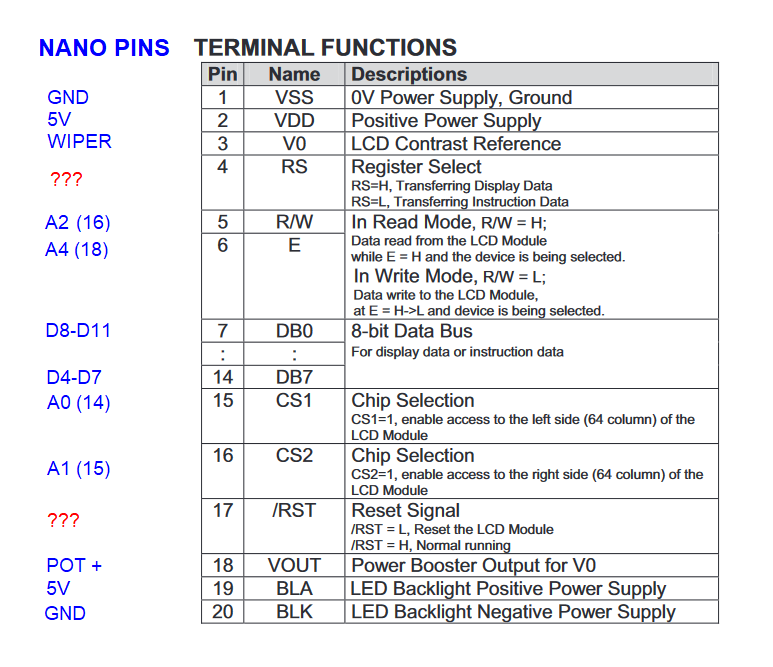
RS, DC, DI, A0, ... are all common names for a RegisterSelect, DataCommand, DataInstruction, Address0 pin.
They all do exactly the same thing: i.e. differentiate between lcd_data() and lcd_command() functionality.
This applies to a whole range of LCD, GLCD, OLED, TFT, ... controllers.
From the U8g Wiki:
U8GLIB_KS0108_128(d0, d1, d2, d3, d4, d5, d6, d7, en, cs1, cs2, di, rw [, reset])
So there is an optional RST pin argument.
I suggest that you connect the RST pin to a spare GPIO pin on your Nano. And add the appropriate optional argument
You must connect the RS pin to A3 (17).
Most modules have a weak pullup on the /RST pin. So omitting any connection will probably work. After all, Oliver made the reset argument optional.
It is wise to put pin functions as a comment to your constructor e.g.
//U8GLIB_KS0108_128 u8g(d0, d1, d2, d3, d4, d5, d6, d7, en, cs1, cs2, di, rw);
U8GLIB_KS0108_128 u8g(   8,  9, 10, 11,  4,  5,  6,  7, 18,  14,  15, 17, 16);
or if you connect RST pin to A5 (19) on a Nano
//U8GLIB_KS0108_128 u8g(d0, d1, d2, d3, d4, d5, d6, d7, en, cs1, cs2, di, rw, rst);
U8GLIB_KS0108_128 u8g(   8,  9, 10, 11,  4,  5,  6,  7, 18,  14,  15, 17, 16, 19);
Personally, I am happier with using the names printed on the Nano e.g.
//U8GLIB_KS0108_128 u8g(d0, d1, d2, d3, d4, d5, d6, d7, en, cs1, cs2, di, rw, rst);
U8GLIB_KS0108_128 u8g(   8,  9, 10, 11,  4,  5,  6,  7, A4,  A0,  A1, A3, A2, A5);
David.

p.s. Note that U8g is deprecated. You should really be using U8g2