Hello, I purchase some solar cells and they came with diodes on them. I believe they are bypass diodes. The seller knew nothing about them.
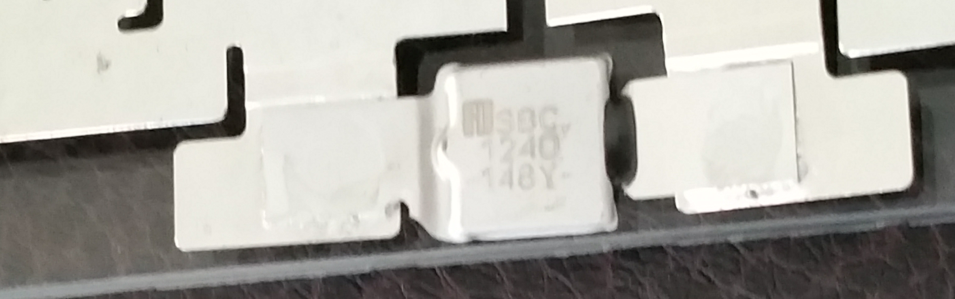
I don't have a part number or a brand name. I believe they are sunpower, but that's all. I have attached two photos showing the diode and the diode number.
Can some one help me identify this diode or tell me a equivalent diode that I can use?
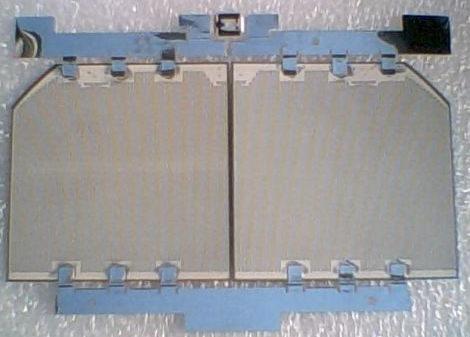
Thirs photo is the back of the two cell array with diode on the top center.
The panels already have the diodes on them - why do you want to know?
Well, they will be either bypass diodes or series diodes - the first is to maintain function of a series array if the particular panel is shadowed, and the second is to maintain function of a parallel array if the particular panel is shadowed by preventing it absorbing power.
In any case, it will generally be a Schottky diode rated for at least the same current and voltage as the array.
Paul__B:
The panels already have the diodes on them - why do you want to know?
&
In any case, it will generally be a Schottky diode rated for at least the same current and voltage as the array
Why do I want to know? Because, although the panels already have the diodes on them, some are broken or missing.
Each cell is rated at 1A and 0.55v. Jesus told me.
Here I'm talking about needing a bypass diode since I need to bypass the each specific cell that might get shaded.
There will be 12 of these 1A @ 0.55v cells connected in series.
What diode (link perhaps?) would be the most appropriate for this?
Its hard to know how big the original pads are from those photos, presumably you
want something the same size / package?
You need a schottky capable of 1A continuous (preferrably a lot more then the forward
voltage drop will be much less), and with a reverse voltage rating above the system
voltage (which you haven't stated)
This is a small surface mount diode that has about 0.4V drop at 1A:
MarkT:
Its hard to know how big the original pads are from those photos, presumably you
want something the same size / package?
Not necessarily. As long as it is the equivalent or a very similar diode, it don't matter.
MarkT:
You need a schottky capable of 1A continuous (preferrably a lot more then the forward
voltage drop will be much less), and with a reverse voltage rating above the system
voltage (which you haven't stated)
How about a 1N5817 schottky diode? I will do some test with these since they are cheap Opinions?
"A reverse voltage rating above the system voltage (which you haven't stated)" How do I even get that info?
Chagrin:
The minimum would be the open circuit voltage of the solar panel, but you should select one at least 50% higher.
Oh, ok. So, each cell (there are two cells in the pic, diode is on the top center bus bar) outputs 0.56v @ ~1ampish and there is two connected in series on every array. Look at the photo I attached to see where the diode is located. The pic is from the back of the cells. I want attach 6 of these in series and add a diode just like in each. Hope I'm clear about it.
Two types of diodes are used in solar arrays. Blocking diodes and bypass diodes.
One blocking diode for the whole array, and one bypass diode per one, two, or more cells.
When one cell is shaded, e.g. when a leaf falls on one cell, the cell does not generate power anymore, but starts to use power. It could melt, and start a fire.
A bypass diode prevents that by shorting the reverse voltage of the cell.
Leo..
Wawa:
Two types of diodes are used in solar arrays. Blocking diodes and bypass diodes.
I explained this back in reply #1.
Wawa:
One blocking diode for the whole array, and one bypass diode per one, two, or more cells.
Well, one blocking diode for each of the paralleled banks.
Wawa:
When one cell is shaded, e.g. when a leaf falls on one cell, the cell does not generate power anymore, but starts to use power. It could melt, and start a fire.
Well, it does not "use" power because it is negatively biased - it would only conduct if its reverse breakdown is exceeded and only then be a fire problem if such breakdown was limited to a small area.
AHH!!!!!!!!!!
I was so exited to see so many replays! None of them suggested a diode alternative or similar one.
(took a deep breath) ok....
If each array produces 1.12v @ 1ampish and I want to connect 6 arrays in series, what sort of bypassing diode in between the arrays do you suggest me to use? Total open voltage would be ~6v @ ~1amp.
Each array already has it's diode, but are not manufactured to connect them in series, thus no diodes included in between each array.
For instance, if I connect first array with a second array, there would be missing one bypass diode in between the two arrays.
Thanks for those who have suggested one already, I'll test those shortly, in the mean time, go at it!
Bypass diodes go ACROSS the cell/array/set of arrays.
You can do whatever you want.
One diode per cell.
One diode per array.
One diode per two or three arrays.
The diode can be anything that can handle 1Amp.
It's just there to protect the cell/array when it's fully shaded and the rest is in full sun.
The diode is hopefully never in use.
The blocking diode should be a low forward voltage diode (schottky), so you don't loose valuable voltage.
A common 1N4004 would loose ~1volt@1A, while a schottky diode would loose ~0.5volt@1A.
The blocking diode stops backflow from the battery into the solar panel when it's dark.
You only need ONE blocking diode per stack.
Leo..
Wawa:
You can do whatever you want.
One diode per cell.
One diode per array.
One diode per two or three arrays.
Well, no, not exactly.
For this application at 6V, the bypass diode is almost certainly superfluous.
It is all about the actual Zener (or avalanche) breakdown voltage of the individual solar cell. The bypass diode must bridge a number of series cells whose combined operational voltage is less than the breakdown voltage of a single cell, because that is the voltage the (remaining) illuminated cells may apply to the shaded cell. My guess would be that the cells have a breakdown voltage greater than 6 V, in which case bypass diodes would be unnecessary for a 6V (nominal) module.
That is all that is needed for protection. For efficiency (in potentially shaded positions), you might like bypass diodes across smaller sub-units.
All this said, I have not seen any bypass diodes in the usual solar arrays such as on my roof. One possible explanation, is that the cells have an extremely low breakdown voltage - in the order of say, 2V, such that an individual shaded cell will simply conduct by itself when reverse biased, but dissipate no more than four or five times its rated power output which given an efficiency of 20% would be no more dissipation than when it is illuminated and actually generating such power. And it would actually be keeping relatively cool because - it is in the shade!
Yes, I knew about the breakdown voltage.
And I have read an article some time ago about the spread between cells.
I think it was somewhere between 5 and 10 volt.
A diode across each cell would be best, but that increases cost.
Because then the diodes have to be embedded in the panel.
I think one bypass diode per 6 or 7 cells was recommended in the article.
When a cell operates in reverse breakdown (no bypass diodes), the cell can get very hot.
Imagine 8volt@5A. 40watt dissipated in one cell. In the sun, on a hot roof.
This all is not important for the low cell count panel of the OP.
Leo..
Well, as painful as it was to detach a diode from the power bus, I did.
I then measure it with my multimeter and it read 0.111 and OL. I also measured the resistance and it read 512 kohms and OL.
My diodes I ordered are still on their way. I'll post updates, thanks all for replying.
Pringles:
I then measure it with my multimeter and it read 0.111 and OL. I also measured the resistance and it read 512 kohms and OL.
0.111 indicates a Schottky - as one might expect. The resistance value is completely meaningless since it is not a resistor.
I had a discussion with the fellow at the Solar shop on Monday - I am not sure he had a clue about it really, but he thought the (power generation) panels had bypass diodes. If they did, they are well concealed - I could see no evidence of them whatsoever. The panel of course has an isolating diode in the little black connection box on the back.

 Opinions?