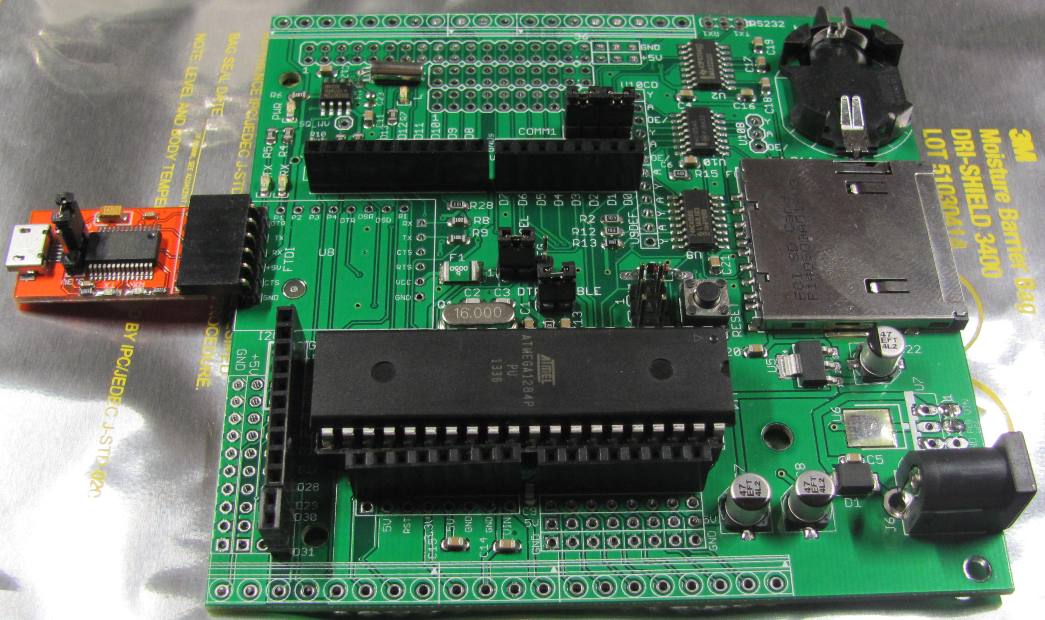
Decoupling caps are 0.1uF (100nF) and are usually small and brown.
Add one from VCC to Gnd, AVCC to Gnd, and Aref to Gnd. Do not connect Aref to 5V.
Connect the caps as close to the pin as you can.
Typically there is 4th from the FTDI header DTR to Reset, and a 10K pullup from Reset to Vcc for software generated reset during software downloads.
LarryD:
OK
You will need 878,674 transistors to replace the AMTEGA328.
Well... I really want to work towards sourced components and possibly making a PCB with the microcontroller placed on board. I honestly do not wish to use 878k transistors for any project.
Kidding aside, I don't believe there is too big of an argument between a SMPS and using a three terminal voltage regulator. I have stopped using 7805s in most of the of my projects in lieu of SMPS as linked to.
A SMPS has effientcy up to 90%.
If you use a 7805, with 12v input at let's say 500ma, you will need to heat sink the TO220.
(12 - 5)*.5 = 3.5 watts "ouch".
At 1 amp that's 7 Watts!
I do find these interesting. I would include 2 of them on a homemade Arduino, one for 5V and one for 3V3.
And one of these: http://www.tinyosshop.com/index.php?route=product/product&product_id=600
I think it would be interesting to arrange right angle male and female headers on the main board which has the ATmega328P, so these modules plug together to make a complete Arduino. A modular Arduino; kind of like a Sparkfun ProtoSnap Pro Mini board, except instead of snapping apart, plug the modules together.
Maybe even include one of these on the board:
If you could cram it all into the footprint of an Arduino, you would have a super-Arduino.
dmjlambert:
If you could cram it all into the footprint of an Arduino, you would have a super-Arduino.
I agree DMJ, I thought it would be nice to have the same footprint of a 3.3v & 5.0v logic converter as well. You could use more I2C circuits without longterm voltage issues. I like the term "super-arduino".
Also, I am not in a big push to put programming on the board yet. I want to move toward a manufactured product with progamming one time. I would use pads and "pogo" pins to program.
I dunno. By the time you're willing to use a TO220-sized regulator, a lot of the motivation for using a switching power supply disappears, especially for that 5V->3.3V step...
The TI NanoModules are neat, too. LMZ21700 data sheet, product information and support | TI.com
I should be very susprised if a switchmode regulator was more efficient thatn a series regulator in reducing 5 V to 3.3 V. Now of course, it does make sense to regulate a higher voltage - 12 V or so - directly to 3.3 V with a switchmode regulator if you do not mind paying 7 times the component cost for that second regulator.
lol. it took me a while to realize everything after the '?' can be left off.
while smps type are more efficient and op is dropping from 12v still makes little sense at the current levels involved. specially when you consider they often have orders of magnitude more noise compared to linear and 4 dollars (double that with s&h) vs 4 cents. of course some get enormous pleasure out of spending more than necessary. strange how people can latch onto an idea...
I use linear voltage regulators all the time and I am a fan of the 7805. Sure, it's not power efficient, but it doesn't have as much ripple as a homebrew beginner SMPS can have.
DIY-ing a discrete SMPS is not for beginners. Not only it is more prone to noise if built on a breadboard or perf board, but care must be taken with component selection and placement. Besides, it usually uses more parts. Even using a switch mode power regulator IC (such as the popular LM2596T-ADJ) requires some knowledge and good design practices.
Therefore, for most beginners or people without a some knowledge in electronics, I suggest just to go ahead and use a linear voltage regulators and be happy! Learn one thing at a time. The OP already did a good job getting his homemade board to work, and that's a lot more than many beginners have accomplished.
To the OP, I just suggest he adds a few bypass caps: before and after the voltage regulator and close to the Atmega328.
CrossRoads:
Decoupling caps are 0.1uF (100nF) and are usually small and brown.
Add one from VCC to Gnd, AVCC to Gnd, and Aref to Gnd. Do not connect Aref to 5V.
Connect the caps as close to the pin as you can.
Typically there is 4th from the FTDI header DTR to Reset, and a 10K pullup from Reset to Vcc for software generated reset during software downloads.
Thank you CrossRoads,
I implemented all of your suggestions except one. I did not add a cap to the FTDI header because I am just popping ATMega328 chips like Nintendo cartridges. I made a new board using 5cm x 7cm proto PCB and added the pin headers this time. I loaded up my Muybridge animation I wrote and posted on another thread.