Hi guys,
I have been struggling for some time to make this work. I basically want to make an arduino recognize if a circuit has been completed by human touching 2 conductors.
I know it can be done easily, because I have seen it even without microcontrollers and it's icredibly reliable: Check this out
And I even found a guy who posted the entire tutorial on youtube.
Human chain tutorial
However, after building the circuit described, and programming the arduino, it doesn't work.
I get voltage dropping under half even if i touch one of the connectors, and is not even consistent. it dropes for a few miliseconds and spikes back up to 1024, and then again under 500... it's all over the place.
What am I doing wrong?
Not everyone has perspiration and will not be conductive. I recall one example who could put his fingers on a live 120 volt circuit and not feel a thing.
Paul
I got the below the other night by pinching a 3.3v wire and an A0 wire between my fingers on my WeMOS D1 board. Licked my fingers to add a little bit of conductivity. In your project you might add a transistor, like a Darlington, to add some amplification to the current being passed.

I am really a rookie, not sure where and how to install the Transistor. And what type would work best. (I assume it will be a NPN)
The below MPSA13 transistors are very sensitive (MPSA14 even more so). I used one to make a coffee can ion chamber to detect Thorium in lantern mantles. You might also look into capacitive touch sensors for a touch switch.
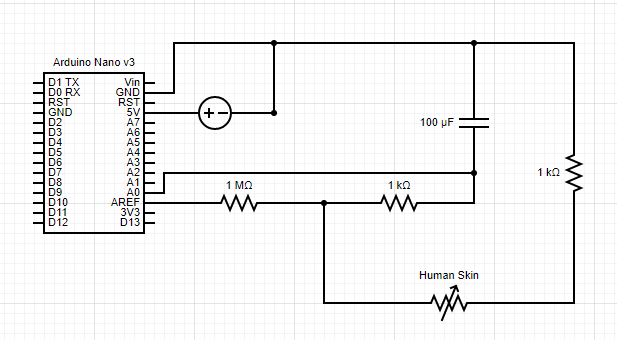
That's actually what I want to avoid. right now my circuit acts like a capacitive sensor, but very unstable... the serial port on A0 reads something like: 1024,853,425,1015,632,933, etc... really messy, no sense... and that happens when I touch one wire, or both in the same time, doesn't make any difference. I am thinking maybe the capacitor needs to be a different value, or maybe there is a problem with the grounding of the whole circuit?...
OP's circuit:
That 100µF cap should make sure the input barely changes. Are you sure it's all connected properly? Soldered connections? Solderless breadboards are known for poor connections especially for thin wires.
Why is it connected to AREF? That's an input. You have A0 effectively floating, after touching for a while and the 100µF cap is fully discharged it should be kept rather firmly at or close to 0.
Like they say, body resistance can vary all over the place. But, I just held my multimeter probes between my thumb & finger on both hands and I got between 3 & 5 Megohms. I do believe the "contact" is the main factor so making my fingers wet or touching a large metal plate with my whole hand should lower the resistance.
So here's what I'd do if you want to put the human between the analog input and ground -
Put a 10M pull-up resistor between the analog input and +5V. (20M if you can find one.) Your ADC should read maxed-out at about 1023.
Put a capacitor (maybe 0.1uF) in parallel with the resistor to filter-out noise and stabilize the readings reading. The capacitor will also add some additional [u]ESD[/u] protection (in addition to the protection diodes built-into the chip).
Touch between the analog input and ground. Assuming 4M body resistance you'll have a voltage divider of 4/14 for an ADC reading of about 292.
If that doesn't work, try shorting the analog input to ground with a wire to make sure it reads zero.