I'm trying to get my Arduino UNO to control a 12V LED strip off of a 5V battery. To do so, I have a boost converter to go from 5V to 12V, and then feed the 12V from the boost converter output to the LED strip. However, when I power it all on, I'm seeing some unusual behavior with the LEDs occasionally flickering and not displaying the patterns I've programmed. I checked the voltage across the inputs to the boost converter (which is nominally 5V) and I'm seeing it drop to ~3V. At the output of the boost converter (nominally 12V), it's reading at ~8.3V.
The LED strip I'm powering is a WS2815 (12V) with 73 LEDs, and I'm using a power supply that has a 5V/5A output. The circuit also has a couple switches and resistors/capacitors (as instructed by some other guides I've read).
These are the parts I'm using, as well as my attempt at a schematic
Power supply:
Does anyone know why I might be seeing such a large voltage drop for only 73 LEDs. Any thoughts/suggestions would be much appreciated! I read that the size of the wires could contribute to voltage drop and will be upgrading them to 22AWG soon to see if that helps, but I assume it's more than just the wires.
I've never seen a 5V battery... But whatever it is, it obviously can't supply the necessary current.
Usually with 12V strips the LEDs are grouped with 3 LEDs in series and with 3 colors we can estimate a maximum of 20mA per LED so with 75 LEDs that's 1.5 Amps "worst case" with all LEDs at full-brightness white (on the 12V side of the DC-DC converter).
And the power is 1.5 Amps X 12V = 18 Watts.
If the DC-DC converter was 100% efficient (which it isn't) the 5V supply would have to put-out 18 Watts, or 3.6 Amps. It may have to supply more to allow for inefficiency, but if you never go all-white, full brightness you might get-by with less.
My apologies, I used the word "battery" when I meant to say power supply.
According to the LED strip's specs, each LED draws 0.3W. So the total power for 73 LEDs is 0.3W * 73 = 21.9 W. At 12V, that should be 1.825 Amps of draw on the power supply. Since my power supply is rated for 5A of output current, I thought it would be fine for supplying the necessary current to the LED strip.
If the DC-DC converter was 100% efficient (which it isn't) the 5V supply would have to put-out 18 Watts, or 3.6 Amps
I didn't account for the DC-DC converter drawing this amount of current. If my above calculations are correct, that would mean the 5V supply would need to provide 21.9 Watts, or 4.38 Amps of current. This sort of defeats the purpose of me stepping up from 5V to 12V since the reason I did that was to reduce the current requirements on the power supply.
For context, I am ultimately trying to power an LED strip (either 5V or 12V) with the Arduino and an external 5v battery (the kind to charge phones). It has a maximum of 3A output current, so I'm trying to stay under that given the fixed number of LEDs (73). I originally used a 5V LED strip but noticed significant voltage drop and was hoping the increased voltage of the 12V strip would reduce the current requirements. But now it seems like the current draw is back up to over 3A due to the boost converter. Am I understanding this properly?
Boost converters are typically 80-90% efficient. Assume 80% to be conservative.
So if the LEDs draw 21.9W, the boost converter has to draw 21.9/0.8 = 27.4 W from the 5V supply, or 5.5A.
The 5V/5A power supply can't provide that much current, and even if it could, it is unlikely that the boost converter could handle that much input current.
Pololu is very careful to specify the input current limits on the high quality boost converters that they manufacture.
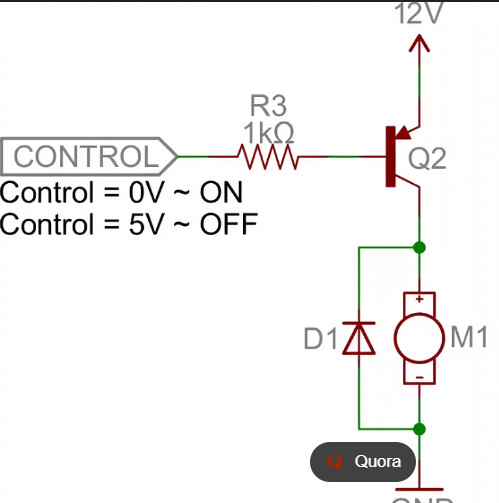
That won't work either, for a 12V supply. The base voltage of an NPN transistor has to be 0.7V higher than the emitter voltage for the transistor to conduct.
Sorry, I'm still trying to digest all that and do some research on how to use a transistor to step-up voltage, but does your proposed configuration require a 12V power supply? The two design constraints I have are 1) the number of LEDs (73), and 2) the power supply is a 5V / 3A external power bank. Does the "+12V" in your diagram refer to an external power source or is that's what generated at the collector of the transistor?
Not with those parts. A "a 5V/3A power supply" provides 15 Watts maximum, not the 21.9 W required by the LEDs, nor the 27.4 W required by the boost converter.
Buy equipment designed for the task, and you will be fine. An option is to use a 12V battery.
Right, I’m referring to an external 12vDC supply such as a wall transformer. A transistor does not step up voltage, think of it as an electronic switch controlled by the arduino turning on and off the 12v supply to the LED strips.