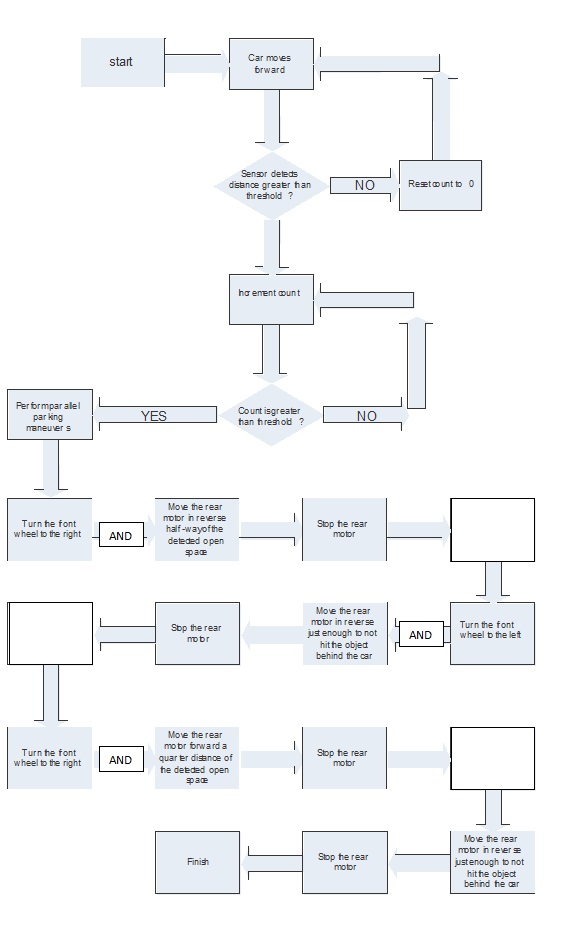
Hi guys, help needed to create carry on the code for my parallel parking RC car project.
I have done the code for forward/reverse and left/right turn in the presence of an obstacle. Appreciate if anyone can help me to complete or provide guidance for the parallel parking part. I believe case coding is required but I'm not good in programming. Please help.
This is the code for moving away from obstacle.
const int pingPin = 7;
const int pingPin2 = 5;

void setup() {
    // set the switch as an input:
//    pinMode(switchPin, INPUT);
Serial.begin(9600);
//Dist.begin(A0);

    // set all the other pins you're using as outputs:


    // set enablePin high so that motor can turn on:

}

void loop() {
   long duration, cm;
   long duration2, cm2;

     // The PING))) is triggered by a HIGH pulse of 2 or more microseconds.
  // Give a short LOW pulse beforehand to ensure a clean HIGH pulse:
  pinMode(pingPin, OUTPUT);
  digitalWrite(pingPin, LOW);
  delayMicroseconds(2);
  digitalWrite(pingPin, HIGH);
  delayMicroseconds(5);
  digitalWrite(pingPin, LOW);

   pinMode(pingPin2, OUTPUT);
  digitalWrite(pingPin2, LOW);
  delayMicroseconds(2);
  digitalWrite(pingPin2, HIGH);
  delayMicroseconds(5);
  digitalWrite(pingPin2, LOW);

  // The same pin is used to read the signal from the PING))): a HIGH
  // pulse whose duration is the time (in microseconds) from the sending
  // of the ping to the reception of its echo off of an object.
  pinMode(pingPin, INPUT);
  duration = pulseIn(pingPin, HIGH);
  pinMode(pingPin2, INPUT);
  duration2 = pulseIn(pingPin2, HIGH);

  // convert the time into a distance
    cm = microsecondsToCentimeters(duration);
    cm2 = microsecondsToCentimeters(duration2);

  Serial.print(cm);
  Serial.print("cm");

  Serial.print("\t");    // prints a tab

  Serial.print(cm2);
  Serial.print("cm");
  Serial.println();
  delay(100);


}
long microsecondsToCentimeters(long microseconds)
{
  // The speed of sound is 340 m/s or 29 microseconds per centimeter.
  // The ping travels out and back, so to find the distance of the
  // object we take half of the distance travelled.
  return microseconds / 29 / 2;
}
This is the code for multiple sensors (front, side and rear) which I have not integrate into the main code above:
// this constant won't change.  It's the pin number
// of the sensor's output:
const int pingPin1 = 2;
const int pingPin2 = 7;
const int pingPin3 = 8;
//const int pingPin4 = 10;

void setup() {
  // initialize serial communication:
  Serial.begin(9600);
}

void loop()
{
  // establish variables for duration of the ping,
  // and the distance result in inches and centimeters:
  long duration1, cm;
  pinMode(pingPin1, OUTPUT);
  digitalWrite(pingPin1, LOW);
  delayMicroseconds(2);
  digitalWrite(pingPin1, HIGH);
  delayMicroseconds(5);
  digitalWrite(pingPin1, LOW);
  pinMode(pingPin1, INPUT);
  duration1 = pulseIn(pingPin1, HIGH);
    cm = microsecondsToCentimeters(duration1);
  Serial.print("A ");
  Serial.print(cm);
    Serial.print("\t");    // prints a tab

  long duration2, cm2;
  pinMode(pingPin2, OUTPUT);
  digitalWrite(pingPin2, LOW);
  delayMicroseconds(2);
  digitalWrite(pingPin2, HIGH);
  delayMicroseconds(5);
  digitalWrite(pingPin2, LOW);
  pinMode(pingPin2, INPUT);
  duration2 = pulseIn(pingPin2, HIGH);
    cm2 = microsecondsToCentimeters(duration2);
  Serial.print("B ");
  Serial.print(cm2);
    Serial.print("\t");    // prints a tab

  long duration3, cm3;
  pinMode(pingPin3, OUTPUT);
  digitalWrite(pingPin3, LOW);
  delayMicroseconds(2);
  digitalWrite(pingPin3, HIGH);
  delayMicroseconds(5);
  digitalWrite(pingPin3, LOW);
  pinMode(pingPin3, INPUT);
  duration3 = pulseIn(pingPin3, HIGH);
    cm = microsecondsToCentimeters(duration3);
  Serial.print("C ");
  Serial.println(cm3);

 /* long duration4;
  pinMode(pingPin4, OUTPUT);
  digitalWrite(pingPin4, LOW);
  delayMicroseconds(2);
  digitalWrite(pingPin4, HIGH);
  delayMicroseconds(5);
  digitalWrite(pingPin4, LOW);
  pinMode(pingPin4, INPUT);
  duration4 = pulseIn(pingPin4, HIGH);
  Serial.print("D ");
  Serial.println(duration4);
*/

 delay(10);
}
long microsecondsToCentimeters(long microseconds)
{
  // The speed of sound is 340 m/s or 29 microseconds per centimeter.
  // The ping travels out and back, so to find the distance of the
  // object we take half of the distance travelled.
  return microseconds / 29 / 2;
}