Hi,
I am trying to connect the ACC 103 to an Arduino since I do not have the proper display for this sensor and at the same time I want to store and log the data. Hence, the use of Arduino.
Is there an available library for this accelerometer or something similar? The output is 2-wire, I connected the black wire to the GND of the Arduino and the red wire to a digital pin. I tried using the digitalRead but I am only getting 0 reading.
int sensor = 7;
int output;

void setup() {
pinMode(sensor, INPUT);
Serial.begin(9600);

}

void loop() {
output = digitalRead(sensor);
delay(500);
Serial.println(output);

}
The reason that you are not getting a reading other than 0, when connected to a digital input is that the accelerometer is an analogue accelerometer.
You need to connect the output of that accelerometer power supply to an analog input.
The output of the ACC103 accelerometer is 10mV/g nominal.
This is fairly small so you will probably have to use the X10 or X100 gain settings.
I am not sure whether the output of the amplifier is zero volts when no acceleration is sensed and goes positive and negative as acceleration is sensed, or whether there is some fixed offset.
Unfortunately, I haven't been able to find a manual for that accelerometer power supply. It looks like model ACC-2, is that correct?
Hi,
I tried it first using the analog pin which I got some reading but I am not sure if it is correct since the value just keeps on adding up even if I don't move the sensor. Since you pointed it out that it is an analog accelerometer, maybe I just need to do something with the code to correct it.
I also do not have the manual for the power supply, I only have the calibration certificate.
Thank you for your response!
Additional information, this is the specification of the Power Supply. I am using the ACC-PS2.

I suggest moving the connection to an analogue pin, and changing your code to:
int sensor = A0;
int output;

void setup() {
pinMode(sensor, INPUT);
Serial.begin(115200);
}

void loop() {
output = analogRead(sensor);
Serial.println(output);
delay(10);
}
Use the Serial Plotter and starting with the gain switch set to X1, shake the accelerometer along it's axis as fast as you can.
You might see a waveform, but it could be very small.
Try that first and tell me what the reading is when stationary, before trying the higher gains. (We don't want the output going too far negative, but a few millivolts is ok).
Hi John,
I am getting a reading now. I guess I was moving the accelerometer at the wrong axis. I was moving it up and down which is why I am not getting a reading. But when I moved it forward and backwards I am getting a spike on the reading.
Here's the reading when it is stationary:
Here's the reading when I moved the sensor back and forth:
That trace when moving the sensor back and forth looks promising.
The first trace though shows that the output has gone up to 5V ( or even higher).
I think that the output of the power supply is coupled through a capacitor, possibly 10µF.
I'm basing that guess on the schematic of the ACC-PS1 which is shown below:
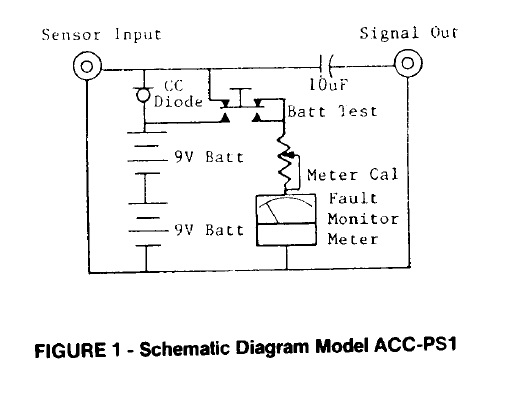
That was the only schematic i could see.
If that is the case then that 10µF capacitor is taking a long time to charge up via the high input resistance of the Arduino input.
Do you have a supply of resistors?
I would suggest using two equal value to the resistors, (suggested value 10kΩ to 100kΩ), to bias the Arduino input.
Connect one from GND to the analogue input and the other from the analogue input to 5V.
This should hold the analogue input at around half the supply voltage, and give you an analog reading of around 512 when the accelerometer is stationary.
Hi,
what do you mean about connecting a resistor from analogue to 5V? Currently, I am not connected to the 5V of the Arduino. Since the output from the power supply only has two wires (Red and Black). I connected the black to the GND of Arduino, and the red to the A0 of the Arduino.
I connected a 10k ohm resistor from GND to A0 as you mentioned. But I am kind of lost with the other one you mentioned. Can you clarify on this.
Thank you very much.


