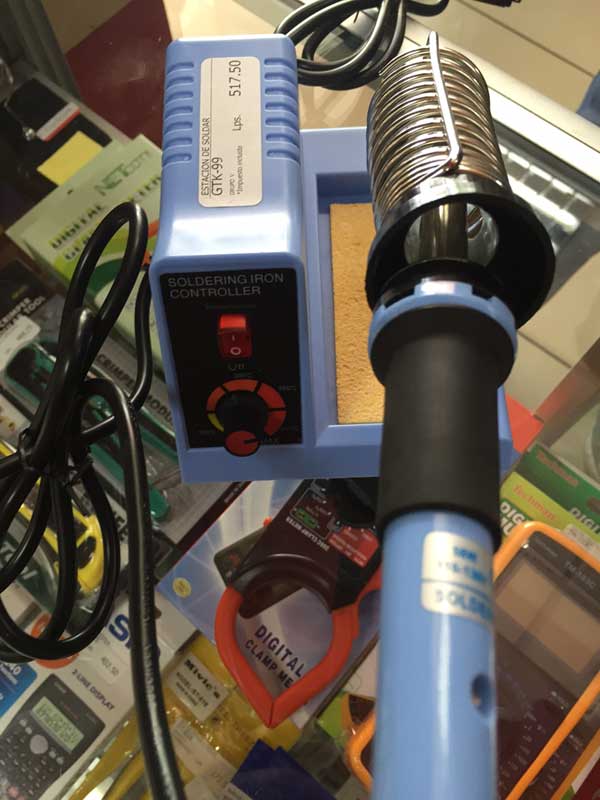
I had a small truper 60W soldering iron which I liked because it had a fine tip but today it stopped working. I plug it in and it simply wont heat up at all. Its all glued up rubber so opening it up doesnt seem like an option.
These are some locally available ones and I was wondering if anyone had ever heard of any of these:
There is a 25W, but Ive read 25W is too low to get a good solder melted?
I would suggest a 50 to 60 W temp controlled iron.
There are some good ones available from china these days , just make sure though that spare tips will be available in future.
Not a problem with weller but i have had some fairly expensive irons in the past now useless from lack of replacement bits.
If you get a cheap one make sure you order the bits at the same time.
Got it! These are all chinese, its hard to get known brands down here. But one of those chinese ones is probably made at the weller factory in China
Anyway, Ill get the last one because its temperature controlled (plus tips) and has that nice holder (burnt my fingers a few times already) and Ill get a FT for my lenk which has held out for a while on me. I just stopped using it because I didnt have the FT for it.
There are many decent soldering irons, and as a professional I generally didn't pay for them - good ones are expensive.
In my view a temperature controlled iron is essential, either adjustable or fixed, and with interchangeable bits. The old weller tcp series were fixed temperature and very reliable, but have been superseded by their own and by many other makers. Quite like metcal devices myself.. A seperate iron asnd power supply with stand is very useful - this could well incorporate temperature control.
What budget do you have mind?
regards
Allan
ps can't you get get a new heating element for your old iron given you liked it?
allanhurst:
In my view a temperature controlled iron is essential.
Completely agree with this. A decent temperature controlled unit can last virtually forever, and anybody that begins using a temperature controlled unit wouldn't ever go to a non-temp controlled one (unless threatened to, or no other option under some circumstances etc).
No I didnt like the truper that burnt out. It didnt have a guard like my lenk 40. It did come with tips, but I can get tips for the lenk as well. So no, I wouldnt want to replace its heating element.
That last one is a piece of junk. Our makerspace had 6 of them, they all fell apart. Get something with an actual variable temperature control. That one is merely a lamp dimmer in a holder.
I think all of those irons are crap. First three aren't temp controlled, last one doesn't look like it has real temp control, just "hot, hotter, hottest" (in other words, it probably doesn't have feedback).
I would buy an old, used weller on eBay (or get one via other means) - get one of the ones with the icky greenish-blue case (the ones after they switched to other colors of case suck - I think they were bought out around then). The magnetic temperature control ones, you'll be passing on to your kids (though the ones with a dial instead of the magnet tips are more convenient). I have three weller irons that I use - and I'm pretty sure every one of them is significantly older than I am, and all work flawlessly.
Tips for Weller irons are still available and produced. We got some just a couple of months ago after getting a pair of super sexy 80W digitally temp controlled units - looks like the last generation of Weller irons before they stopped making good equipment.
25W irons aren't really enough, at least for any sort of serious work. You want 50W - and you MUST have some means of temp control for anything that touches a PCB. You're on here a lot - I'm sure you've seen the weekly "why can't I solder for shit" posts, where people post photos of boards that look like he reworked them with a firebreathing dragon, because they used a shitty non-temp-controlled iron that got too hot, overheated the flux (so it all smokes off before it does it's job), and lifted the traces. I think EVERY "why can't I solder" thread I've seen with pictures had damage that could only be inflicted by an overheated iron shown in the pictures, with one exception (the guy who put solder on the iron, waited for it to stop smoking, and then wondered why it wouldn't wet anything. I think his iron was too hot too, though). You want temp control, set to ~700F for most work.
The soldering iron is the most important tool (after your wire cutter/stripper) when working with electronics, and it is worth it to get a good one.
Hi DrAzzy. Largely agree - the old wellers were excellent workhorses, and you can still get spares
But I've done a load of stuff with 0402 surface mount components, and, particularly if you must use this horrible modern unleaded solder, something fancier is required.. you need two, and they'll set you back at least 500 pounds. And those temperatures, (400C+) the bits don't last long either. Some irons have an idle mode, sitting at say 200C, and when you press the go button heat in 2 or 3 seconds to the required high temperature.
Unleaded solder should be avoided at almost any cost when soldering with an iron. Even if you had to pay $50 a roll for black market solder, it's still worth it based on how much time you'll waste using the unleaded garbage.
I have the Weller WESD51 - temperature controlled (set it where you want it), lots of replacement tips available. It has worked well for me - nice little sponge holder too I have also found one of THESE tip cleaners to be quite handy.
In England we all have to obey the RoHS directive from the EU... ( perhaps not forever)..
this whole RoHS business ( restriction of hazardous substances ) is madness in repect of leaded solder.
Many lead compounds are seriously poisonous, but not metallic lead, When it hits your tum it faces 0.1 Molar hydrochloric
acid , which immediately coats it with lead chloride - a very insoluble salt. It can't go any further.
In any case , who's going to chew circuit boards?.........
There are a few exemptions - Military, medicaL, and 'infrastructure critical' eg mobile phone base stations and microwave datalinks. Why? 'cos everybody knows leaded solder is better. It's less brittle than the replacements and requires lower working temperatures which gives every other component an easier time in manufacture.
Just for fun, consider your motor car . It has loads of electronic gadgets - from the engine control unit to the widget
which adjusts your seat and of course the alternator voltage control box. All of these have soldered components which you can bet are rigorously checked to be lead free just in case you might be tempted to eat them.
So you're safe.
Or are you?
In the engine compartment there's a lead-acid battery containing 20 pounds of lead metal and oxides - and the oxides ares definitely nasty if you ingest them. Fancy chewing that?
As someone who has soldered since my age was in the single digits - get a decent temperature controlled iron. Something that you can easily get replacement tips for.
Forget those conical tips, especially you don't want those really fine, sharply pointed tips. You want a screwdriver aka chisel tip. The flats transfer heat a lot better.
Iron plated copper tips transfer heat well but don't get eaten up by the solder.
I used a Weller with the magnetic tips (uses the curie temperature) for many years with 700 and 800 degree tips, primarily. But if you are going to use non-lead solder, a digital temperature control is a requirement. Many of the non-lead solders seem to be extremely sensitive to soldering temperature.
So I now have two Aoyue digital irons. One is just a soldering station, the other is part of a solder rework station with hot air and desoldering iron (hollow tip and a vacuum pump).
polymorph:
Many of the non-lead solders seem to be extremely sensitive to soldering temperature.
I found this also.
I still use a weller 7 or 8 tip for this but found a lead free solder which works with it well, and bought a couple of Kg for when i need it.
Works with the long conical tip fairly well.
For rework i find it best to wick up the old solder first as the original solder often has low silver content and is poor to work with.